
大肠杆菌血流感染的发病率和抗菌药物耐药性增加:一项多国家基于人群的队列研究。
Increasing incidence and antimicrobial resistance in Escherichia coli bloodstream infections: a multinational population-based cohort study.
机构信息
Department of Population Medicine, University of Guelph, 50 Stone Rd E, Guelph, ON, N1G 2W1, Canada.
Department of Health Security, National Institute for Health and Welfare, Helsinki, Finland.
出版信息
Antimicrob Resist Infect Control. 2021 Sep 6;10(1):131. doi: 10.1186/s13756-021-00999-4.
BACKGROUND
Escherichia coli is an important pathogen in humans and is the most common cause of bacterial bloodstream infections (BSIs). The objectives of our study were to determine factors associated with E. coli BSI incidence rate and third-generation cephalosporin resistance in a multinational population-based cohort.
METHODS
We included all incident E. coli BSIs (2014-2018) from national (Finland) and regional (Australia [Canberra], Sweden [Skaraborg], and Canada [Calgary, Sherbrooke, and western interior]) surveillance. Incidence rates were directly age and sex standardized to the European Union 28-country 2018 population. Multivariable negative binomial and logistic regression models estimated factors significantly associated with E. coli BSI incidence rate and third-generation cephalosporin resistance, respectively. The explanatory variables considered for inclusion in both models were year (2014-2018), region (six areas), age (< 70-years-old and ≥ 70-years-old), and sex (female and male).
RESULTS
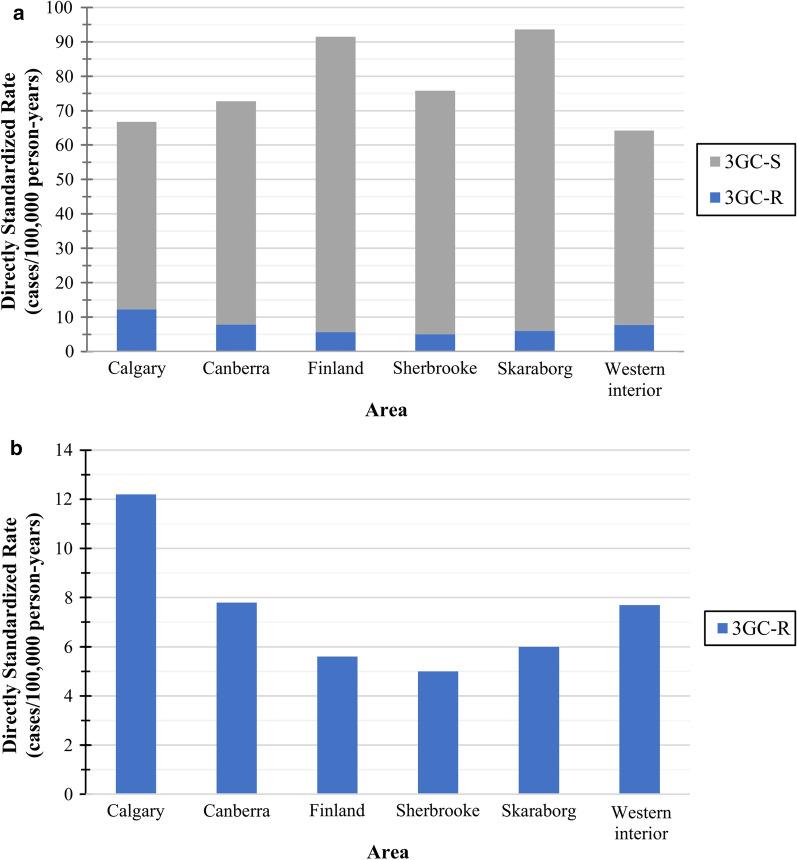
We identified 31,889 E. coli BSIs from 40.7 million person-years of surveillance. Overall and third-generation cephalosporin-resistant standardized rates were 87.1 and 6.6 cases/100,000 person-years, respectively, and increased 14.0% and 40.1% over the five-year study. Overall, 7.8% (2483/31889) of E. coli BSIs were third-generation cephalosporin-resistant. Calgary, Canberra, Sherbrooke, and western interior had significantly lower E. coli BSI rates compared to Finland. The significant association between age and E. coli BSI rate varied with sex. Calgary, Canberra, and western interior had significantly greater odds of third-generation cephalosporin-resistant E. coli BSIs compared to Finland. Compared to 2014, the odds of third-generation cephalosporin-resistant E. coli BSIs were significantly increased in 2016, 2017, and 2018. The significant association between age and the odds of having a third-generation cephalosporin-resistant E. coli BSI varied with sex.
CONCLUSIONS
Increases in overall and third-generation cephalosporin-resistant standardized E. coli BSI rates were clinically important. Overall, E. coli BSI incidence rates were 40-104% greater than previous investigations from the same study areas. Region, sex, and age are important variables when analyzing E. coli BSI rates and third-generation cephalosporin resistance in E. coli BSIs. Considering E. coli is the most common cause of BSIs, this increasing burden and evolving third-generation cephalosporin resistance will have an important impact on human health, especially in aging populations.
背景
大肠杆菌是人类中的一种重要病原体,也是细菌性血流感染(BSI)最常见的原因。我们研究的目的是确定与多民族基于人群队列的大肠杆菌 BSI 发病率和第三代头孢菌素耐药相关的因素。
方法
我们纳入了来自国家(芬兰)和地区(澳大利亚[堪培拉]、瑞典[斯科讷]和加拿大[卡尔加里、舍布鲁克和西部内陆])监测的所有大肠杆菌 BSI(2014-2018 年)。发病率通过直接年龄和性别标准化到欧盟 28 个国家 2018 年的人口进行计算。多变量负二项式和逻辑回归模型分别估计了与大肠杆菌 BSI 发病率和第三代头孢菌素耐药性显著相关的因素。考虑纳入两个模型的解释变量为年份(2014-2018 年)、地区(六个地区)、年龄(<70 岁和≥70 岁)和性别(女性和男性)。
结果
我们从 4070 万个人监测年中确定了 31889 例大肠杆菌 BSI。总发病率和第三代头孢菌素耐药标准化率分别为 87.1 和 6.6 例/10 万人年,在五年研究期间分别增加了 14.0%和 40.1%。总体而言,31889 例大肠杆菌 BSI 中有 7.8%(2483/31889)对第三代头孢菌素耐药。与芬兰相比,卡尔加里、堪培拉、舍布鲁克和西部内陆的大肠杆菌 BSI 发病率明显较低。年龄与大肠杆菌 BSI 发病率之间的显著关联因性别而异。与芬兰相比,卡尔加里、堪培拉和西部内陆的第三代头孢菌素耐药性大肠杆菌 BSI 发生的几率显著增加。与 2014 年相比,2016 年、2017 年和 2018 年第三代头孢菌素耐药性大肠杆菌 BSI 的发生几率显著增加。年龄与第三代头孢菌素耐药性大肠杆菌 BSI 发生几率之间的显著关联因性别而异。
结论
大肠杆菌总发病率和第三代头孢菌素耐药标准化发病率的增加具有重要的临床意义。总体而言,大肠杆菌 BSI 的发病率比来自同一研究地区的先前调查高出 40-104%。地区、性别和年龄是分析大肠杆菌 BSI 发病率和第三代头孢菌素耐药性的重要变量。考虑到大肠杆菌是 BSI 最常见的原因,这种不断增加的负担和第三代头孢菌素耐药性的演变将对人类健康产生重要影响,尤其是在老龄化人口中。


 Zotero 插件