Institute of Pharmaceutical Biology/DCAL, Goethe-University of Frankfurt, Frankfurt/Main, Germany.
Oncogene. 2021 Oct;40(42):6093-6102. doi: 10.1038/s41388-021-02001-2. Epub 2021 Sep 6.
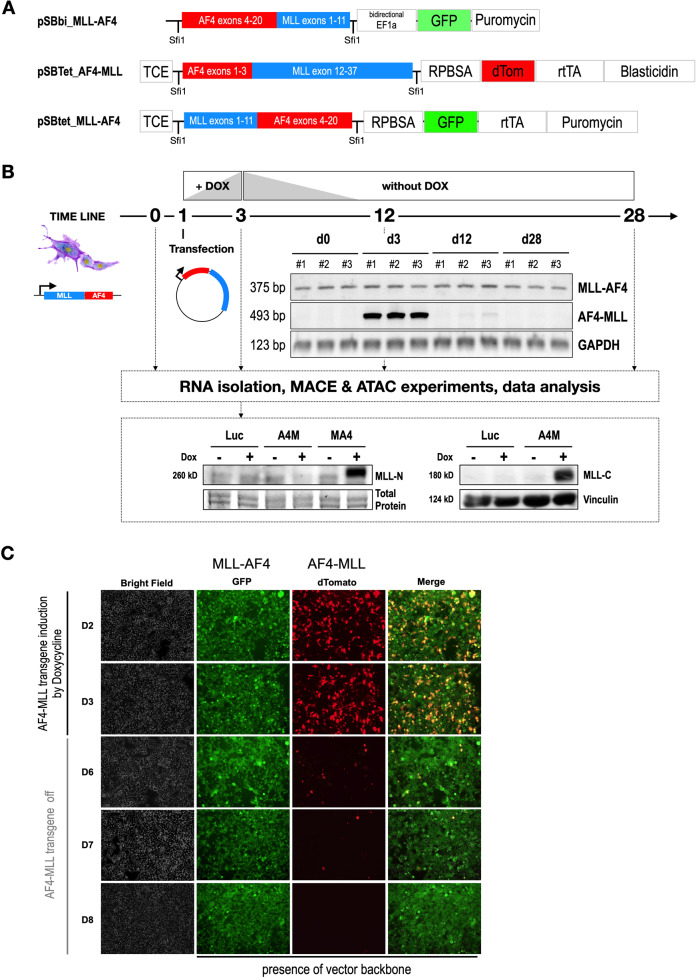
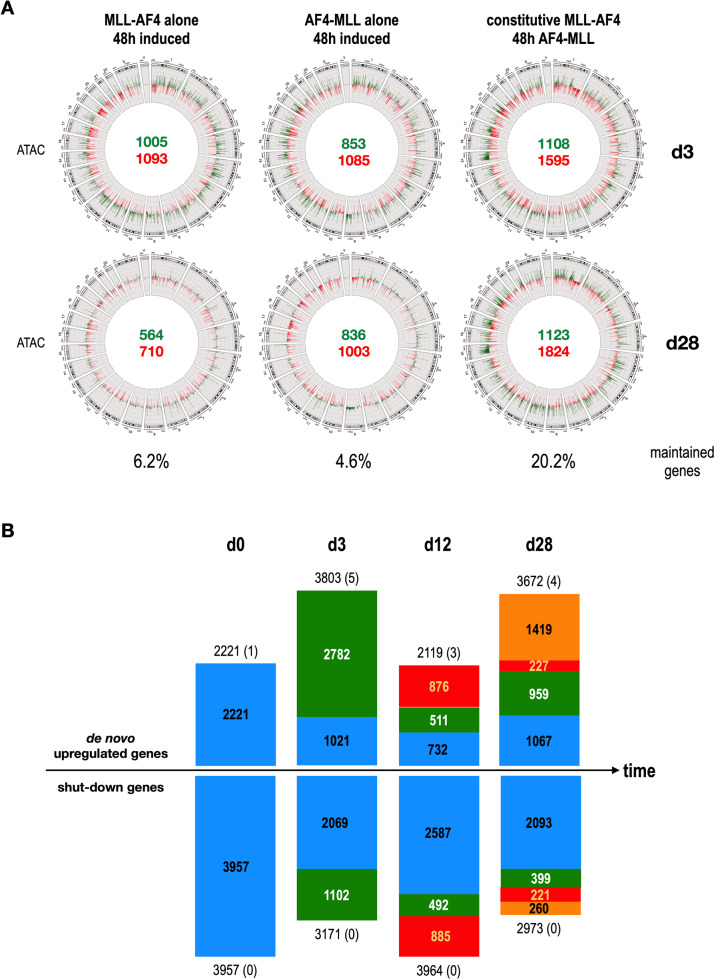
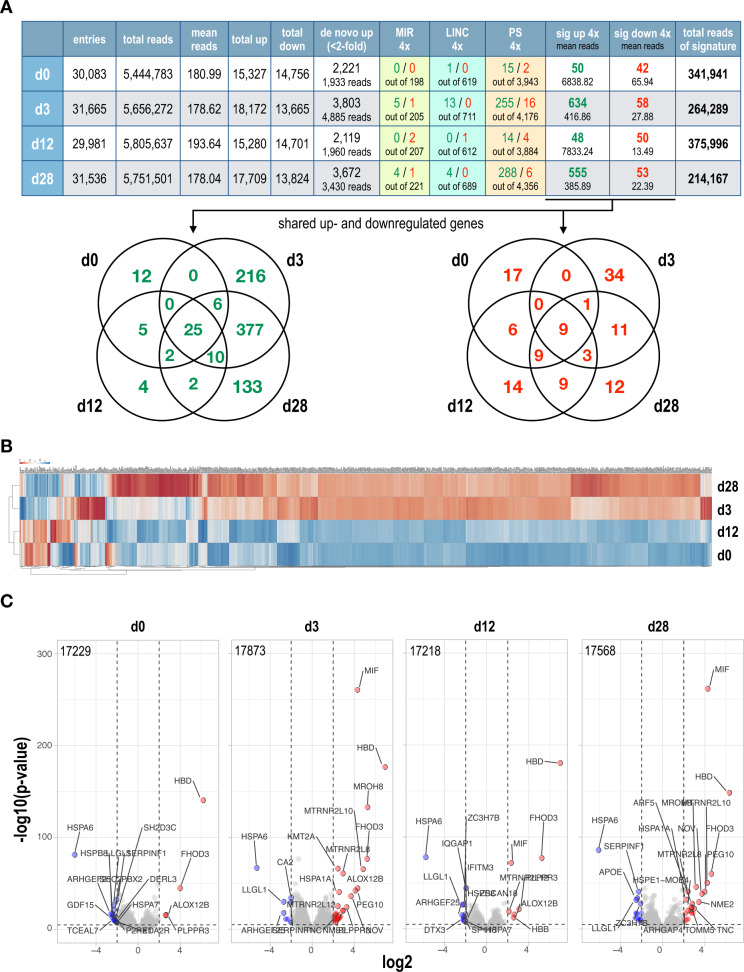
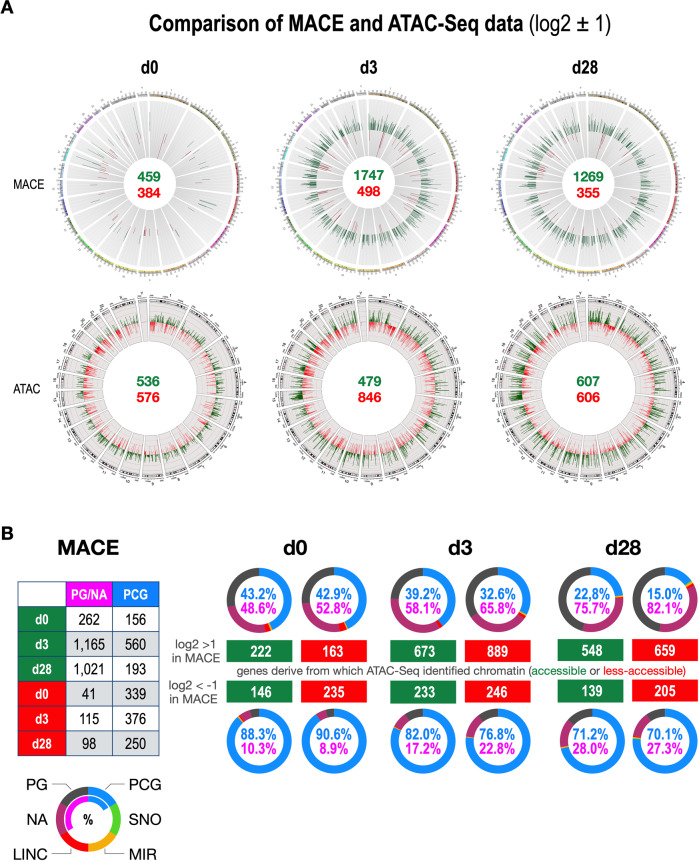
Leukemia patients bearing the t(4;11)(q21;q23) translocations can be divided into two subgroups: those expressing both reciprocal fusion genes, and those that have only the MLL-AF4 fusion gene. Moreover, a recent study has demonstrated that patients expressing both fusion genes have a better outcome than patients that are expressing the MLL-AF4 fusion protein alone. All this may point to a clonal process where the reciprocal fusion gene AF4-MLL could be lost during disease progression, as this loss may select for a more aggressive type of leukemia. Therefore, we were interested in unraveling the decisive role of the AF4-MLL fusion protein at an early timepoint of disease development. We designed an experimental model system where the MLL-AF4 fusion protein was constitutively expressed, while an inducible AF4-MLL fusion gene was induced for only 48 h. Subsequently, we investigated genome-wide changes by RNA- and ATAC-Seq experiments at distinct timepoints. These analyses revealed that the expression of AF4-MLL for only 48 h was sufficient to significantly change the genomic landscape (transcription and chromatin) even on a longer time scale. Thus, we have to conclude that the AF4-MLL fusion protein works through a hit-and-run mechanism, probably necessary to set up pre-leukemic conditions, but being dispensable for later disease progression.
携带 t(4;11)(q21;q23) 易位的白血病患者可分为两个亚组:表达两种相互融合基因的患者和仅表达 MLL-AF4 融合基因的患者。此外,最近的一项研究表明,表达两种融合基因的患者比仅表达 MLL-AF4 融合蛋白的患者预后更好。所有这些都可能指向一个克隆过程,即在疾病进展过程中,相互融合的基因 AF4-MLL 可能会丢失,因为这种丢失可能会选择更具侵袭性的白血病类型。因此,我们有兴趣在疾病发展的早期阶段揭示 AF4-MLL 融合蛋白的决定性作用。我们设计了一个实验模型系统,其中 MLL-AF4 融合蛋白持续表达,而诱导型 AF4-MLL 融合基因仅诱导 48 小时。随后,我们在不同时间点通过 RNA 和 ATAC-Seq 实验研究了全基因组变化。这些分析表明,仅表达 48 小时的 AF4-MLL 就足以显著改变基因组景观(转录和染色质),即使在更长的时间尺度上也是如此。因此,我们不得不得出结论,AF4-MLL 融合蛋白通过一种打了就跑的机制发挥作用,可能是建立白血病前期条件所必需的,但对于后期疾病进展是可有可无的。