Liu Xiangjun, Cheng Ye, Zang Dan, Zhang Min, Li Xiuhua, Liu Dan, Gao Bing, Zhou Huan, Sun Jinzhe, Han Xu, Lin Meixi, Chen Jun
Department of Oncology, The Second Hospital of Dalian Medical University, Dalian, China.
Department of Oncology, The Third Hospital of Dalian Medical University, Dalian, China.
Front Oncol. 2021 Aug 19;11:720842. doi: 10.3389/fonc.2021.720842. eCollection 2021.
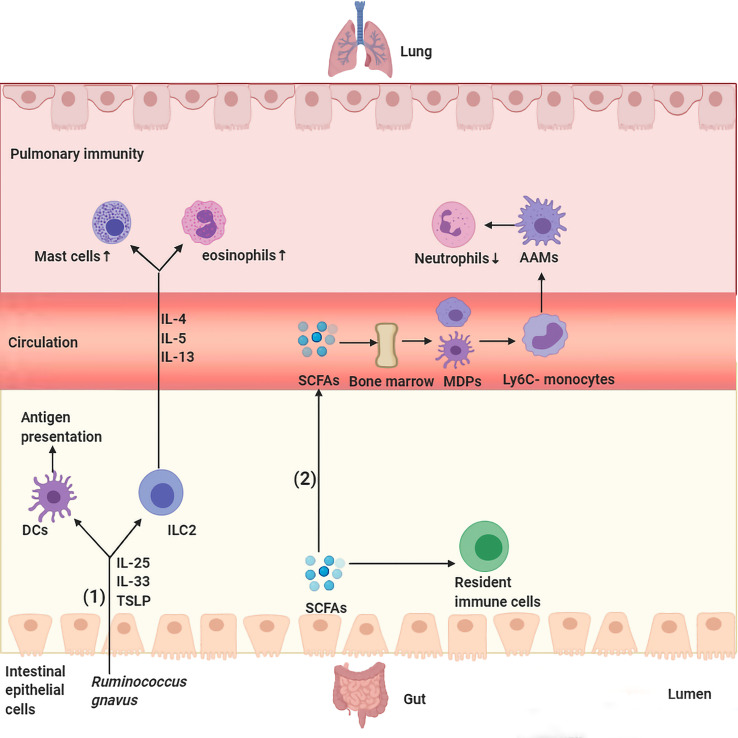
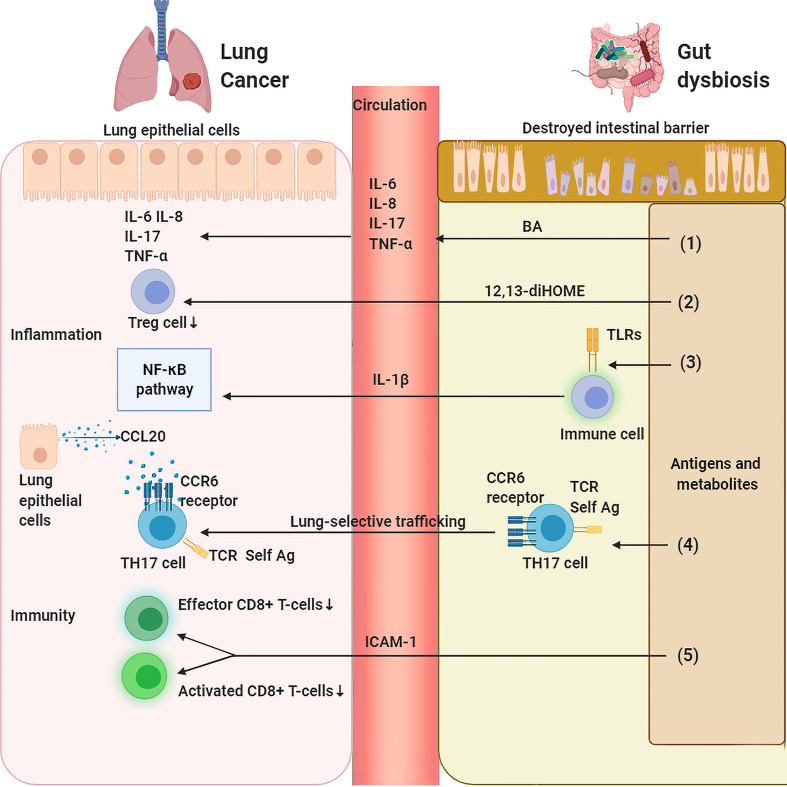
The influence of microbiota on host health and disease has attracted adequate attention, and gut microbiota components and microbiota-derived metabolites affect host immune homeostasis locally and systematically. Some studies have found that gut dysbiosis, disturbance of the structure and function of the gut microbiome, disrupts pulmonary immune homeostasis, thus leading to increased disease susceptibility; the gut-lung axis is the primary cross-talk for this communication. Gut dysbiosis is involved in carcinogenesis and the progression of lung cancer through genotoxicity, systemic inflammation, and defective immunosurveillance. In addition, the gut microbiome harbors the potential to be a novel biomarker for predicting sensitivity and adverse reactions to immunotherapy in patients with lung cancer. Probiotics and fecal microbiota transplantation (FMT) can enhance the efficacy and depress the toxicity of immune checkpoint inhibitors by regulating the gut microbiota. Although current studies have found that gut microbiota closely participates in the development and immunotherapy of lung cancer, the mechanisms require further investigation. Therefore, this review aims to discuss the underlying mechanisms of gut microbiota influencing carcinogenesis and immunotherapy in lung cancer and to provide new strategies for governing gut microbiota to enhance the prevention and treatment of lung cancer.
微生物群对宿主健康和疾病的影响已引起足够关注,肠道微生物群的组成成分和微生物群衍生的代谢产物会在局部和全身影响宿主免疫稳态。一些研究发现,肠道微生物群失调,即肠道微生物组结构和功能的紊乱,会破坏肺部免疫稳态,从而导致疾病易感性增加;肠-肺轴是这种交流的主要交互途径。肠道微生物群失调通过基因毒性、全身炎症和免疫监视缺陷参与肺癌的发生和发展。此外,肠道微生物组有潜力成为预测肺癌患者免疫治疗敏感性和不良反应的新型生物标志物。益生菌和粪便微生物群移植(FMT)可通过调节肠道微生物群提高免疫检查点抑制剂的疗效并降低其毒性。尽管目前的研究发现肠道微生物群密切参与肺癌的发生发展和免疫治疗,但其机制仍需进一步研究。因此,本综述旨在探讨肠道微生物群影响肺癌致癌作用和免疫治疗的潜在机制,并为调控肠道微生物群以加强肺癌的预防和治疗提供新策略。