Faculty of Medicine, Mohammed VI University of Health Sciences (UM6SS), Casablanca, Morocco.
National Reference Laboratory, Mohammed VI University of Health Sciences (UM6SS), Casablanca, Morocco.
Front Cell Infect Microbiol. 2021 Aug 18;11:720701. doi: 10.3389/fcimb.2021.720701. eCollection 2021.
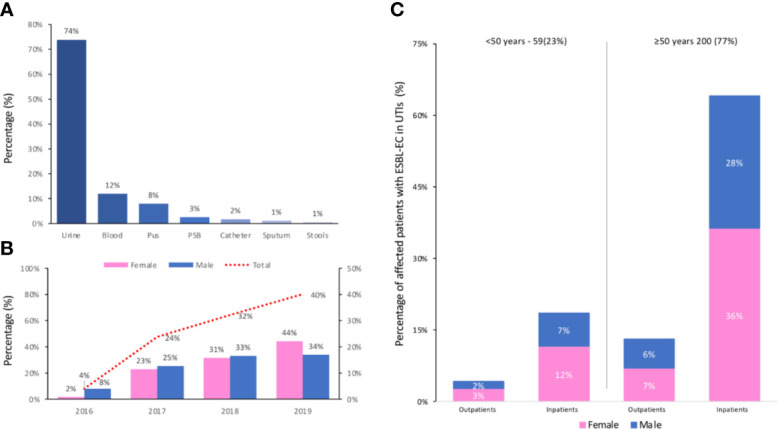
Extended-spectrum β-lactamases producing (ESBL-EC) lend resistance to most β-lactam antibiotics. Because of limited treatment options, ESBL-EC infections are generally more difficult to treat, leading to higher hospital costs, reduced rates of microbiological and clinical responses, and a threat to the patient's life. This study aimed to determine the antibiotic resistance pattern of ESBL-EC isolated from patients with urinary tract infection in Morocco. This retrospective laboratory-based study was conducted at Cheikh Khalifa International University Hospital, Casablanca, from January 2016 to June 2019. A total of 670 urine samples were collected from urinary tract infection patients and processed by standard microbiological methods. susceptibility testing to different antibiotics of all identified isolates of was performed following Kirby-Bauer's disc diffusion method on Mueller-Hinton Agar according to the EUCAST standards. The reviewing of ESBL-EC was confirmed by the appearance of a characteristically shaped zone referred to as a "champagne cork" using the Combined Disk Test. Among a total of 438 isolated from nonrepetitive urine samples, two hundred fifty-nine (59%) were ESBL-EC, of which 200 (77%) were isolated from adult patients (over the age of 50) and the majority were female. All ESBL-EC isolates were resistant to third-generation cephalosporin and quinolones and sensitive to carbapenem and fosfomycin. Knowledge of antimicrobial resistance patterns in ESBL-EC, the major pathogen associated with urinary tract infection, is indispensable as a guide in choosing empirical antimicrobial treatment.
产超广谱β-内酰胺酶的肠杆菌科细菌(ESBL-EC)对大多数β-内酰胺类抗生素具有耐药性。由于治疗选择有限,ESBL-EC 感染通常更难治疗,导致更高的医院费用、微生物学和临床反应率降低,并对患者的生命构成威胁。本研究旨在确定摩洛哥尿路感染患者分离的 ESBL-EC 的抗生素耐药模式。这是一项回顾性的基于实验室的研究,于 2016 年 1 月至 2019 年 6 月在卡萨布兰卡的谢赫·哈利法国际大学医院进行。从尿路感染患者中采集了 670 份尿液样本,并通过标准微生物学方法进行处理。根据欧盟药敏试验标准,采用 Kirby-Bauer 纸片扩散法对所有鉴定的 进行了不同抗生素的药敏试验,在 Mueller-Hinton 琼脂上进行。使用联合药敏纸片试验,当出现特征性的“香槟塞”形状的抑菌圈时,可确认为 ESBL-EC。在从非重复尿液样本中分离出的 438 株 中,有 259 株(59%)为 ESBL-EC,其中 200 株(77%)分离自成年患者(50 岁以上),且大多数为女性。所有 ESBL-EC 分离株均对第三代头孢菌素和喹诺酮类药物耐药,对碳青霉烯类和磷霉素敏感。了解 ESBL-EC(与尿路感染相关的主要病原体)的抗生素耐药模式对于指导经验性抗菌治疗的选择是必不可少的。