Department of Medical Oncology, National Cancer Center/National Clinical Research Center for Cancer/Cancer Hospital, Chinese Academy of Medical Sciences and Peking Union Medical College, Beijing, China.
Department of Pathology, National Cancer Center/National Clinical Research Center for Cancer/Cancer Hospital, Chinese Academy of Medical Sciences and Peking Union Medical College, Beijing, China.
Thorac Cancer. 2021 Oct;12(19):2585-2593. doi: 10.1111/1759-7714.14144. Epub 2021 Sep 6.
Transformation to small cell lung cancer (SCLC) is a resistance mechanism of epidermal growth factor receptor (EGFR) mutant lung adenocarcinoma (LADC) patients treated with EGFR tyrosine kinase inhibitors (TKIs). Here, we describe the clinical characteristics and prognosis of these patients and explore the treatment modes after transformation.
EGFR-mutant LADC patients with SCLC transformation were retrospectively included in the study. Demographic and clinical data were collected. Survival outcomes and corresponding influential factors were analyzed.
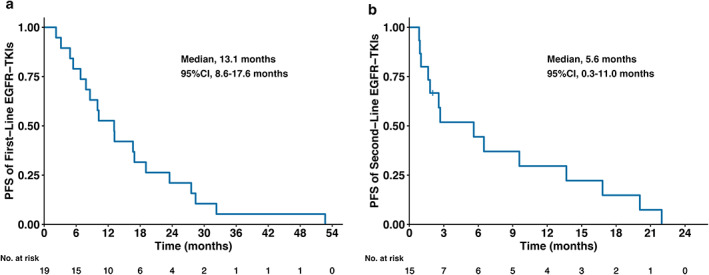
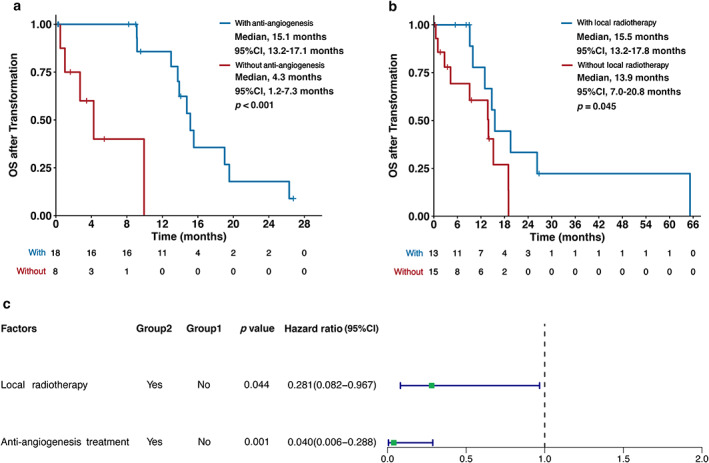
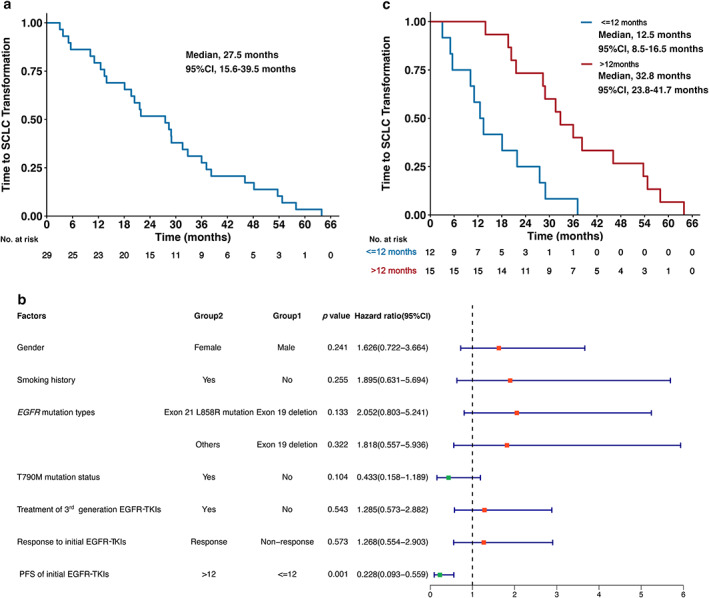
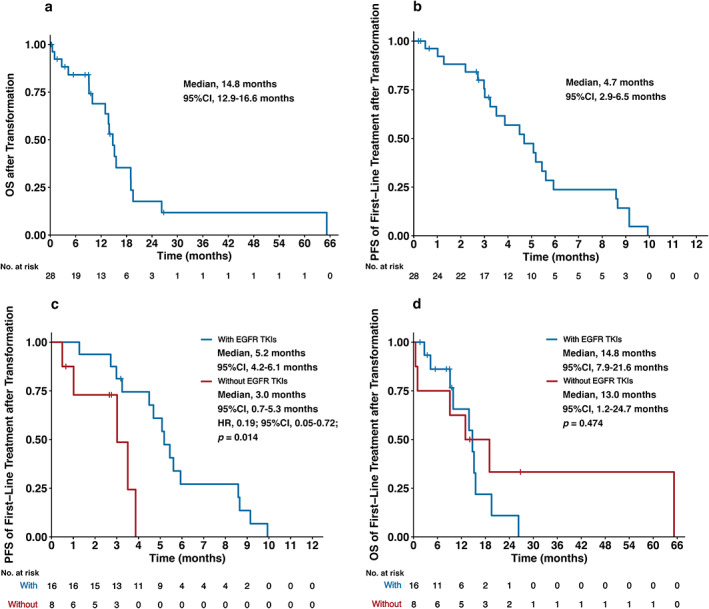
Twenty-nine patients were included in the study. The median progression-free survival (PFS) of patients who received first-line EGFR-TKIs was 13.1 months. The median time to SCLC transformation was 27.5 months. After transformation, the objective response rates of patients who received first-line chemotherapy with or without EGFR-TKIs were 43.8% and 37.5%, respectively. The median PFS of patients reveiving chemotherapy with EGFR-TKIs was significantly longer than that of patients receiving chemotherapy without EGFR-TKIs (5.2 vs. 3.0 months; HR, 0.19; 95% CI: 0.05-0.72; p = 0.014). However, there was no significant difference in median overall survival (OS) between patients who received chemotherapy with or without EGFR-TKIs (14.8 vs. 13.0 months; p = 0.474). In the multivariate Cox proportional hazards regression analysis, both anti-angiogenic treatment (HR, 0.04; 95% CI: 0.01-0.29; p = 0.001) and local radiotherapy (HR, 0.28; 95% CI: 0.08-0.97; p = 0.044) were significantly associated with better patient OS after transformation.
Compared with chemotherapy alone, the combination of chemotherapy and EGFR-TKIs as first-line treatment after SCLC transformation can benefit patients in PFS but not in OS. However, anti-angiogenic therapies and local radiotherapy can significantly prolong OS after transformation.
表皮生长因子受体(EGFR)突变型肺腺癌(LADC)患者接受 EGFR 酪氨酸激酶抑制剂(TKI)治疗后发生小细胞肺癌(SCLC)转化是一种耐药机制。在这里,我们描述了这些患者的临床特征和预后,并探讨了转化后的治疗模式。
回顾性纳入接受 EGFR 突变型 LADC 且发生 SCLC 转化的患者。收集患者的人口统计学和临床数据。分析生存结果及其影响因素。
本研究共纳入 29 例患者。患者接受一线 EGFR-TKI 治疗的中位无进展生存期(PFS)为 13.1 个月。SCLC 转化的中位时间为 27.5 个月。转化后,接受一线化疗联合或不联合 EGFR-TKI 治疗的患者客观缓解率分别为 43.8%和 37.5%。接受化疗联合 EGFR-TKI 治疗的患者中位 PFS 明显长于仅接受化疗的患者(5.2 个月 vs. 3.0 个月;HR,0.19;95%CI:0.05-0.72;p=0.014)。然而,接受化疗联合或不联合 EGFR-TKI 治疗的患者中位总生存期(OS)无显著差异(14.8 个月 vs. 13.0 个月;p=0.474)。多因素 Cox 比例风险回归分析显示,抗血管生成治疗(HR,0.04;95%CI:0.01-0.29;p=0.001)和局部放疗(HR,0.28;95%CI:0.08-0.97;p=0.044)与转化后患者的 OS 显著相关。
与单纯化疗相比,SCLC 转化后一线治疗中化疗联合 EGFR-TKI 可使患者的 PFS 获益,但 OS 无获益。然而,抗血管生成治疗和局部放疗可显著延长转化后的 OS。