Department of Rehabilitation Sciences, Graduate School of Medical Sciences, Kitasato University, Sagamihara, Japan.
Department of Rehabilitation, School of Allied Health Sciences, Kitasato University, Sagamihara, Japan.
ESC Heart Fail. 2021 Dec;8(6):5092-5101. doi: 10.1002/ehf2.13577. Epub 2021 Sep 6.
High-sensitivity cardiac troponin T (hs-cTnT) and B-type natriuretic peptide (BNP) are associated with prognosis and severity in patients with heart failure (HF); however, their association with physical function is unclear. This study aimed to investigate whether hs-cTnT and BNP levels are associated with physical function in patients with HF.
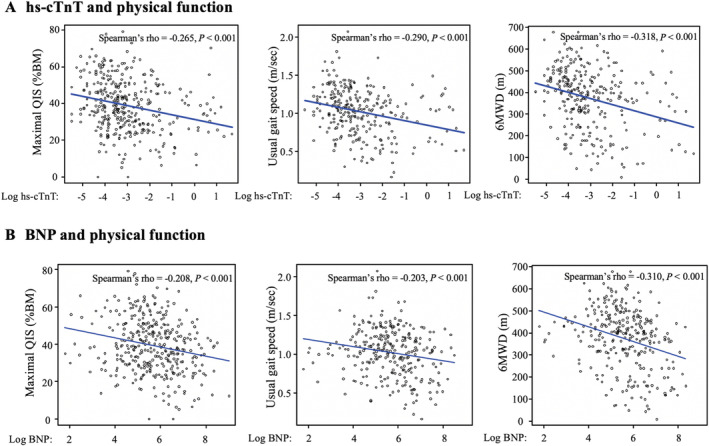
Hs-cTnT, BNP, and physical function (maximal quadriceps isometric strength [QIS], usual gait speed, and 6-min walk distance [6MWD]) were evaluated in 363 consecutive patients with HF (median age, 70 [60-78] years). Patients were divided into four groups according to their median hs-cTnT and BNP levels. After adjusting for demographic characteristics, laboratory levels, and HF severity, higher hs-cTnT and BNP levels were significantly associated with lower physical function (log hs-cTnT, β = -0.162, P = 0.001, for maximal QIS; β = -0.175, P = 0.002, for usual gait speed, and β = -0.129, P = 0.004, for 6MWD; log BNP, β = -0.090, P = 0.092, for maximal QIS, β = 0.038, P = 0.516, for usual gait speed, and β = -0.108, P = 0.023, for 6MWD). In addition, the high hs-cTnT and high BNP group had significantly lower physical function (all P < 0.05) than the low hs-cTnT and low BNP group.
Higher hs-cTnT and BNP levels are both associated with lower physical function in patients with HF, but hs-cTnT levels showed a more consistent association. The combination of hs-cTnT and BNP may be effective for the stratification of physical function in patients with HF.
高敏心肌肌钙蛋白 T(hs-cTnT)和 B 型利钠肽(BNP)与心力衰竭(HF)患者的预后和严重程度相关,但它们与身体功能的关系尚不清楚。本研究旨在探讨 hs-cTnT 和 BNP 水平与 HF 患者身体功能的关系。
连续评估了 363 例 HF 患者(中位年龄 70[60-78]岁)的 hs-cTnT、BNP 和身体功能(最大股四头肌等长强度[QIS]、常规步行速度和 6 分钟步行距离[6MWD])。根据 hs-cTnT 和 BNP 的中位数将患者分为四组。调整人口统计学特征、实验室水平和 HF 严重程度后,较高的 hs-cTnT 和 BNP 水平与较低的身体功能显著相关(log hs-cTnT,β=-0.162,P=0.001,用于最大 QIS;β=-0.175,P=0.002,用于常规步行速度,β=-0.129,P=0.004,用于 6MWD;log BNP,β=-0.090,P=0.092,用于最大 QIS,β=0.038,P=0.516,用于常规步行速度,β=-0.108,P=0.023,用于 6MWD)。此外,高 hs-cTnT 和高 BNP 组的身体功能明显低于低 hs-cTnT 和低 BNP 组(均 P<0.05)。
较高的 hs-cTnT 和 BNP 水平均与 HF 患者的身体功能降低相关,但 hs-cTnT 水平的相关性更为一致。hs-cTnT 和 BNP 的联合检测可能有助于对 HF 患者身体功能进行分层。