Gateway Antarctica, School of Earth and Environment, University of Canterbury, Christchurch, New Zealand.
Department of Zoology & Entomology, University of Pretoria, Hatfield, Pretoria, South Africa.
Glob Chang Biol. 2021 Dec;27(23):6252-6262. doi: 10.1111/gcb.15828. Epub 2021 Sep 7.
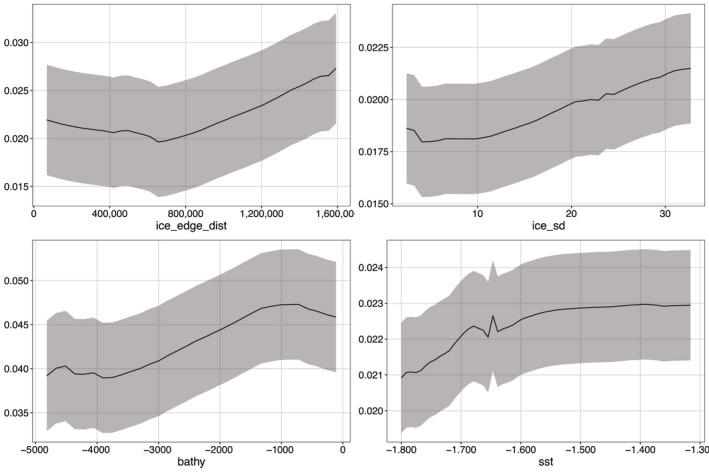
The impacts of climate change in Antarctica and the Southern Ocean are not uniform and ice-obligate species with dissimilar life-history characteristics will likely respond differently to their changing ecosystems. We use a unique data set of Weddell Leptonychotes weddellii and crabeater seals' (CESs) Lobodon carcinophaga breeding season distribution in the Weddell Sea, determined from satellite imagery. We contrast the theoretical climate impacts on both ice-obligate predators who differ in life-history characteristics: CESs are highly specialized Antarctic krill Euphausia superba predators and breed in the seasonal pack ice; Weddell seals (WESs) are generalist predators and breed on comparatively stable fast ice. We used presence-absence data and a suite of remotely sensed environmental variables to build habitat models. Each of the environmental predictors is multiplied by a 'climate change score' based on known responses to climate change to create a 'change importance product'. Results show CESs are more sensitive to climate change than WESs. Crabeater seals prefer to breed close to krill, and the compounding effects of changing sea ice concentrations and sea surface temperatures, the proximity to krill and abundance of stable breeding ice, can influence their post-breeding foraging success and ultimately their future breeding success. But in contrast to the Ross Sea, here WESs prefer to breed closer to larger colonies of emperor penguins (Aptenodytes forsteri). This suggests that the Weddell Sea may currently be prey-abundant, allowing the only two air-breathing Antarctic silverfish predators (Pleuragramma antarctica) (WESs and emperor penguins) to breed closer to each other. This is the first basin-scale, region-specific comparison of breeding season habitat in these two key Antarctic predators based on real-world data to compare climate change responses. This work shows that broad-brush, basin-scale approaches to understanding species-specific responses to climate change are not always appropriate, and regional models are needed-especially when designing marine protected areas.
南极洲和南大洋的气候变化影响并不均匀,具有不同生活史特征的冰栖物种可能对其不断变化的生态系统有不同的反应。我们使用了一组独特的数据,即威德尔海豹(Leptonychotes weddellii)和食蟹海豹(Lobodon carcinophaga)在威德尔海繁殖季节的分布,这些数据是通过卫星图像确定的。我们对比了两种具有不同生活史特征的冰栖捕食者的理论气候影响:食蟹海豹是高度专业化的南极磷虾(Euphausia superba)捕食者,在季节性的冰区繁殖;威德尔海豹(Weddell seals)是一般的捕食者,在相对稳定的快速冰上繁殖。我们使用存在-缺失数据和一套遥感环境变量来构建栖息地模型。每个环境预测因子都乘以一个基于对气候变化已知反应的“气候变化得分”,以创建一个“变化重要性产品”。结果表明,食蟹海豹对气候变化比威德尔海豹更为敏感。食蟹海豹更喜欢在靠近磷虾的地方繁殖,而海冰浓度和海水表面温度的变化、靠近磷虾的位置以及稳定繁殖冰的丰度等复合因素,会影响它们的繁殖后觅食成功,并最终影响它们未来的繁殖成功。但与罗斯海不同的是,威德尔海豹更喜欢在离皇帝企鹅(Aptenodytes forsteri)更大的繁殖地更近的地方繁殖。这表明威德尔海目前可能是猎物丰富的,这使得仅有的两种呼吸空气的南极银鱼捕食者(威德尔海豹和皇帝企鹅)能够更靠近彼此繁殖。这是首次基于实际数据对这两种关键南极捕食者的繁殖季节栖息地进行的盆地规模、区域特定比较,以比较气候变化的反应。这项工作表明,理解物种对气候变化的具体反应的全面、盆地规模的方法并不总是合适的,需要区域模型——特别是在设计海洋保护区时。