Laboratory of Neurogenetics, National Institute on Aging, National Institutes of Health, Bethesda, MD, USA.
Department of Clinical Neuroscience, UCL Institute of Neurology, London, United Kingdom.
J Neurol Sci. 2021 Oct 15;429:117615. doi: 10.1016/j.jns.2021.117615. Epub 2021 Aug 12.
Despite the established importance of identifying depression in Parkinson's disease, our understanding of the factors which place the Parkinson's disease patient at future risk of depression is limited.
Our sample consisted of 874 patients from two longitudinal cohorts, PPMI and PDBP, with median follow-up durations of 7 and 3 years respectively. Risk factors for depressive symptoms at baseline were determined using logistic regression. A Cox regression model was then used to identify baseline factors that predisposed the non-depressed patient to develop depressive symptoms that were sustained for at least one year, while adjusting for antidepressant use and cognitive impairment. Common predictors between the two cohorts were identified with a random-effects meta-analysis.
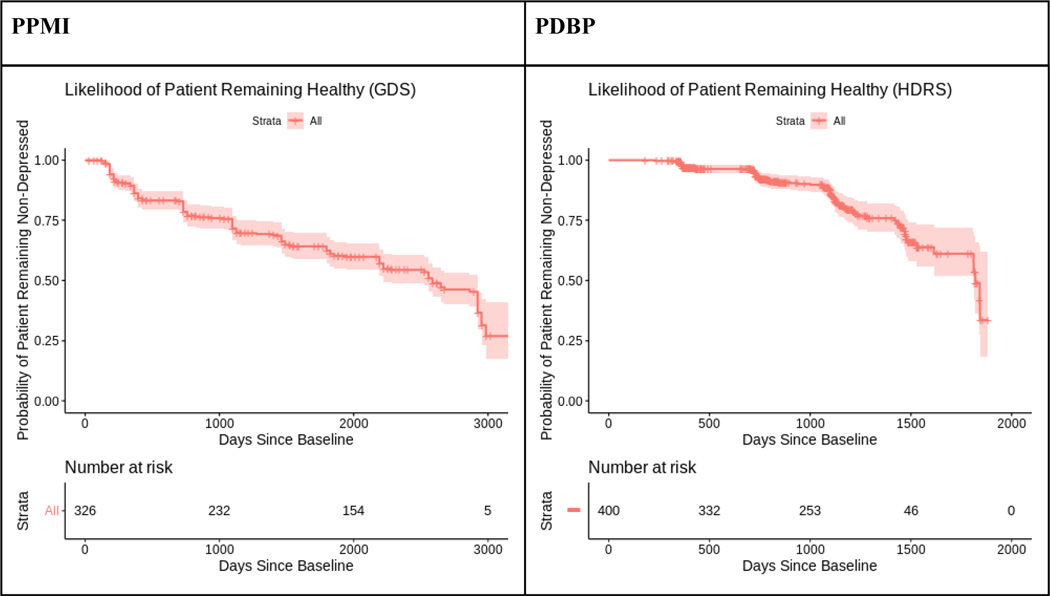
We found in our analyses that the majority of baseline non-depressed patients would develop sustained depressive symptoms at least once during the course of the study. Probable REM sleep behavior disorder (pRBD), age, duration of diagnosis, impairment in daily activities, mild constipation, and antidepressant use were among the baseline risk factors for depression in either cohort. Our Cox regression model indicated that pRBD, impairment in daily activities, hyposmia, and mild constipation could serve as longitudinal predictors of sustained depressive symptoms.
We identified several potential risk factors to aid physicians in the early detection of depression in Parkinson's disease patients. Our findings also underline the importance of adjusting for multiple covariates when analyzing risk factors for depression.
尽管已经确定了在帕金森病中识别抑郁的重要性,但我们对使帕金森病患者处于未来抑郁风险的因素的了解有限。
我们的样本由来自两个纵向队列 PPMI 和 PDBP 的 874 名患者组成,中位随访时间分别为 7 年和 3 年。使用逻辑回归确定基线时抑郁症状的危险因素。然后,使用 Cox 回归模型来识别使非抑郁患者易患持续至少一年的抑郁症状的基线因素,同时调整抗抑郁药的使用和认知障碍。使用随机效应荟萃分析确定两个队列之间的常见预测因素。
我们的分析发现,大多数基线非抑郁患者在研究过程中至少会出现一次持续的抑郁症状。可能的 REM 睡眠行为障碍(pRBD)、年龄、诊断持续时间、日常活动受损、轻度便秘和抗抑郁药的使用是两个队列中抑郁的基线危险因素之一。我们的 Cox 回归模型表明,pRBD、日常活动受损、嗅觉减退和轻度便秘可作为持续抑郁症状的纵向预测因素。
我们确定了几个潜在的危险因素,以帮助医生早期发现帕金森病患者的抑郁。我们的发现还强调了在分析抑郁风险因素时调整多个协变量的重要性。