Center for Muscle and Joint Health, Department of Sports Science and Clinical Biomechanics, University of Southern Denmark, Campusvej 55, 5230, Odense M, Denmark.
Department of Radiology, Hospital Lillebælt, Vejle, Denmark.
Arthritis Res Ther. 2021 Sep 7;23(1):235. doi: 10.1186/s13075-021-02608-6.
Evidence on prognostic factors associated with progression to total hip replacement (THR) in hip osteoarthritis (OA) is for the most patient- and disease-specific characteristics either conflicting or inconclusive. Therefore, the objectives of this study of participants with hip OA enrolled in a structured program of supervised education and exercise therapy were to describe the rate of THR and to identify prognostic factors for receiving THR within the following 2 years.
Participants aged ≥ 45 years with hip OA enrolled in Good Life with osteoArthritis in Denmark (GLA:D®) from July 2014 to March 2017 were included. Potential prognostic factors included demographic and disease-specific baseline characteristics and measures of physical activity and quality of life (QoL). Information on THR was retrieved from The Danish National Patient Registry. A multivariable Cox proportional hazards model was developed.
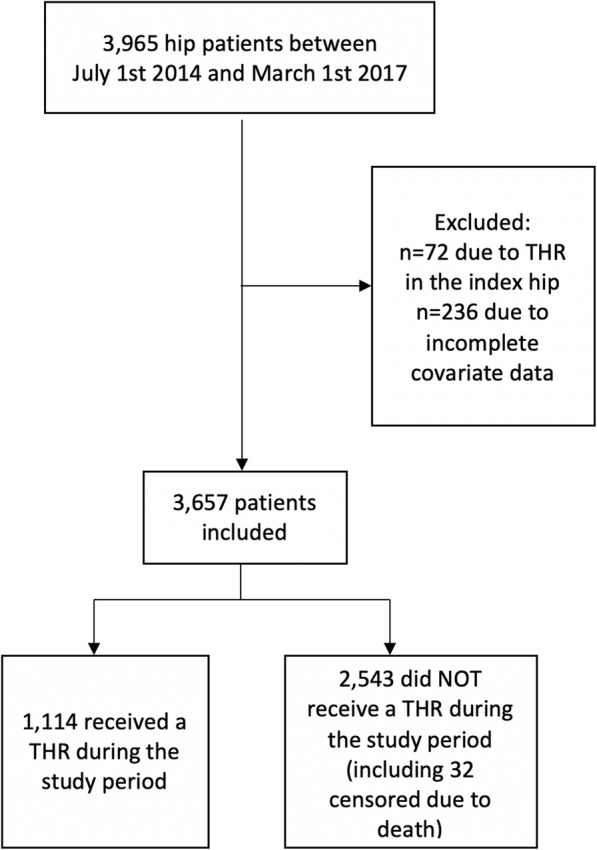
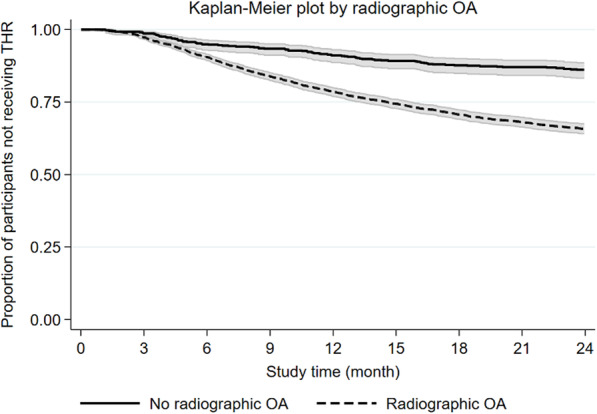
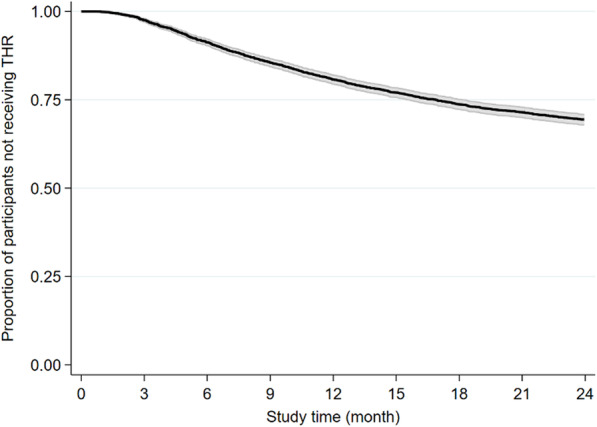
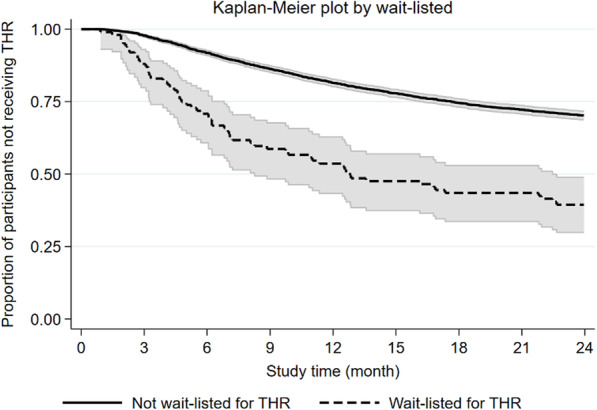
Of 3657 included participants, 30% received a THR within 2 years. Of the 100 participants already wait-listed for THR, 60% had the procedure. Of 22 candidate prognostic factors, 14 were statistically significant for receiving THR. Factors associated with a faster rate of THR included being "male" (HR 1.43), having "self-reported radiographic hip OA" (HR 2.32), being "wait-listed for THR" (HR 2.17), and having a higher "pain intensity" (HR 1.01). In contrast, faster "walking speed" (HR 0.64), better "hip-related QoL" (HR 0.98), and having "three or more comorbidities" (HR 0.62) were predictive of a slower rate of THR.
During the 2-year follow-up period, 30% of the cohort received a THR. Notably, 40% of those wait-listed for THR when entering the program did not receive THR within 2 years. A number of baseline prognostic factors for receiving THR were identified.
关于髋关节骨关节炎(OA)进展为全髋关节置换术(THR)的预后因素的证据,大多数是针对患者和疾病特异性特征,要么相互矛盾,要么没有定论。因此,本研究的目的是描述接受髋关节 OA 结构化教育和运动治疗计划的参与者的 THR 发生率,并确定在接下来的 2 年内接受 THR 的预后因素。
纳入 2014 年 7 月至 2017 年 3 月期间参加丹麦骨性关节炎美好生活研究(GLA:D®)的年龄≥45 岁的髋关节 OA 患者。潜在的预后因素包括人口统计学和疾病特异性基线特征以及身体活动和生活质量(QoL)的测量。THR 信息从丹麦国家患者登记处检索。建立多变量 Cox 比例风险模型。
在纳入的 3657 名参与者中,30%在 2 年内接受了 THR。在已经等待 THR 的 100 名参与者中,有 60%接受了手术。在 22 个候选预后因素中,有 14 个与接受 THR 具有统计学意义。与更快接受 THR 相关的因素包括“男性”(HR 1.43)、“自我报告的放射影像学髋关节 OA”(HR 2.32)、“等待 THR”(HR 2.17)和“更高的疼痛强度”(HR 1.01)。相反,更快的“步行速度”(HR 0.64)、更好的“髋关节相关 QoL”(HR 0.98)和“有三种或更多合并症”(HR 0.62)与较慢的 THR 速度相关。
在 2 年的随访期间,队列中有 30%的患者接受了 THR。值得注意的是,当进入该计划时,40%等待 THR 的患者在 2 年内未接受 THR。确定了一些接受 THR 的基线预后因素。