Department of Implantology, School and Hospital of Stomatology, Shanghai Engineering Research Center of Tooth Restoration and Regeneration, Tongji University, Shanghai, China.
Department of Stomatology, First Affiliated Hospital of Soochow University, Jiangsu Province, China.
Aging (Albany NY). 2021 Sep 7;13(17):21599-21609. doi: 10.18632/aging.203504.
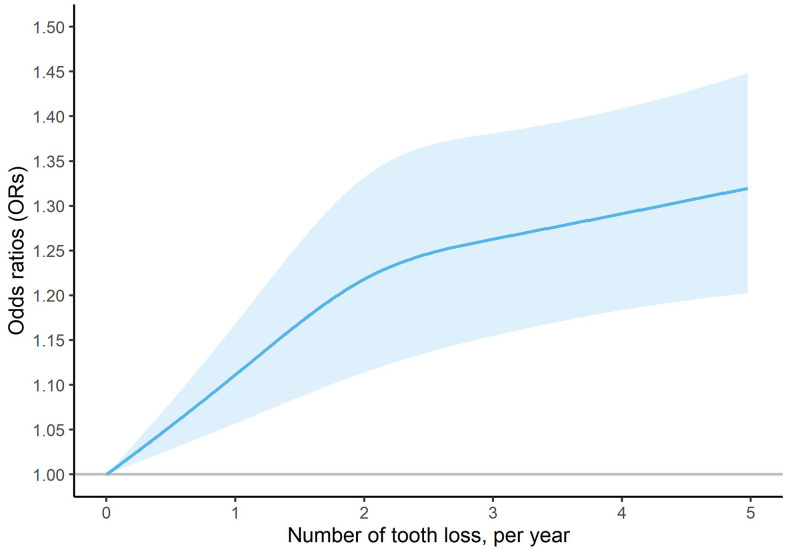
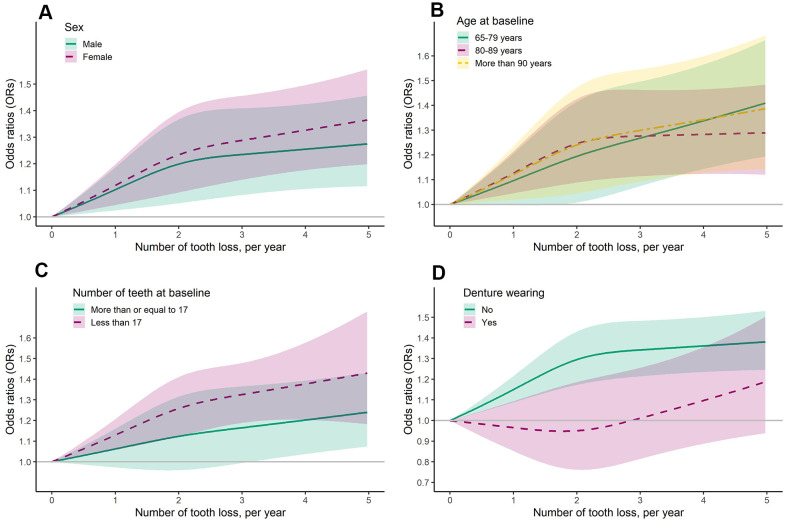
Mild cognitive impairment (MCI) is a symptomatic predementia phase of the trajectory of cognitive decline, and its prevalence increases with age. Although the relationship between oral health and MCI have been explored previously, it is uncertain whether individuals with different tooth loss rates have altered MCI risks. We hereby conducted a longitudinal study by using data from the Chinese Longitudinal Healthy Longevity Survey to investigate the association. Tooth loss rate was defined as the difference of teeth between two interview waves divided by years of interval; participants were then grouped into four categories: stable, no tooth loss; mild, 0-1 tooth loss; middle, 1-2 tooth loss; and severe, more than 2 tooth loss per year. Cognitive function was assessed by the Chinese version of Mini-Mental State Examination. We used the generalized estimating equation model to estimate the odds ratio (OR) and the 95% confidence intervals (CIs) and applied the restricted cubic spline function to explore the dose-response association. Among 11,862 participants, 3,966 developed MCI in a median follow-up time of 5.93 years. Higher tooth loss rate was associated with an increased risk of MCI in elderly subjects. Compared with subjects with stable tooth, the corresponding ORs (95% CIs) were 0.94 (0.85-1.03), 1.16 (1.04-1.29) and 1.28 (1.17-1.40) for subjects with the mild, middle and severe rate of tooth loss. A nonlinear dose-response relationship was detected ( = 0.0165). Similar results were observed in the subgroup analyses stratified by sex, age at baseline, and number of teeth at baseline. The positive association was only observed among denture nonwearers (OR : 1.19; 1.06-1.35; OR : 1.35; 1.22-1.50), but not among denture wearers. In conclusion, among elderly population in China, higher rate of tooth loss may be associated with an increased risk of MCI, while denture wearers may be less likely to develop MCI.
轻度认知障碍(MCI)是认知能力下降轨迹中的一个有症状的痴呆前期阶段,其患病率随着年龄的增长而增加。尽管先前已经探讨了口腔健康与 MCI 之间的关系,但尚不确定不同牙齿缺失率的个体是否会改变 MCI 的风险。我们使用中国长寿纵向研究的数据进行了一项纵向研究,以调查这种关联。牙齿缺失率定义为两次访谈之间牙齿数量的差异除以间隔年数;然后将参与者分为四组:稳定,无牙齿缺失;轻度,0-1 颗牙齿缺失;中度,1-2 颗牙齿缺失;严重,每年超过 2 颗牙齿缺失。认知功能通过中文版简易精神状态检查进行评估。我们使用广义估计方程模型来估计优势比(OR)和 95%置信区间(CI),并应用限制三次样条函数来探索剂量反应关联。在 11862 名参与者中,中位数随访时间为 5.93 年,有 3966 人发生 MCI。较高的牙齿缺失率与老年人发生 MCI 的风险增加有关。与稳定牙齿的受试者相比,轻度、中度和重度牙齿缺失率的相应 OR(95%CI)分别为 0.94(0.85-1.03)、1.16(1.04-1.29)和 1.28(1.17-1.40)。检测到非线性剂量反应关系( = 0.0165)。按性别、基线年龄和基线牙齿数量分层的亚组分析也观察到了类似的结果。这种正相关仅在非义齿佩戴者中观察到(OR:1.19;1.06-1.35;OR:1.35;1.22-1.50),而在义齿佩戴者中则没有。总之,在中国老年人群中,较高的牙齿缺失率可能与 MCI 的风险增加有关,而义齿佩戴者可能不太可能发生 MCI。