School of Dentistry, Autonomous University of Yucatan 61a street number 492a Donwtown Zip Code, 97000 Mérida, México
Med Oral Patol Oral Cir Bucal. 2021 Jan 1;26(1):e43-e48. doi: 10.4317/medoral.23940.
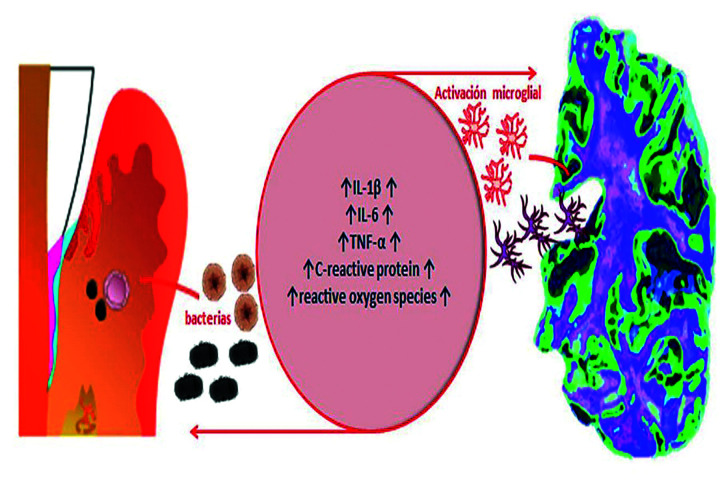
Alzheimer's disease (AD), the main cause of dementia in the adult population, is characterized by a progressive loss of cognitive function. It is considered that neuroinflammation plays a fundamental role in its onset and progression. The bacteria present in the disbiotic microbiome generated during the course of periodontitis (PE) are capable of inducing a systemic inflammatory response, exacerbating the production of proinflammatory mediators that have the potential to spread to the systemic circulation.
A literature review was made using the databases Scielo, PubMed, EBSCO and key words "Alzheimer disease", "Periodontitis", "Neurodegeneration", "Inflammation mediators", "Elderly".
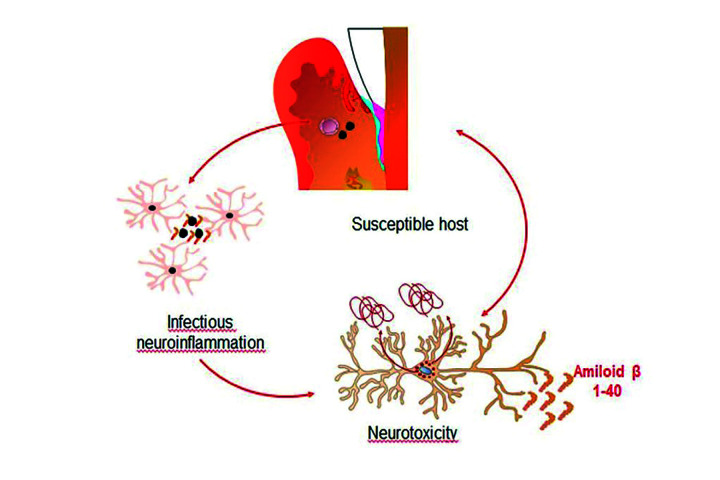
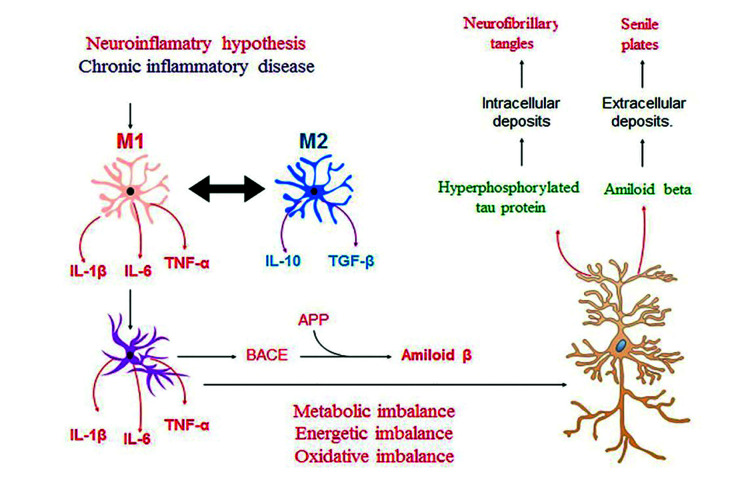
Several hypotheses point to similar pathophysiological pathways in the establishment of AD and PE, sharing cellular and molecular proinflammatory characteristics. In periodontitis, locally produced cytokines and pro-inflammatory products spread from the ulcerated periodontal pocket into the systemic circulation, or around the trigeminal nerve terminals, which allows the passage of bacteria or their products to the brain. This fact leads to the formation of plaques of amyloid peptide and intraneuronal neurofibrillar tangles (NFTs) that activate the glial cells producing a significant increase in proinflammatory cytokines in the affected regions that lead to a loss of neuronal synapses and neurodegeneration, contributing to the progression of AD.
This review of the literature contributes to the understanding of the pathological pathways shared by both diseases such as oxidative damage and inflammation. There is not enough evidence to determine an association between this two pathologies, so it is considered necessary to conduct studies for determine if periodontitis is capable of inducing or exacerbating the neuroinflammation that will trigger AD.
阿尔茨海默病(AD)是成年人痴呆的主要原因,其特征是认知功能逐渐丧失。据认为,神经炎症在其发病和进展中起着根本性作用。在牙周炎(PE)过程中产生的失调微生物组中的细菌能够引起全身炎症反应,加剧促炎介质的产生,这些介质有可能扩散到全身循环。
使用 Scielo、PubMed、EBSCO 数据库和关键词“阿尔茨海默病”、“牙周炎”、“神经退行性变”、“炎症介质”、“老年人”进行文献回顾。
有几个假设指向 AD 和 PE 建立过程中相似的病理生理途径,具有细胞和分子促炎特征。在牙周炎中,局部产生的细胞因子和促炎产物从溃疡性牙周袋扩散到全身循环,或围绕三叉神经末梢扩散,允许细菌或其产物进入大脑。这一事实导致淀粉样肽斑块和神经元内神经原纤维缠结(NFTs)的形成,激活胶质细胞,导致受影响区域中促炎细胞因子显著增加,导致神经元突触丧失和神经退行性变,从而促进 AD 的进展。
对这两种疾病(如氧化损伤和炎症)共同的病理途径的文献回顾有助于理解。没有足够的证据来确定这两种病理学之间的关联,因此有必要进行研究以确定牙周炎是否能够引发或加剧引发 AD 的神经炎症。