Microbiome Center, Department of Surgery, University of Chicago, Chicago, IL, United States of America.
Public Health Sciences, Parkinson School of Health Sciences and Public Health, Loyola University Chicago, Maywood, IL, United States of America.
PLoS One. 2021 Sep 8;16(9):e0255323. doi: 10.1371/journal.pone.0255323. eCollection 2021.
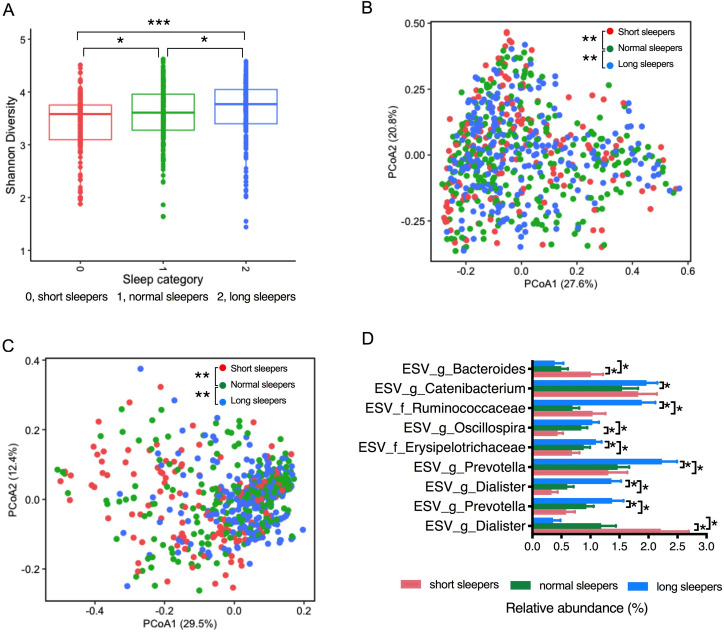
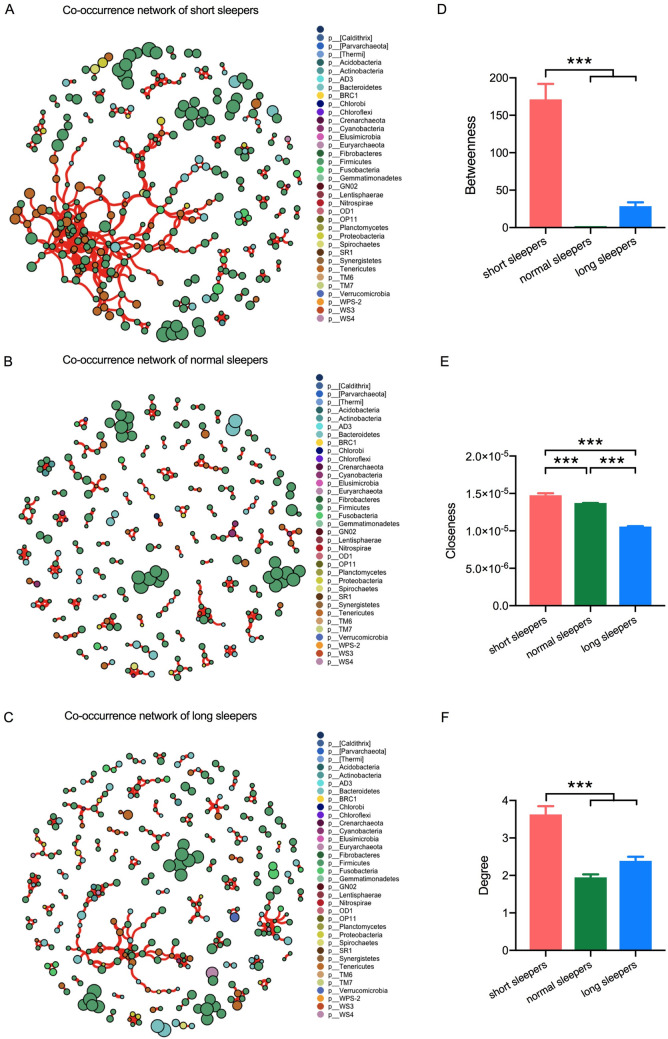
Sleep disorders are increasingly being characterized in modern society as contributing to a host of serious medical problems, including obesity and metabolic syndrome. Changes to the microbial community in the human gut have been reportedly associated with many of these cardiometabolic outcomes. In this study, we investigated the impact of sleep length on the gut microbiota in a large cohort of 655 participants of African descent, aged 25-45, from Ghana, South Africa (SA), Jamaica, and the United States (US). The sleep duration was self-reported via a questionnaire. Participants were classified into 3 sleep groups: short (<7hrs), normal (7-<9hrs), and long (≥9hrs). Forty-seven percent of US participants were classified as short sleepers and 88% of SA participants as long sleepers. Gut microbial composition analysis (16S rRNA gene sequencing) revealed that bacterial alpha diversity negatively correlated with sleep length (p<0.05). Furthermore, sleep length significantly contributed to the inter-individual beta diversity dissimilarity in gut microbial composition (p<0.01). Participants with both short and long-sleep durations exhibited significantly higher abundances of several taxonomic features, compared to normal sleep duration participants. The predicted relative proportion of two genes involved in the butyrate synthesis via lysine pathway were enriched in short sleep duration participants. Finally, co-occurrence relationships revealed by network analysis showed unique interactions among the short, normal and long duration sleepers. These results suggest that sleep length in humans may alter gut microbiota by driving population shifts of the whole microbiota and also specific changes in Exact Sequence Variants abundance, which may have implications for chronic inflammation associated diseases. The current findings suggest a possible relationship between disrupted sleep patterns and the composition of the gut microbiota. Prospective investigations in larger and more prolonged sleep researches and causally experimental studies are needed to confirm these findings, investigate the underlying mechanism and determine whether improving microbial homeostasis may buffer against sleep-related health decline in humans.
睡眠障碍在现代社会中越来越被认为是导致许多严重医学问题的原因,包括肥胖和代谢综合征。据报道,人类肠道微生物群落的变化与许多这些心血管代谢结果有关。在这项研究中,我们调查了睡眠长度对来自加纳、南非(SA)、牙买加和美国(US)的 655 名年龄在 25-45 岁的非洲裔参与者的肠道微生物群的影响。通过问卷自我报告了睡眠时间。参与者被分为 3 个睡眠组:短(<7 小时)、正常(7-<9 小时)和长(≥9 小时)。47%的美国参与者被归类为短睡眠者,88%的 SA 参与者为长睡眠者。肠道微生物组成分析(16S rRNA 基因测序)显示,细菌 α多样性与睡眠长度呈负相关(p<0.05)。此外,睡眠长度显著导致肠道微生物组成的个体间β多样性差异(p<0.01)。与正常睡眠时间参与者相比,短睡眠和长睡眠持续时间的参与者的几个分类特征的丰度显著更高。参与丁酸合成的两个基因的预测相对比例通过赖氨酸途径在短睡眠持续时间参与者中富集。最后,通过网络分析揭示的共现关系显示了短、正常和长睡眠时间参与者之间的独特相互作用。这些结果表明,人类的睡眠长度可能通过驱动整个微生物群的种群转移以及特定的 Exact Sequence Variants 丰度变化来改变肠道微生物群,这可能与慢性炎症相关疾病有关。目前的研究结果表明,睡眠模式的破坏与肠道微生物群的组成之间可能存在关系。需要在更大规模和更长时间的睡眠研究和因果实验研究中进行前瞻性研究,以证实这些发现,研究潜在机制,并确定改善微生物稳态是否可以缓冲人类与睡眠相关的健康下降。