Watkins-Martin Kia, Orri Massimiliano, Pennestri Marie-Hélène, Castellanos-Ryan Natalie, Larose Simon, Gouin Jean-Philippe, Ouellet-Morin Isabelle, Chadi Nicholas, Philippe Frederick, Boivin Michel, Tremblay Richard E, Côté Sylvana, Geoffroy Marie-Claude
Department of Psychiatry, McGill Group for Suicide Studies, Douglas Mental Health University Institute, Montreal, QC, Canada.
Department of Educational and Counselling Psychology, McGill University, Montreal, QC, H3A 1Y2, Canada.
Ann Gen Psychiatry. 2021 Sep 8;20(1):42. doi: 10.1186/s12991-021-00362-2.
Concerns have been raised that the COVID-19 pandemic could increase risk for adverse mental health outcomes, especially in young adults, a vulnerable age group. We investigated changes in depression and anxiety symptoms (overall and severe) from before to during the pandemic, as well as whether these changes are linked to COVID-19-related stressors and pre-existing vulnerabilities in young adults followed in the context of a population-based cohort.
Participants (n = 1039) from the Quebec Longitudinal Study of Child Development reported on their depression (Centre for Epidemiological Studies Depression Scale, short form) and anxiety (General Anxiety Disorder-7 Scale) symptoms and completed a COVID-19 questionnaire during the first wave of the COVID-19 pandemic in the summer of 2020 (age 22 years). Assessments at age 20 (2018) were used to estimate pre-pandemic depression and anxiety symptom severity.
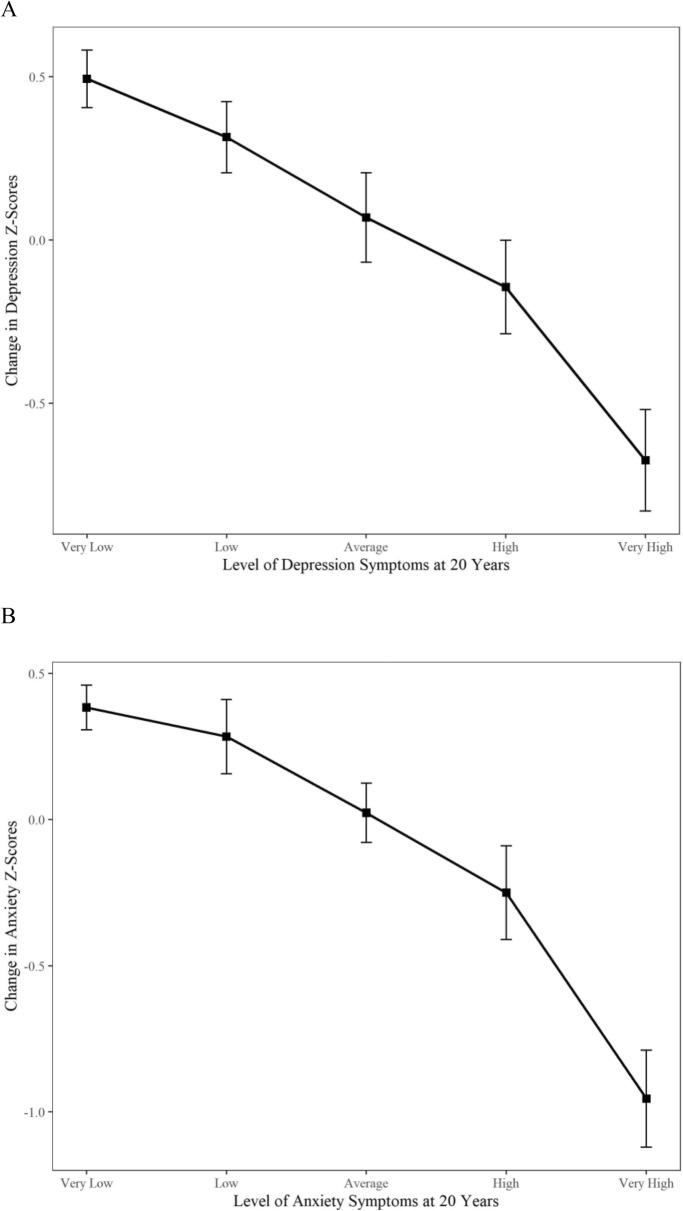
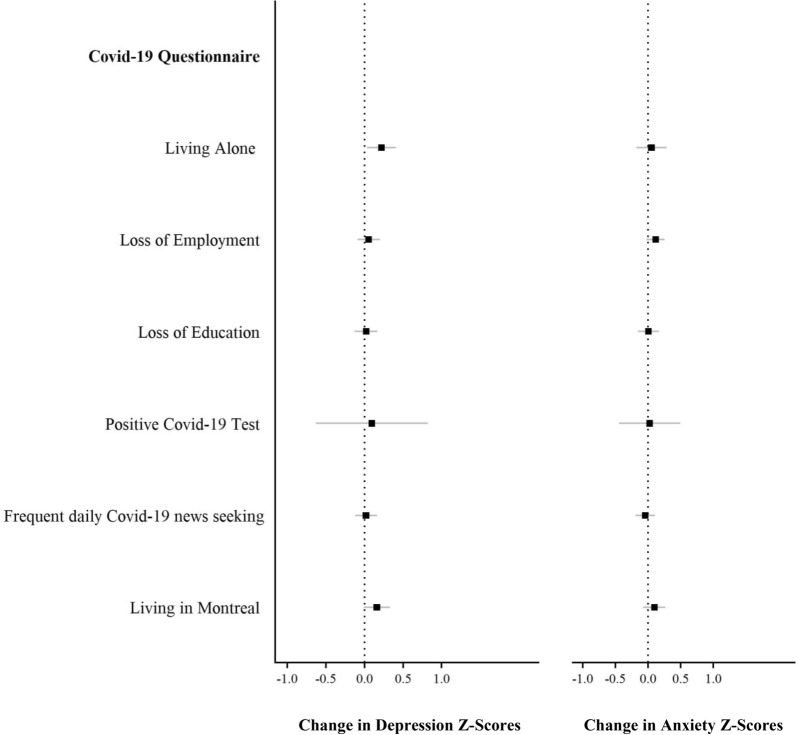
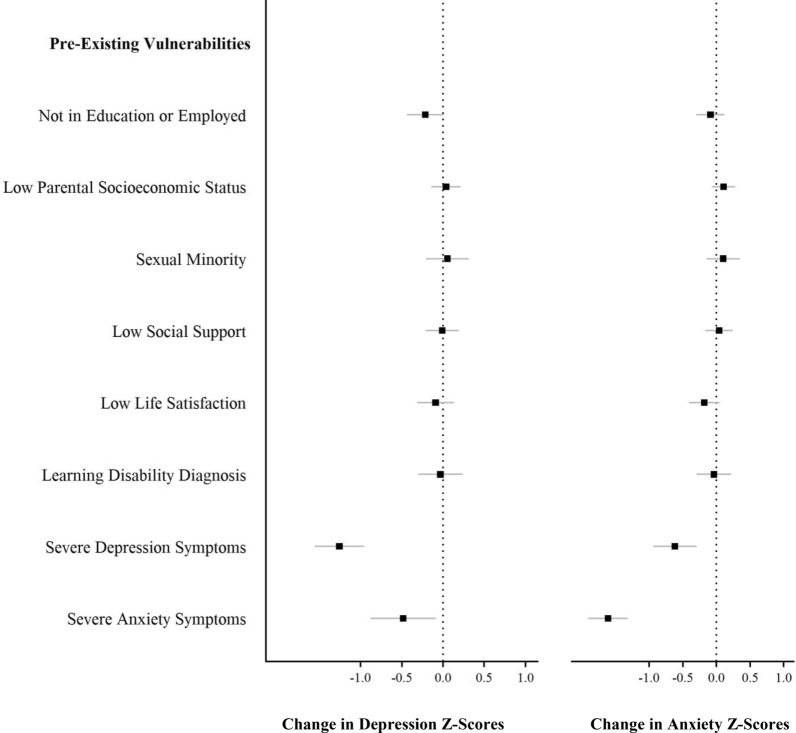
While mean levels of depression and anxiety symptoms did not change from before to during the first wave of the COVID-19 pandemic (e.g., the mean of depressive symptoms was 9.30 in 2018 and 9.59 in 2020), we observed a slight increase in rates of severe depression (scores ≥ 21) from before (6.1%) to during (8.2%) the pandemic. Most COVID-19-related variables (e.g., loss of education/occupation, frequent news-seeking) - except living alone - and most pre-existing vulnerabilities (e.g., low SES, low social support) were not associated with changes in depression or anxiety symptoms. However, results varied as a function of pre-pandemic levels of depression and anxiety: depression and anxiety symptoms increased among adults with the lowest levels of symptoms before the pandemic, while they decreased among those with the highest levels of symptoms, possibly reflecting a regression to the mean.
Depression and anxiety symptoms in young adults from Québec in Summer 2020 were mostly comparable to symptoms reported in 2018. Most COVID-19-related stressors and pre-existing vulnerabilities were not associated with changes in symptoms, except living alone and pre-existing symptoms of depression and anxiety. However, the increased rate of severe depression warrants further investigation.
人们担心新冠疫情可能会增加心理健康不良后果的风险,尤其是在年轻人这一脆弱的年龄组中。我们调查了疫情前到疫情期间抑郁和焦虑症状(总体和严重症状)的变化,以及这些变化是否与新冠相关压力源和年轻人中存在的既往易感性有关,该研究是在一个基于人群的队列研究背景下进行的。
来自魁北克儿童发展纵向研究的参与者(n = 1039)报告了他们的抑郁症状(流行病学研究中心抑郁量表简版)和焦虑症状(广泛性焦虑障碍7项量表),并在2020年夏天新冠疫情第一波期间(22岁)完成了一份新冠问卷。2018年20岁时的评估用于估计疫情前抑郁和焦虑症状的严重程度。
虽然在新冠疫情第一波期间,抑郁和焦虑症状的平均水平从疫情前到疫情期间没有变化(例如,抑郁症状的平均值在2018年为9.30,在2020年为9.59),但我们观察到严重抑郁(得分≥21)的发生率从疫情前(6.1%)到疫情期间(8.2%)略有增加。大多数与新冠相关的变量(如教育/职业丧失、频繁寻求新闻)——除了独居——以及大多数既往易感性(如低社会经济地位、低社会支持)与抑郁或焦虑症状的变化无关。然而,结果因疫情前抑郁和焦虑水平而异:疫情前症状水平最低的成年人中,抑郁和焦虑症状增加,而症状水平最高的成年人中,症状减少,这可能反映了向均值的回归。
2020年夏天魁北克年轻人的抑郁和焦虑症状大多与2018年报告的症状相当。除了独居以及既往的抑郁和焦虑症状外,大多数与新冠相关的压力源和既往易感性与症状变化无关。然而,严重抑郁发生率的增加值得进一步调查。