Department of Psychiatry, Amsterdam Public Health, Amsterdam University Medical Center, Vrije Universiteit, Amsterdam, Netherlands; Geestelijke gezondheidszorg (GGZ) InGeest Specialized Mental Health Care, Amsterdam, Netherlands.
Department of Psychiatry, Amsterdam Public Health, Amsterdam University Medical Center, Vrije Universiteit, Amsterdam, Netherlands; Geestelijke gezondheidszorg (GGZ) InGeest Specialized Mental Health Care, Amsterdam, Netherlands.
Lancet Psychiatry. 2021 Feb;8(2):121-129. doi: 10.1016/S2215-0366(20)30491-0. Epub 2020 Dec 8.
The impact of the COVID-19 pandemic on mental health in people with pre-existing mental health disorders is unclear. In three psychiatry case-control cohorts, we compared the perceived mental health impact and coping and changes in depressive symptoms, anxiety, worry, and loneliness before and during the COVID-19 pandemic between people with and without lifetime depressive, anxiety, or obsessive-compulsive disorders.
Between April 1 and May 13, 2020, online questionnaires were distributed among the Netherlands Study of Depression and Anxiety, Netherlands Study of Depression in Older Persons, and Netherlands Obsessive Compulsive Disorder Association cohorts, including people with (n=1181) and without (n=336) depressive, anxiety, or obsessive-compulsive disorders. The questionnaire contained questions on perceived mental health impact, fear of COVID-19, coping, and four validated scales assessing depressive symptoms, anxiety, worry, and loneliness used in previous waves during 2006-16. Number and chronicity of disorders were based on diagnoses in previous waves. Linear regression and mixed models were done.
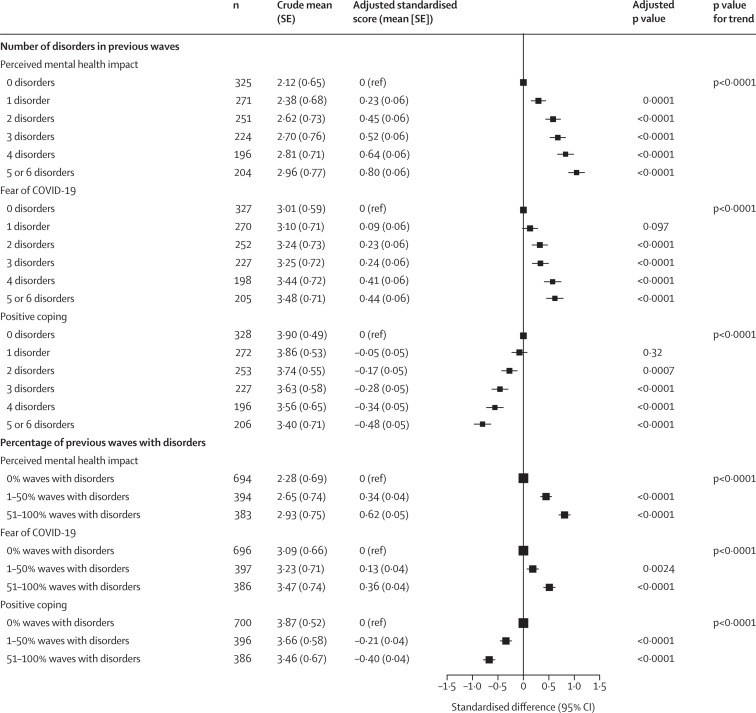
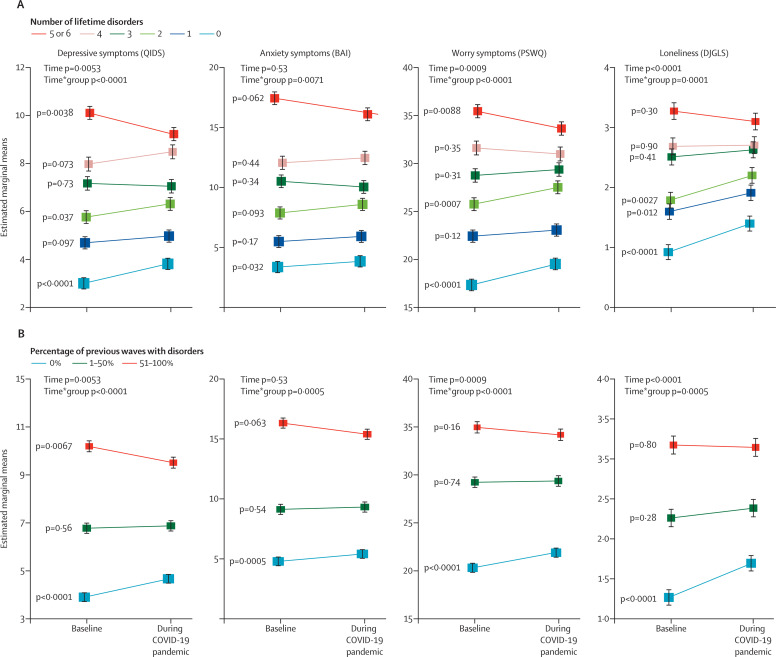
The number and chronicity of disorders showed a positive graded dose-response relation, with greater perceived impact on mental health, fear, and poorer coping. Although people with depressive, anxiety, or obsessive-compulsive disorders scored higher on all four symptom scales than did individuals without these mental health disorders, both before and during the COVID-19 pandemic, they did not report a greater increase in symptoms during the pandemic. In fact, people without depressive, anxiety, or obsessive-compulsive disorders showed a greater increase in symptoms during the COVID-19 pandemic, whereas individuals with the greatest burden on their mental health tended to show a slight symptom decrease.
People with depressive, anxiety, or obsessive-compulsive disorders are experiencing a detrimental impact on their mental health from the COVID-19 pandemic, which requires close monitoring in clinical practice. Yet, the COVID-19 pandemic does not seem to have further increased symptom severity compared with their prepandemic levels.
Dutch Research Council.
COVID-19 大流行对先前存在精神健康障碍的人的心理健康的影响尚不清楚。在三个精神病学病例对照队列中,我们比较了患有和不患有终生抑郁、焦虑或强迫症的人在 COVID-19 大流行前后对精神健康的感知影响以及应对方式和抑郁、焦虑、担忧和孤独感的变化。
2020 年 4 月 1 日至 5 月 13 日,通过在线问卷在荷兰抑郁和焦虑研究、荷兰老年抑郁研究和荷兰强迫症协会队列中进行了调查,包括患有(n=1181)和不患有(n=336)抑郁、焦虑或强迫症的人。问卷包含对精神健康影响的感知、对 COVID-19 的恐惧、应对方式以及四个在 2006-16 年期间的先前波次中使用的经验证的评估抑郁症状、焦虑、担忧和孤独感的量表。疾病的数量和慢性程度基于先前波次中的诊断。进行了线性回归和混合模型分析。
疾病的数量和慢性程度呈正分级剂量反应关系,对精神健康、恐惧和应对能力的感知影响更大。尽管患有抑郁、焦虑或强迫症的人在所有四个症状量表上的得分均高于没有这些心理健康障碍的人,但无论是在 COVID-19 大流行之前还是期间,他们都没有报告症状在大流行期间有更大的增加。事实上,没有抑郁、焦虑或强迫症的人在 COVID-19 大流行期间症状有更大的增加,而那些精神健康负担最大的人则表现出症状略有减轻。
患有抑郁、焦虑或强迫症的人正在经历 COVID-19 大流行对其心理健康的不利影响,这需要在临床实践中密切监测。然而,与大流行前相比,COVID-19 大流行似乎并没有进一步增加症状的严重程度。
荷兰研究委员会。