Research, Teaching and Innovation Unit, Parc Sanitari Sant Joan de Déu, Sant Boi de Llobregat, Barcelona, Spain; Centre for Biomedical Research on Mental Health (CIBERSAM), Spain.
Research, Teaching and Innovation Unit, Parc Sanitari Sant Joan de Déu, Sant Boi de Llobregat, Barcelona, Spain; Centre for Biomedical Research on Mental Health (CIBERSAM), Spain.
J Affect Disord. 2022 Dec 1;318:22-28. doi: 10.1016/j.jad.2022.08.127. Epub 2022 Sep 1.
The type of pre-existing disorder might determine changes in mental health symptoms (i.e., anxiety, depression) during the COVID-19 pandemic and influence the effect of psychological factors (e.g., social support, resilience, stress) on such symptoms.
Longitudinal data from two assessments (June-2020 and February/March-2021) collected through telephone interviews (Spanish general population) were analysed. Outcome variables included anxiety (GAD-7) and depressive symptoms (PHQ-8). Psychological factors included COVID-perceived stress (adapted COVID-perceived risk scale), social support (OSSS-3), and resilience (CD-RISC). Pre-existing mental conditions (3 groups: mood, anxiety, and comorbid depression+anxiety) were assessed using the CIDI checklist. Changes in anxiety and depressive symptoms between baseline and follow-up were assessed with the paired samples Wilcoxon test. Tobit regression and interaction models were conducted to test associations between psychological factors and these symptoms in follow-up.
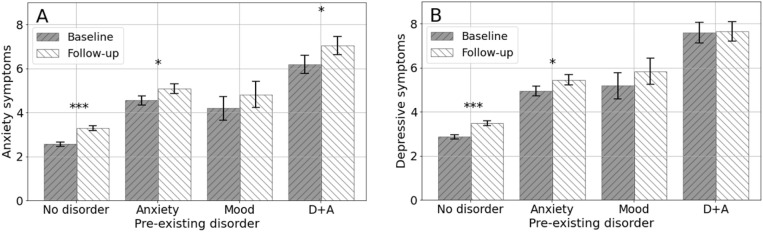
Final sample included 1942 participants (mean age 49.6 yrs., ±16.7; 51.7 % females). Anxiety symptoms increased in all groups except for those with pre-existing mood conditions. Depressive symptoms only increased in those without pre-existing mental disorders and in those with pre-existing anxiety. Higher baseline resilience, increases in social support, and decreases in COVID-perceived stress were associated with lower anxiety and depressive symptoms. The type of pre-existing mental disorder did not modify these associations.
Lack of pre-pandemic data and the limited number of pre-existing mental conditions.
Having pre-pandemic mental disorders is associated with different patterns of anxiety and depressive symptoms during the pandemic. COVID-related stress, social support, and resilience are key factors in improving mental health regardless of the mental diagnosis.
先前存在的疾病类型可能会影响 COVID-19 大流行期间心理健康症状(即焦虑、抑郁)的变化,并影响心理因素(如社会支持、韧性、压力)对这些症状的影响。
通过电话访谈(西班牙普通人群)收集了两次评估(2020 年 6 月和 2021 年 2 月/3 月)的纵向数据进行分析。结局变量包括焦虑(GAD-7)和抑郁症状(PHQ-8)。心理因素包括 COVID 感知压力(适应 COVID 感知风险量表)、社会支持(OSSS-3)和韧性(CD-RISC)。先前存在的精神状况(3 组:心境、焦虑和共病抑郁+焦虑)使用 CIDI 清单进行评估。使用配对样本 Wilcoxon 检验评估基线和随访之间焦虑和抑郁症状的变化。进行 Tobit 回归和交互模型检验随访中心理因素与这些症状之间的关联。
最终样本包括 1942 名参与者(平均年龄 49.6 岁,±16.7;51.7%为女性)。除了先前存在心境障碍的组外,所有组的焦虑症状均增加。只有没有先前精神障碍的组和先前存在焦虑的组的抑郁症状增加。较高的基线韧性、社会支持的增加和 COVID 感知压力的降低与较低的焦虑和抑郁症状相关。先前存在的精神障碍类型并未改变这些关联。
缺乏大流行前的数据和先前存在的精神障碍数量有限。
在大流行前存在精神障碍与大流行期间焦虑和抑郁症状的不同模式相关。与精神诊断无关,与 COVID 相关的压力、社会支持和韧性是改善心理健康的关键因素。