Rizzuto Laura, Hay Phillipa, Noetel Melissa, Touyz Stephen
School of Psychology, The University of Sydney, Sydney, Australia.
Translational Health Research Institute, School of Medicine, Western Sydney University, Greater Western Sydney, Australia.
J Eat Disord. 2021 Sep 8;9(1):111. doi: 10.1186/s40337-021-00467-9.
There is preliminary evidence to suggest that yoga can be beneficial in reducing anxiety, depression and general eating disorder symptoms in people with Anorexia Nervosa (AN). It is unclear whether the therapeutic benefits of yoga are supported or utilised in the treatment of AN amongst clinical experts. The present study aimed to explore and synthesise expert opinion on the use of yoga as an adjunctive therapy in the management of anxiety, depression and over-exercise in individuals with AN.
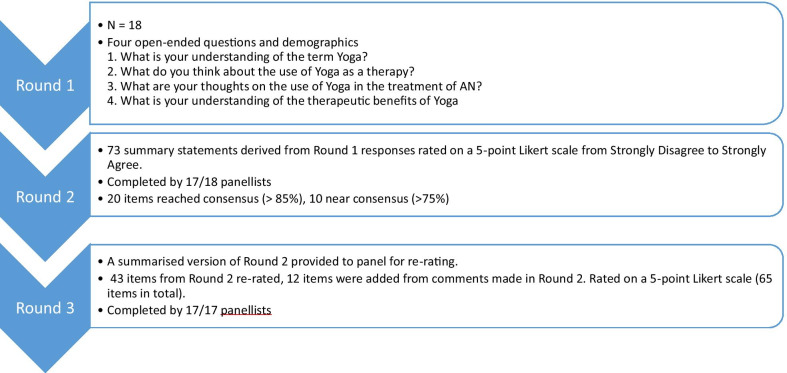
A Delphi methodology was employed, with clinicians considered experts in the treatment of AN recruited internationally to form the panel (n = 18). The first iteration of questionnaires comprised of four open-ended questions concerning the experts' understanding of the term yoga and opinions on its' use in therapy generally and more specifically in the treatment of AN. Using content analysis, statements were derived from this data and included as Likert-based items in two subsequent rounds where panellists rated their level of agreement on each item. Seventeen out of 18 respondents completed all three iterations.
Consensus (level of agreement defined at ≥ 85%) was achieved for 36.47% of the items included in the second and third rounds. The panel reached consensus on items defining yoga and pertaining to its' general benefits. The panel agreed that yoga is a adjunct therapy for various problems, consensus was not achieved on the specific use of yoga as an adjunct therapy in the treatment of comorbid anxiety, depression or trauma in patients with AN. Although the expert panel acknowledged a number of benefits for use of yoga in AN, they strongly endorsed that future research should evaluate the potential risks of using yoga as an embodied practice.
It is possible that yoga could be considered for inclusion in future guidelines if supported by empirical research. We conclude that there seems to be enough consensus that such further scientific investigation is warranted. This study aimed to explore expert opinion on the use of yoga as an adjunctive therapy in the management of anxiety, depression and over-exercise in individuals with Anorexia Nervosa (AN). Clinicians considered experts in the treatment of AN recruited internationally to form the panel (n = 18). Experts were asked about their understanding of the term yoga and their opinions on its' use in therapy. The panel reached consensus on items defining yoga and pertaining to its' general benefits. Although the panel agreed that yoga is a nice additional therapy for various problems, consensus was not achieved on the use of yoga as an additional therapy in the treatment of specific problems like anxiety, depression or trauma in people with AN. The expert panel acknowledged a number of benefits for use of yoga in AN. However the panel strongly considered that future research should evaluate the potential risks of using yoga as an embodied practice. The areas of collective agreement gained in the study can serve as preliminary guidelines for the use of yoga in AN whilst guiding future research directions.
有初步证据表明,瑜伽有助于减轻神经性厌食症(AN)患者的焦虑、抑郁和一般饮食失调症状。目前尚不清楚临床专家在AN的治疗中是否支持或采用瑜伽的治疗益处。本研究旨在探讨和综合专家对于将瑜伽作为辅助疗法用于管理AN患者的焦虑、抑郁和过度运动的意见。
采用德尔菲法,在国际范围内招募被认为是AN治疗专家的临床医生组成小组(n = 18)。第一轮问卷由四个开放式问题组成,涉及专家对瑜伽一词的理解以及对其在一般治疗中,特别是在AN治疗中的使用意见。通过内容分析,从这些数据中得出陈述,并在随后两轮中作为基于李克特量表的项目纳入,小组成员对每个项目的同意程度进行评分。18名受访者中有17名完成了所有三轮调查。
第二轮和第三轮纳入的项目中有36.47%达成了共识(同意程度定义为≥85%)。小组在定义瑜伽及其一般益处的项目上达成了共识。小组一致认为瑜伽是治疗各种问题的辅助疗法,但在将瑜伽作为辅助疗法用于治疗AN患者的共病焦虑、抑郁或创伤的具体应用上未达成共识。尽管专家小组承认在AN中使用瑜伽有诸多益处,但他们强烈支持未来的研究应评估将瑜伽作为一种身体练习方式使用的潜在风险。
如果有实证研究支持,未来的指南有可能考虑纳入瑜伽。我们得出结论,似乎有足够的共识表明有必要进行进一步的科学研究。本研究旨在探讨专家对于将瑜伽作为辅助疗法用于管理神经性厌食症(AN)患者的焦虑、抑郁和过度运动的意见。在国际范围内招募被认为是AN治疗专家的临床医生组成小组(n = 18)。询问专家对瑜伽一词的理解以及他们对其在治疗中的使用意见。小组在定义瑜伽及其一般益处的项目上达成了共识。尽管小组一致认为瑜伽是治疗各种问题的不错的辅助疗法,但在将瑜伽作为辅助疗法用于治疗AN患者的特定问题如焦虑、抑郁或创伤上未达成共识。专家小组承认在AN中使用瑜伽有诸多益处。然而,小组强烈认为未来的研究应评估将瑜伽作为一种身体练习方式使用的潜在风险。本研究中达成的集体共识领域可作为在AN中使用瑜伽的初步指南,同时指导未来的研究方向。
