Department of Oncology, Department of Public Health Sciences and Division of Cancer Care and Epidemiology, Queen's University, Kingston, ON, Canada
Program On Regulation, Therapeutics And Law (PORTAL), Division of Pharmacoepidemiology and Pharmacoeconomics, Department of Medicine, Brigham and Women's Hospital and Harvard Medical School, Boston, MA, USA.
BMJ. 2021 Sep 8;374:n1959. doi: 10.1136/bmj.n1959.
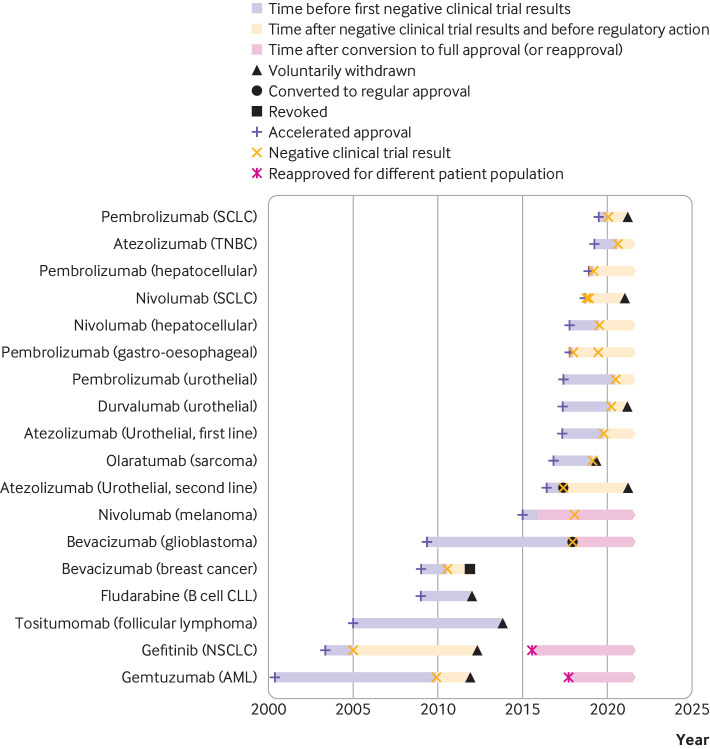
To investigate the regulatory handling of cancer drugs that were granted accelerated approval by the US Food and Drug Administration (FDA) but failed to improve the primary endpoint in post-approval trials and to evaluate the extent to which negative post-approval trials changed the recommendations in treatment guidelines.
Retrospective observational study.
FDA and National Comprehensive Cancer Network (NCCN) reports.
Cancer drugs that received accelerated approval from the FDA and had negative post-approval trials.
Regulatory outcomes, including withdrawal, conversion to regular approval, and no action.
18 indications for 10 cancer drugs that received accelerated approval but failed to improve the primary endpoint in post-approval trials were identified. Of these, 11 (61%) were voluntarily withdrawn by the manufacturer and one (bevacizumab for breast cancer) was revoked by the FDA. Of the 11 withdrawals, six occurred in 2021 alone. The remaining six (33%) indications remain on the label. The NCCN guidelines provide a high level of endorsement (category 1 endorsement for one and category 2A endorsement for seven) for accelerated approval drugs that have failed post-approval trials, sometimes even after the approval has been withdrawn or revoked.
Cancer drug indications that received accelerated approval often remained on formal FDA approved drug labelling and continued to be recommended in clinical guidelines several years after statutorily required post-approval trials showed no improvement in the primary efficacy endpoint. Clinical guidelines should better align with the results of post-approval trials of cancer drugs that received accelerated approval.
调查美国食品和药物管理局 (FDA) 加速批准但在批准后试验中未能改善主要终点的癌症药物的监管处理情况,并评估负面批准后试验在多大程度上改变了治疗指南中的建议。
回顾性观察性研究。
FDA 和国家综合癌症网络 (NCCN) 报告。
获得 FDA 加速批准且批准后试验结果为阴性的癌症药物。
监管结果,包括撤市、转换为常规批准和无行动。
确定了 10 种癌症药物的 18 种适应症,这些药物获得了加速批准,但在批准后试验中未能改善主要终点。其中,11 种(61%)由制造商自愿撤回,1 种(贝伐珠单抗治疗乳腺癌)被 FDA 撤销。在 11 次撤市中,仅 2021 年就有 6 次。其余 6 个(33%)适应症仍在标签上。NCCN 指南对加速批准药物提供了高度认可(一种为 1 类认可,七种为 2A 类认可),即使在批准被撤销或撤回后,这些药物仍被用于批准后试验失败。
获得加速批准的癌症药物适应症通常仍保留在正式的 FDA 批准药物标签上,并在法规要求的批准后试验显示主要疗效终点无改善后数年继续在临床指南中推荐。临床指南应更好地与获得加速批准的癌症药物批准后试验的结果保持一致。