Department of Hepatopancreatobiliary Surgery, Fujian Abdominal Surgery Research Institute, the First Affiliated Hospital of Fujian Medical University, Fujian, China.
Sci Rep. 2021 Sep 8;11(1):17844. doi: 10.1038/s41598-021-97362-9.
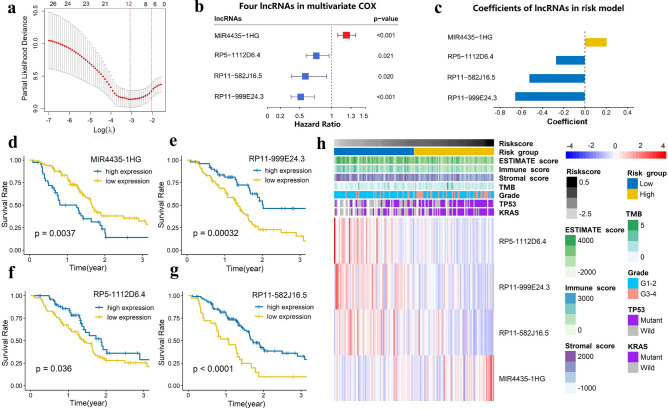
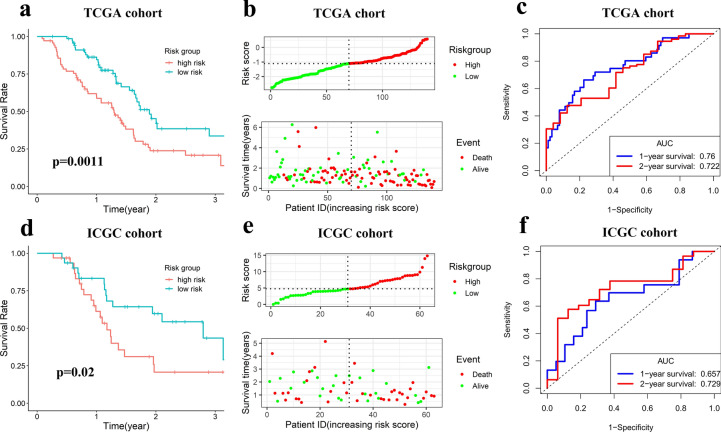
Pancreatic ductal adenocarcinoma (PDAC) is a highly aggressive, fatal tumor. N6-methylandenosine (m6A) methylation is the major epigenetic modification of RNA including lncRNAs. The roles of m6A-related lncRNAs in PDAC have not been fully clarified. This study aims to assess gene signatures and prognostic value of m6A-related lncRNAs in PDAC. The Cancer Genome Atlas (TCGA) dataset and the International Cancer Genome Consortium (ICGC) dataset were explored to identify m6A-related lncRNAs. Univariate, least absolute shrinkage and selection operator (LASSO) and multivariate Cox regression were performed to construct the m6A-related lncRNAs prognostic riskscore (m6A-LPR) model to predict the overall survival (OS) in the TCGA training cohort. Kaplan-Meier curve with log-rank test and receiver operating characteristic (ROC) curve were used to evaluate the prognostic value of the m6A-LPR. Furthermore, the robustness of the m6A-LPR was further validated in the ICGC cohort. Tumor immunity was evaluated using ESTIMATE and CIBERSORT algorithms. A total of 262 m6A-related lncRNAs were identified in two datasets. In the TCGA training cohort, 28 prognostic m6A-related lncRNAs were identified and the m6A-LPR including four m6A-related lncRNAs was constructed. The m6A-LPR was able to identify high-risk patients with significantly poorer OS and accurately predict OS in both the TCGA training cohort and the ICGC validation cohort. Analysis of tumor immunity revealed that high-risk groups had remarkably lower stromal, immune, and ESTIMATE scores. Moreover, high-risk groups were associated with significantly higher levels of plasma B cells and resting NK cells infiltration, and lower levels of infiltrating resting memory CD4 T cells, monocytes, and resting mast cells. Our study proposed a robust m6A-related prognostic signature of lncRNAs for predicting OS in PDAC, which provides some clues for further studies focusing on the mechanism process underlying m6A modification of lncRNAs.
胰腺导管腺癌(PDAC)是一种高度侵袭性和致命性的肿瘤。N6-甲基腺苷(m6A)甲基化是包括 lncRNAs 在内的 RNA 的主要表观遗传修饰。m6A 相关 lncRNAs 在 PDAC 中的作用尚未完全阐明。本研究旨在评估 m6A 相关 lncRNAs 在 PDAC 中的基因特征和预后价值。本研究利用癌症基因组图谱(TCGA)数据集和国际癌症基因组联盟(ICGC)数据集,鉴定 m6A 相关 lncRNAs。单因素、最小绝对值收缩和选择算子(LASSO)和多因素 Cox 回归分析用于构建 m6A 相关 lncRNAs 预后风险评分(m6A-LPR)模型,以预测 TCGA 训练队列的总生存期(OS)。Kaplan-Meier 曲线和对数秩检验和接受者操作特征(ROC)曲线用于评估 m6A-LPR 的预后价值。此外,还在 ICGC 队列中进一步验证了 m6A-LPR 的稳健性。使用 ESTIMATE 和 CIBERSORT 算法评估肿瘤免疫。在两个数据集中共鉴定出 262 个 m6A 相关 lncRNAs。在 TCGA 训练队列中,鉴定出 28 个预后 m6A 相关 lncRNAs,并构建了包含 4 个 m6A 相关 lncRNAs 的 m6A-LPR。m6A-LPR 能够识别出总生存期明显较差的高危患者,并在 TCGA 训练队列和 ICGC 验证队列中准确预测 OS。肿瘤免疫分析显示,高危组的基质、免疫和 ESTIMATE 评分明显较低。此外,高危组与血浆 B 细胞和静息 NK 细胞浸润水平显著升高,以及静息记忆 CD4 T 细胞、单核细胞和静息肥大细胞浸润水平显著降低有关。本研究提出了一种稳健的 m6A 相关 lncRNA 预后标志物,用于预测 PDAC 的 OS,为进一步研究 m6A 修饰 lncRNA 的机制过程提供了一些线索。