Zou Niexia, Zhou Dengbo, Chen Yinglong, Lin Ping, Chen Yufeng, Wang Wei, Xie Jianghui, Wang Mingyuan
Institute of Horticultural Science and Engineering, Huaqiao University, Xiamen, China.
Key Laboratory of Biology and Genetic Resources of Tropical Crops, Ministry of Agriculture, Institute of Tropical Bioscience and Biotechnology, Chinese Academy of Tropical Agricultural Sciences, Haikou, China.
Front Microbiol. 2021 Aug 23;12:706647. doi: 10.3389/fmicb.2021.706647. eCollection 2021.
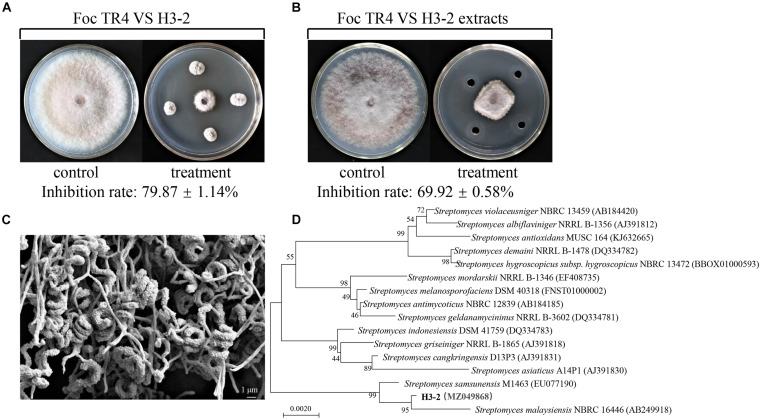
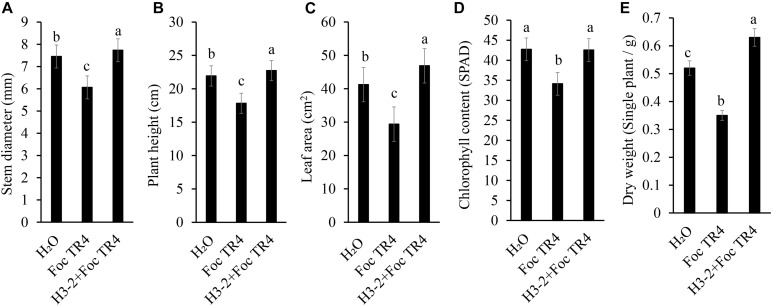
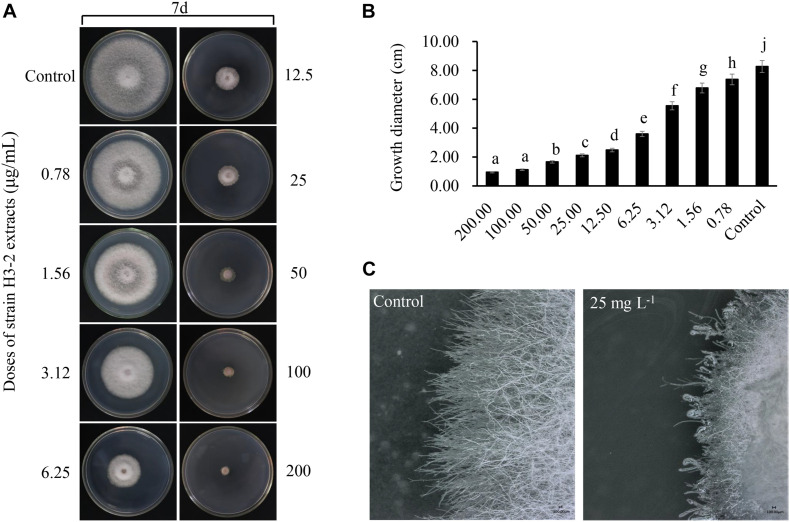
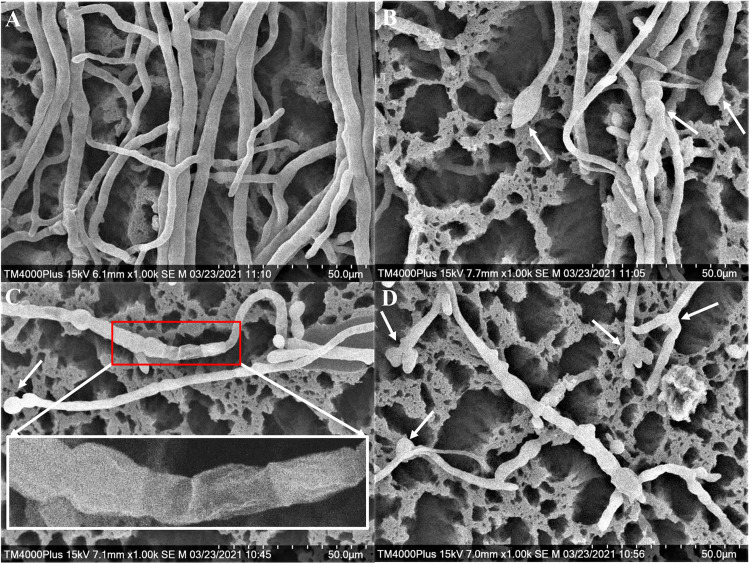
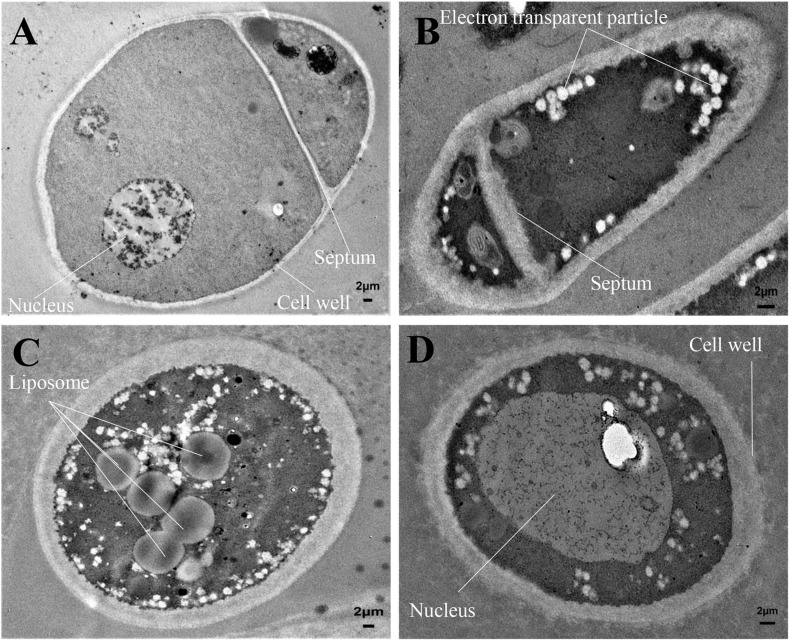
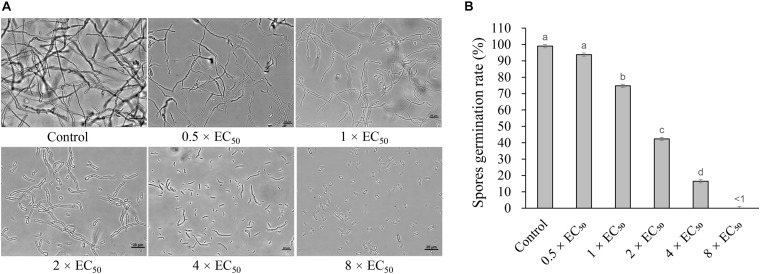
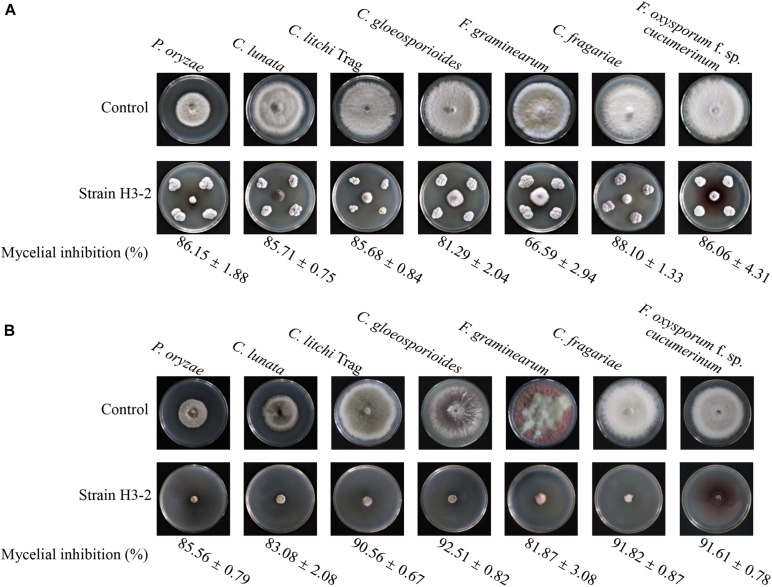
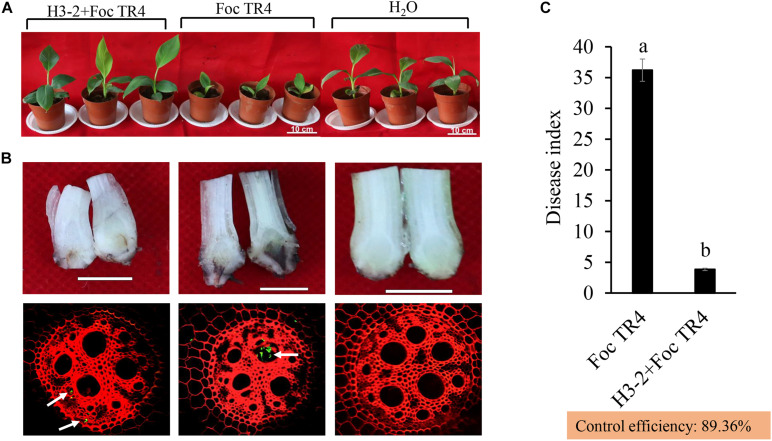
Banana Fusarium wilt disease caused by f. sp. (Foc) seriously threatens the banana industry. Foc tropical race 4 (Foc TR4) can infect almost all banana cultivars. Compared with traditional physical and chemical practices, biocontrol strategy using beneficial microbes is considered as an environmentally sound option to manage fungal disease. In this study, a strain, H3-2, isolated from a non-infected banana orchard, exhibited high antifungal activity against Foc TR4. According to its morphological, physiological, and biochemical characteristics, the strain H3-2 was identified as sp. and convinced by the polymorphic phylogenic analysis of 16S sequences. Extracts of the strain H3-2 suppressed the growth and spore germination of Foc TR4 by destroying cell membrane integrity and mycelial ultrastructure. Notably, the strain and its extracts showed broad-spectrum antifungal activity against the selected seven fungal phytopathogens. Fourteen chemical compounds in the extracts were identified by gas chromatography-mass spectrometer (GC-MS), primarily phenolic compounds. Additional pot inoculation experiment demonstrated that the fermentation broth of the strain H3-2 promoted the growth of banana seedlings by efficiently inhibiting the spread of banana Fusarium wilt disease. This study demonstrated the potential application of the novel sp. H3-2 for the management of banana Fusarium wilt.
由尖孢镰刀菌古巴专化型(Foc)引起的香蕉枯萎病严重威胁着香蕉产业。尖孢镰刀菌热带4号小种(Foc TR4)几乎能感染所有香蕉品种。与传统的物理和化学方法相比,利用有益微生物的生物防治策略被认为是管理真菌病害的一种环保选择。在本研究中,从一个未感染的香蕉果园分离出的菌株H3-2对Foc TR4表现出高抗真菌活性。根据其形态、生理和生化特征,菌株H3-2被鉴定为芽孢杆菌属,并通过16S序列的多态系统发育分析得以确认。菌株H3-2的提取物通过破坏细胞膜完整性和菌丝超微结构来抑制Foc TR4的生长和孢子萌发。值得注意的是,该菌株及其提取物对所选的七种真菌植物病原菌表现出广谱抗真菌活性。通过气相色谱-质谱联用仪(GC-MS)鉴定出提取物中的14种化合物,主要是酚类化合物。额外的盆栽接种实验表明,菌株H3-2的发酵液通过有效抑制香蕉枯萎病的传播促进了香蕉幼苗的生长。本研究证明了新型芽孢杆菌属菌株H3-2在管理香蕉枯萎病方面的潜在应用。