Liu Dafeng, Zhou Lingyun, Zhang Xinyi, Zeng Yilan, Bai Lang, Wu Dongbo, Tang Hong
Center of Infectious Diseases, Sichuan University West China Hospital, Chengdu, China.
Department of Internal Medicine, The Public and Health Clinic Centre of Chengdu, Chengdu, China.
Int J Endocrinol. 2021 Aug 24;2021:1264707. doi: 10.1155/2021/1264707. eCollection 2021.
This study is aimed at the characteristics of glucose metabolism and islet cell function evaluated by the homeostasis model assessment of cell function (HOMA-) value and its risk factors in chronic hepatitis B (CHB) patients.
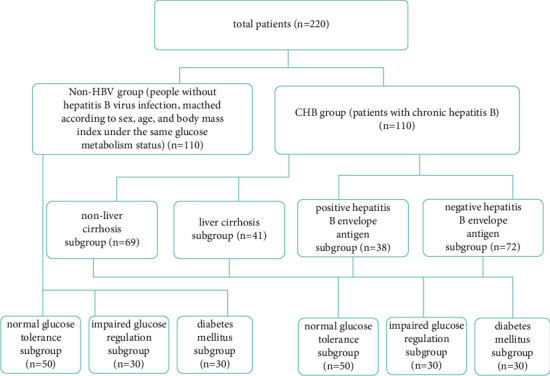
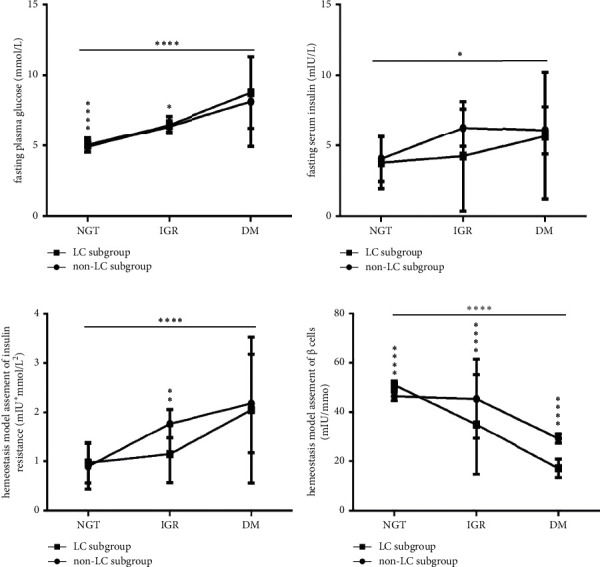
This cross-sectional study recruited 110 CHB patients (CHB group) and 110 patients without hepatitis B virus (non-HBV group); the groups were matched according to sex, age, and body mass index under the same glucose metabolism status. The risk factors, characteristics, and differences in glucose metabolism and HOMA- values between the two groups were analyzed.
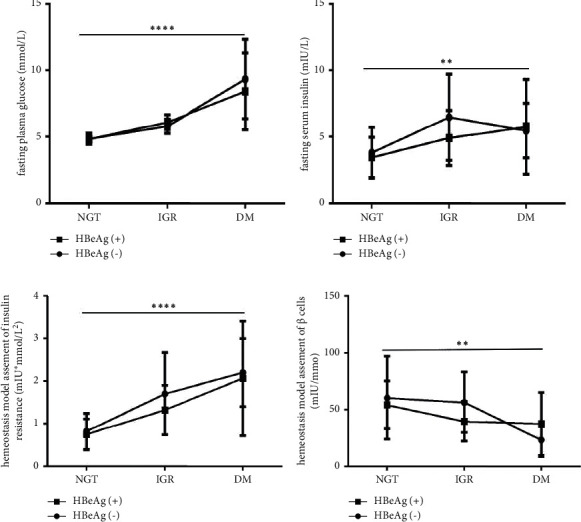
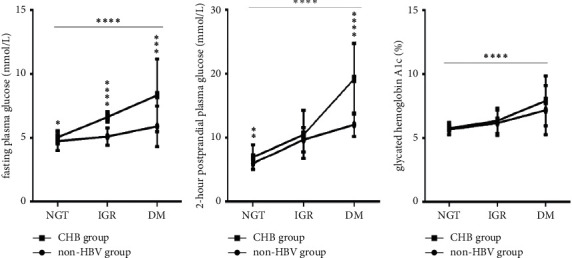
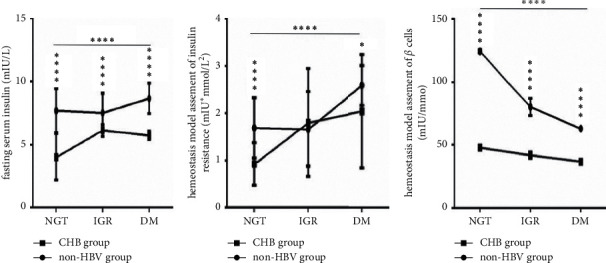
The abnormal glucose metabolism rate was higher in CHB patients with liver cirrhosis (LC) or hepatitis B envelope antigen (HBeAg) (-) status. In addition, under the same glucose metabolism status, the fasting plasma glucose (FPG) levels and 2-hour postprandial plasma glucose (2h-PG) levels in the CHB group were higher, while the HOMA- values were significantly lower and the homeostasis model assessment of insulin resistance (HOMA-IR) value was not higher than that in the non-HBV group (all < 0.0001). Further analyses revealed that the main risk factors for abnormal glucose metabolism were HBeAg (-) status and hepatitis B envelope antibody levels. But HBV serological and virological indicators had no effects on the HOMA- values.
Islet cell function in patients with CHB was compromised, which is closely associated with fasting and postprandial hyperglycemia in chronic hepatitis B patients. Further research should be done to verify the compromised islet cell function and then to investigate the mechanisms behind the effect of hepatitis B virus infection on islet cell function in CHB patients.
本研究旨在通过细胞功能稳态模型评估(HOMA-β)值评估慢性乙型肝炎(CHB)患者的糖代谢特征、胰岛细胞功能及其危险因素。
本横断面研究招募了110例CHB患者(CHB组)和110例无乙肝病毒感染的患者(非HBV组);两组在相同糖代谢状态下根据性别、年龄和体重指数进行匹配。分析两组之间的危险因素、糖代谢特征以及HOMA-β值的差异。
肝硬化(LC)或乙肝e抗原(HBeAg)阴性状态的CHB患者糖代谢异常率更高。此外,在相同糖代谢状态下,CHB组的空腹血糖(FPG)水平和餐后2小时血糖(2h-PG)水平更高,而HOMA-β值显著更低,胰岛素抵抗稳态模型评估(HOMA-IR)值不高于非HBV组(均P<0.0001)。进一步分析显示,糖代谢异常的主要危险因素是HBeAg阴性状态和乙肝e抗体水平。但HBV血清学和病毒学指标对HOMA-β值无影响。
CHB患者的胰岛β细胞功能受损,这与慢性乙型肝炎患者的空腹和餐后高血糖密切相关。应进一步开展研究以验证受损的胰岛β细胞功能,进而探究乙肝病毒感染对CHB患者胰岛β细胞功能影响的机制。