Department of Infectious Diseases, Tongji Hospital, Tongji Medical College, Huazhong University of Science and Technology, Wuhan 430030, Hubei Province, China.
Department of Oncology, Tongji Hospital, Tongji Medical College, Huazhong University of Science and Technology, Wuhan 430030, Hubei Province, China.
World J Gastroenterol. 2019 Apr 28;25(16):1950-1963. doi: 10.3748/wjg.v25.i16.1950.
Chronic hepatitis B is a highly heterogeneous disease that can be divided into four phases: Immune tolerant (IT), immune active (IA), inactive carrier (IC) and hepatitis B envelope antigen (HBeAg)-negative hepatitis (ENEG).
To investigate the immune status of natural killer (NK) and T cells in different phases of chronic hepatitis B.
The frequency, phenotype and function of circulating NK cells, as well as nonantigen-specific and hepatitis B virus (HBV)-specific T cell responses were detected by flow cytometry in healthy and HBV-infected subjects.
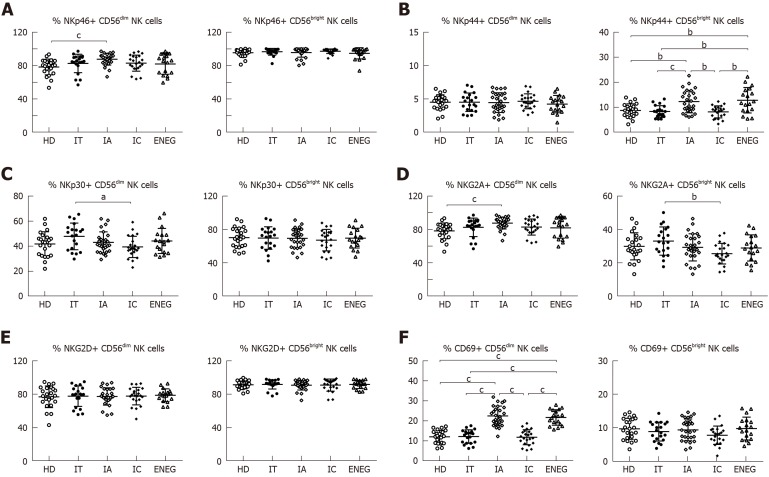
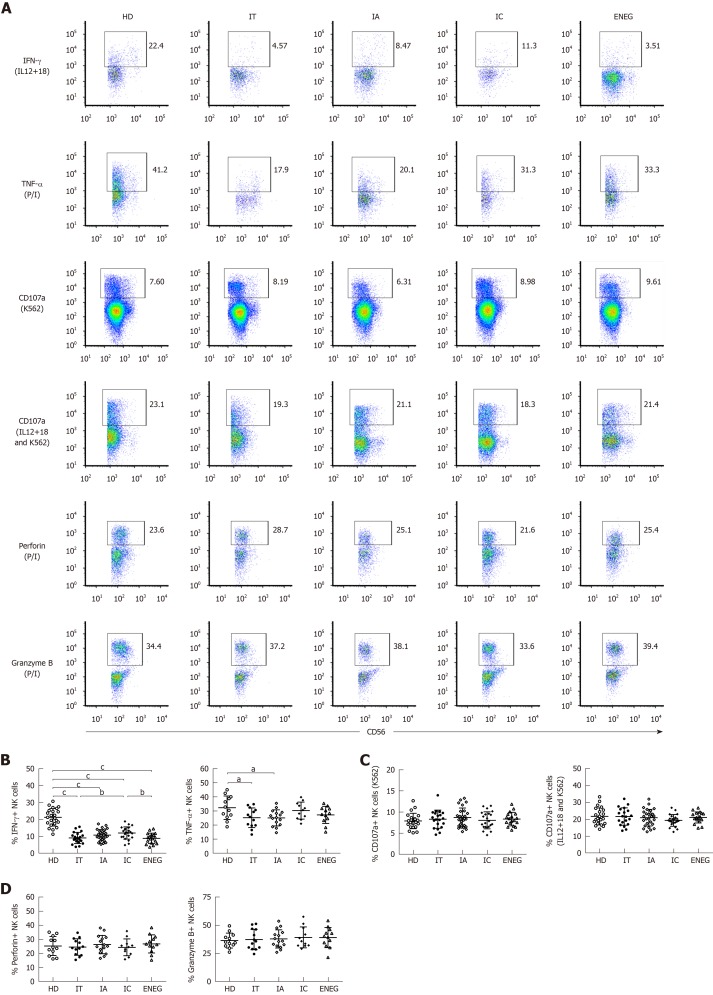
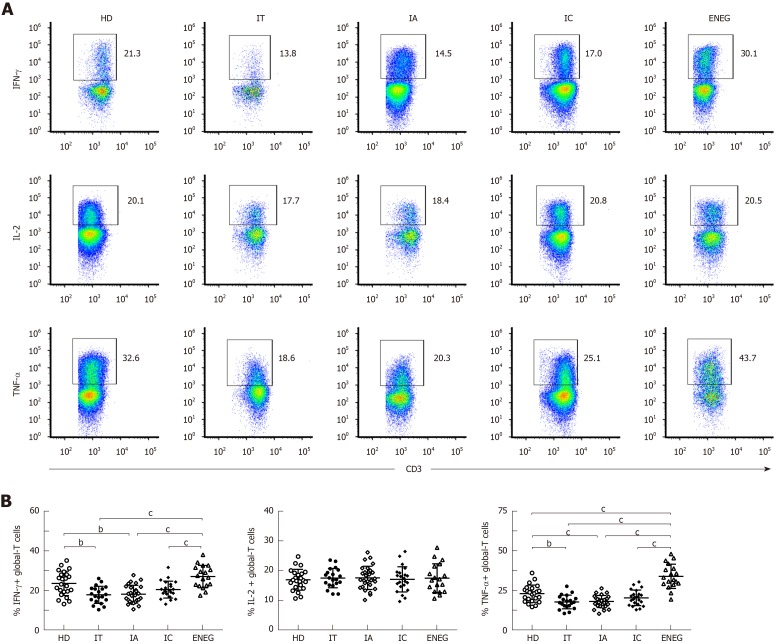
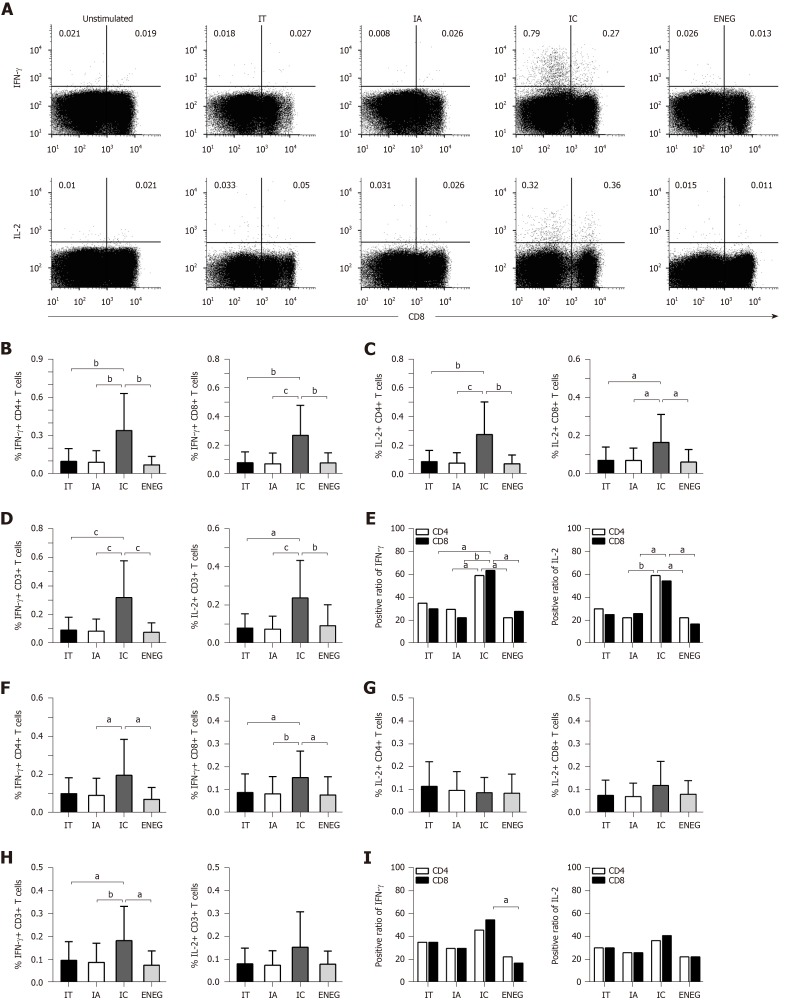
The ability of NK cells to produce IFN-γ was markedly attenuated in HBV-infected patients overall but was less compromised in IC patients. Patients in the IT and IA phases also displayed significantly lower TNF-α production compared to healthy subjects. NK cells were phenotypically activated in the IA and ENEG phases, as evidenced by the upregulation of NKp44 in CD56 NK cells and CD69 in CD56 NK cells. Furthermore, global T-cells from the ENEG phase displayed a proinflammatory cytokine profile with upregulated IFN-γ and TNF-α expression, while this profile was suppressed in IT and IA patients. Finally, core and S antigen-specific T cell responses were significantly stronger after expansion in the IC phase compared to other phases.
Our findings demonstrate the changes in immune response pattern during the natural history of HBV infection. Both NK and T cells are functionally impaired in the IT and IA phases. With the spontaneous clearance of HBeAg and hepatitis B surface antigen decline, NK cell cytokine production and HBV-specific T responses are partially restored in IC phase, and the ENEG phase is dominated by nonantigen-specific T cell responses.
慢性乙型肝炎是一种高度异质性的疾病,可以分为四个阶段:免疫耐受(IT)、免疫激活(IA)、非活动期携带者(IC)和乙型肝炎包膜抗原(HBeAg)阴性肝炎(ENEG)。
研究慢性乙型肝炎不同阶段自然杀伤(NK)和 T 细胞的免疫状态。
采用流式细胞术检测健康和乙型肝炎病毒(HBV)感染者循环 NK 细胞的频率、表型和功能,以及非抗原特异性和 HBV 特异性 T 细胞反应。
NK 细胞产生 IFN-γ的能力在 HBV 感染者中总体上明显减弱,但在 IC 患者中受损程度较小。IT 和 IA 期患者与健康受试者相比,TNF-α的产生也显著降低。IA 和 ENEG 期 NK 细胞表型激活,CD56 NK 细胞中 NKp44上调,CD56 NK 细胞中 CD69上调。此外,ENEG 期的总 T 细胞表现出促炎细胞因子谱,IFN-γ和 TNF-α表达上调,而 IT 和 IA 期患者的这种谱被抑制。最后,与其他阶段相比,IC 期核心和 S 抗原特异性 T 细胞反应在扩增后显著增强。
我们的研究结果表明,在 HBV 感染的自然史中,免疫反应模式发生了变化。在 IT 和 IA 期,NK 和 T 细胞的功能均受损。随着 HBeAg 和乙型肝炎表面抗原的自发清除,IC 期 NK 细胞细胞因子产生和 HBV 特异性 T 反应部分恢复,ENEG 期主要由非抗原特异性 T 细胞反应主导。