Sorbonne Université, Inserm, Centre d'Immunologie et des Maladies Infectieuses, Cimi-Paris, Paris, France.
Division of Immunology, Germans Trias i Pujol University Hospital and Research Institute, Badalona, Spain.
Front Cell Infect Microbiol. 2021 Aug 23;11:709893. doi: 10.3389/fcimb.2021.709893. eCollection 2021.
Innate immune activation during Covid-19 infection is associated with pernicious clinical outcome.
Coronavirus disease 2019 (Covid-19) is a worldwide threat that has already caused more than 3 000 000 deaths. It is characterized by different patterns of disease evolution depending on host factors among which old-age and pre-existing comorbidities play a detrimental role. Previous coronavirus epidemics, notably SARS-CoV, were associated with increased serum neopterin levels, which can be interpreted as a sign of acute innate immunity in response to viral infection. Here we hypothesize that neopterin may serve as a biomarker of SARS-CoV-2 viral infection and Covid-19 disease severity.
We measured neopterin blood levels by ELISA. Seric concentration was quantified from 256 healthy donors and 374 Covid-19 patients at hospital admission. Enrolled Covid-19 patients were all symptomatic and displayed a large spectrum of comorbidities. Patients were followed until disease resolution or death.
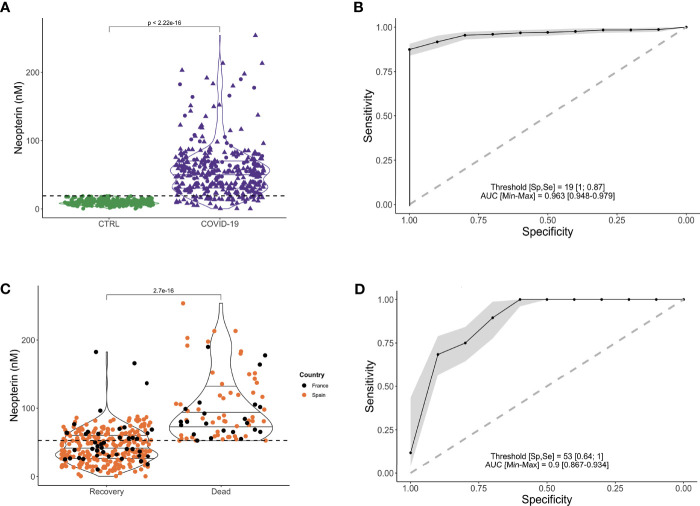
Severe and critically ill SARS-CoV-2 infected patients were characterized by a profound exacerbation of immune activation characterized by elevated neopterin blood levels. Systemic neopterin levels above 19nM stratified healthy individuals from Covid-19 patients with 87% specificity and 100% sensitivity. Moreover, systemic neopterin levels above 53nM differentiated non-survivors from survivors with 64% specificity and 100% sensitivity.
We propose that neopterin concentration measured at arrival to hospital is a hallmark of severe Covid-19 and identifies a high-risk population of pernicious clinical outcome with a need for special medical care.
COVID-19 感染期间固有免疫激活与不良临床结局相关。
COVID-19 是一种全球性威胁,已导致超过 300 万人死亡。它的特点是疾病演变模式因宿主因素而异,其中老年和预先存在的合并症起着有害的作用。以前的冠状病毒流行,特别是 SARS-CoV,与血清中新蝶呤水平的升高有关,这可以解释为对病毒感染的急性固有免疫的迹象。在这里,我们假设新蝶呤可能是 SARS-CoV-2 病毒感染和 COVID-19 疾病严重程度的生物标志物。
我们通过 ELISA 测量了新蝶呤的血液水平。血清浓度从 256 名健康供体和 374 名入院时的 COVID-19 患者中定量。所有纳入的 COVID-19 患者均有症状,并表现出多种合并症。患者被随访至疾病缓解或死亡。
严重和危重症 SARS-CoV-2 感染患者的特点是免疫激活明显加剧,表现为新蝶呤血液水平升高。系统新蝶呤水平高于 19nM 将健康个体与 COVID-19 患者区分开来,特异性为 87%,敏感性为 100%。此外,系统新蝶呤水平高于 53nM 将非幸存者与幸存者区分开来,特异性为 64%,敏感性为 100%。
我们提出,入院时测量的新蝶呤浓度是严重 COVID-19 的标志,并确定了具有不良临床结局高风险的人群,需要特殊的医疗护理。