Al-Mosul General Hospital, Mosul University Post Office, P.O. Box 11104, Mosul 41002, Iraq.
School of Pharmacy, Biodiscovery Institute, University Park, University of Nottingham, Nottingham NG7 2RD, UK.
Molecules. 2021 Aug 25;26(17):5136. doi: 10.3390/molecules26175136.
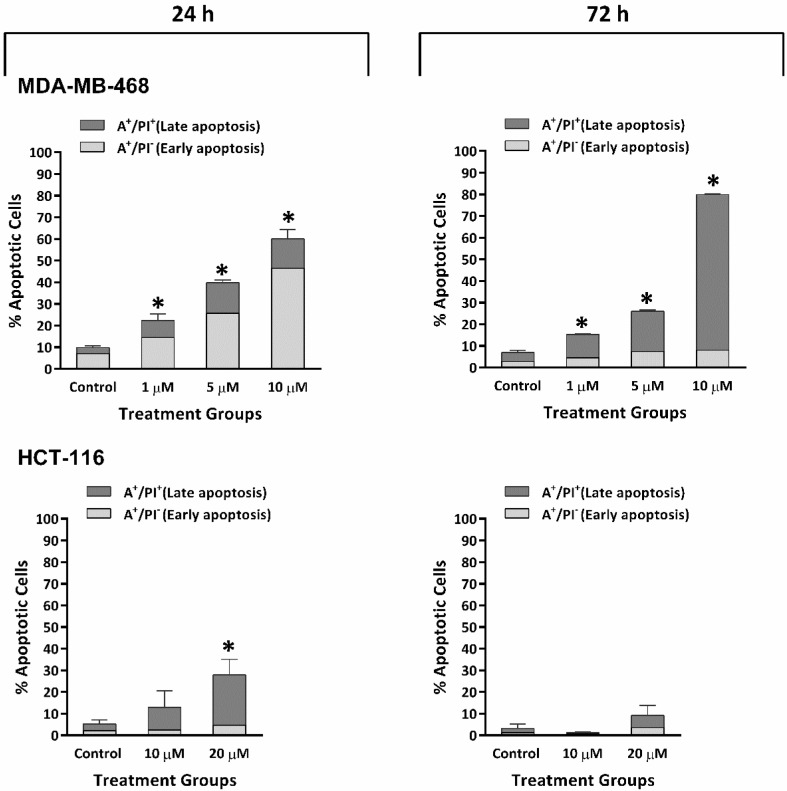
Thymoquinone (TQ) is the main biologically active constituent of . Many studies have confirmed its anticancer actions. Herein, we investigated the different anticancer activities of, and considered resistance mechanisms to, TQ. MTT and clonogenic data showed TQ's ability to suppress breast MDA-MB-468 and T-47D proliferation at lower concentrations compared to other cancer and non-transformed cell lines tested (GI values ≤ 1.5 µM). Flow-cytometric analyses revealed that TQ consistently induced MDA-MB-468 and T-47D cell-cycle perturbation, specifically inducing pre-G1 populations. In comparison, less sensitive breast MCF-7 and colon HCT-116 cells exhibited only transient increases in pre-G1 events. Annexin V/PI staining confirmed apoptosis induction in MDA-MB-468 and HCT-116 cells, which was continuous in the former and transient in the latter. Experiments revealed the role of reactive oxygen species (ROS) generation and aneuploidy induction in MDA-MB-468 cells within the first 24 h of treatment. The ROS-scavenger NAD(P)H dehydrogenase (quinone 1) (NQO1; DT-diaphorase) and glutathione (GSH) were implicated in resistance to TQ. Indeed, western blot analyses showed that NQO1 is expressed in all cell lines in this study, except those most sensitive to TQ-MDA-MB-468 and T-47D. Moreover, TQ treatment increased NQO1 expression in HCT-116 in a concentration-dependent fashion. Measurement of GSH activity in MDA-MB-468 and HCT-116 cells found that GSH is similarly active in both cell lines. Furthermore, GSH depletion rendered these cells more sensitive to TQ's antiproliferative actions. Therefore, to bypass putative inactivation of the TQ semiquinone metabolite, the benzylamine analogue was designed and synthesised following modification of TQ's carbon-3 atom. However, the structural modification negatively impacted potency against MDA-MB-468 cells. In conclusion, we disclose the following: (i) The anticancer activity of TQ may be a consequence of ROS generation and aneuploidy; (ii) Early GSH depletion could substantially enhance TQ's anticancer activity; (iii) Benzylamine substitution at TQ's carbon-3 failed to enhance anticancer activity.
姜黄素(TQ)是 的主要生物活性成分。许多研究证实了它的抗癌作用。在此,我们研究了 TQ 的不同抗癌活性,并考虑了对其的耐药机制。MTT 和集落形成数据表明,与其他测试的癌症和非转化细胞系相比,TQ 能够以较低的浓度抑制乳腺癌 MDA-MB-468 和 T-47D 的增殖(GI 值≤1.5μM)。流式细胞术分析显示,TQ 一致诱导 MDA-MB-468 和 T-47D 细胞周期扰动,特别是诱导 G1 期前群体。相比之下,敏感性较低的乳腺癌 MCF-7 和结肠 HCT-116 细胞仅显示 G1 期前事件的短暂增加。 Annexin V/PI 染色证实 MDA-MB-468 和 HCT-116 细胞诱导凋亡,前者持续,后者短暂。实验揭示了在治疗的前 24 小时内,活性氧(ROS)的产生和非整倍体诱导在 MDA-MB-468 细胞中的作用。ROS 清除剂 NAD(P)H 脱氢酶(醌 1)(NQO1;二硫还原酶)和谷胱甘肽(GSH)被认为与 TQ 耐药有关。事实上,Western blot 分析表明,在本研究中的所有细胞系中都表达 NQO1,除了对 TQ-MDA-MB-468 和 T-47D 最敏感的细胞系外。此外,TQ 以浓度依赖性方式增加 HCT-116 中的 NQO1 表达。测量 MDA-MB-468 和 HCT-116 细胞中的 GSH 活性发现,GSH 在这两种细胞系中均具有活性。此外,GSH 耗竭使这些细胞对 TQ 的抗增殖作用更敏感。因此,为了绕过 TQ 半醌代谢物的潜在失活,设计并合成了苄胺类似物,对 TQ 的碳-3 原子进行了修饰。然而,结构修饰对 MDA-MB-468 细胞的活性产生了负面影响。总之,我们揭示了以下内容:(i)TQ 的抗癌活性可能是 ROS 产生和非整倍体的结果;(ii)早期 GSH 耗竭可显著增强 TQ 的抗癌活性;(iii)TQ 碳-3 位的苄胺取代未能增强抗癌活性。