Council for Agricultural Research and Economics-Research Centre for Viticulture and Enology, CREA-VE Viale XXVIII Aprile 26, 31015 Conegliano, Italy.
Bertani Domains Società Agricola A R.L., Via Asiago 1, 37023 Grezzana, Italy.
Molecules. 2021 Aug 27;26(17):5198. doi: 10.3390/molecules26175198.
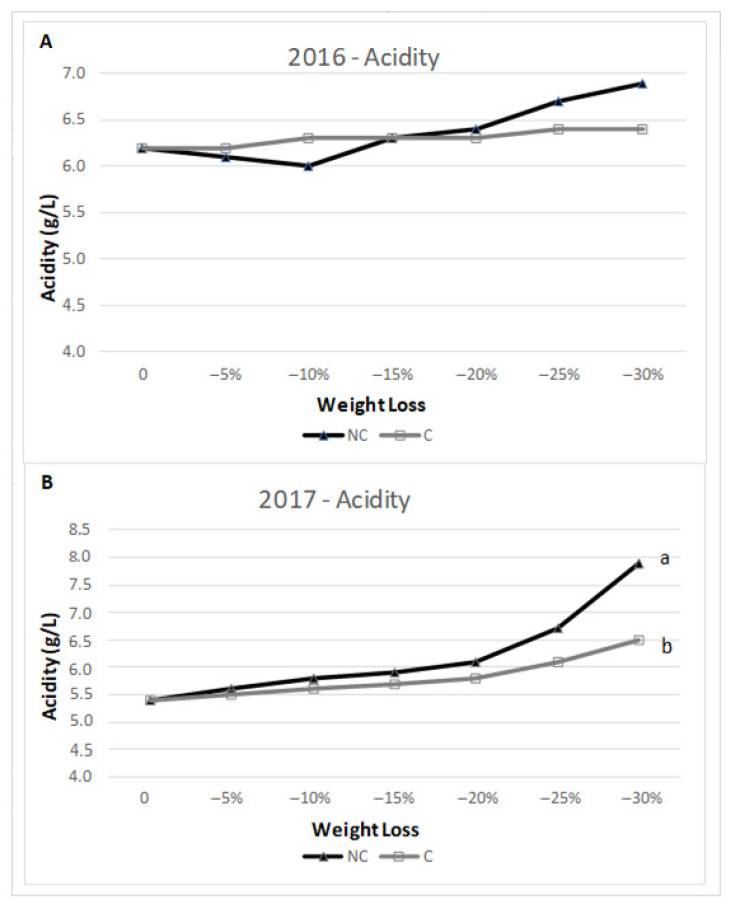
In the Valpolicella area (Verona, Italy) cv. Corvina is the main grape variety used to produce Amarone wine. Before starting the winemaking process, the Corvina grapes are stored in a withering (i.e., dehydrating) warehouse until about 30% of the berry weight is lost (WL). This practice is performed to concentrate the metabolites in the berry and enrich the Amarone wine in aroma and antioxidant compounds. In compliance with the guidelines and strict Amarone protocol set by the Consorzio of Amarone Valpolicella, withering must be carried out by setting the grapes in a suitable environment, either under controlled relative air humidity (RH) conditions and wind speed (WS)-no temperature modification is to be applied-or, following the traditional methods, in non-controlled environmental conditions. In general, the two processes have different dehydration kinetics due to the different conditions in terms of temperature, RH, and WS, which affect the accumulation of sugars and organic acids and the biosynthesis of secondary metabolites such as stilbenes and glycoside aroma precursors. For this study, the two grape-withering processes were carried out under controlled (C) and non-controlled (NC) conditions, and the final compositions of the Corvina dried grapes were compared also to evaluate the effects on the organoleptic characteristics of Amarone wine. The findings highlighted differences between the two processes mainly in terms of the secondary metabolites of the dried grapes, which affect the organoleptic characteristics of Amarone wine. Indeed, by the sensory evaluation, wines produced by adopting the NC process were found more harmonious, elegant, and balanced. Finally, we can state how using a traditional system, grapes were characterised by higher levels of VOCs (volatile compounds), whilst wines had a higher and appreciable complexity and finesse.
在瓦波利切拉地区(意大利维罗纳),卡尔卡耐卡(Corvina)是酿造阿玛罗尼葡萄酒的主要葡萄品种。在开始酿酒之前,科维纳葡萄会被储存在风干(即脱水)仓库中,直到失去约 30%的浆果重量(WL)。这种做法是为了浓缩浆果中的代谢物,并使阿玛罗尼葡萄酒在香气和抗氧化化合物方面更加丰富。根据阿玛罗尼瓦波利切拉联盟(Consorzio of Amarone Valpolicella)的指导方针和严格的阿玛罗尼协议,风干必须在适当的环境中进行,要么在受控的相对空气湿度(RH)和风速(WS)条件下进行,要么在非受控的环境条件下采用传统方法进行。一般来说,由于温度、RH 和 WS 等条件的不同,这两种过程具有不同的脱水动力学,这会影响糖和有机酸的积累以及类黄酮和糖苷香气前体等次生代谢物的生物合成。在这项研究中,两种葡萄风干过程在受控(C)和非受控(NC)条件下进行,比较了最终的科维纳干葡萄成分,以评估其对阿玛罗尼葡萄酒感官特性的影响。研究结果突出了两种过程之间的差异,主要是在干葡萄的次生代谢物方面,这会影响阿玛罗尼葡萄酒的感官特性。实际上,通过感官评估,采用 NC 工艺生产的葡萄酒被发现更加和谐、优雅和平衡。最后,我们可以说,采用传统系统,葡萄的挥发性有机化合物(VOCs)水平更高,而葡萄酒的复杂性和精致度更高。