National and Local Joint Engineering Research Center of Biomedical Functional Materials, Nanjing 210023, China.
Jiangsu Collaborative Innovation Center of Biomedical Functional Materials, Nanjing 210023, China.
Molecules. 2021 Sep 5;26(17):5403. doi: 10.3390/molecules26175403.
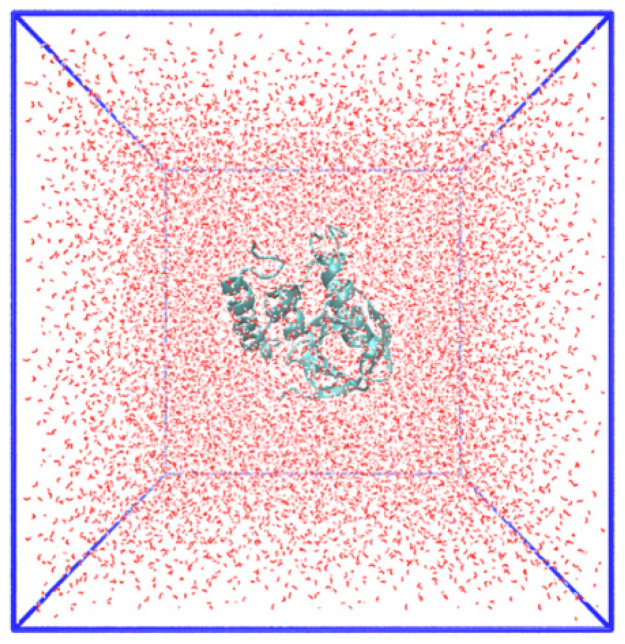
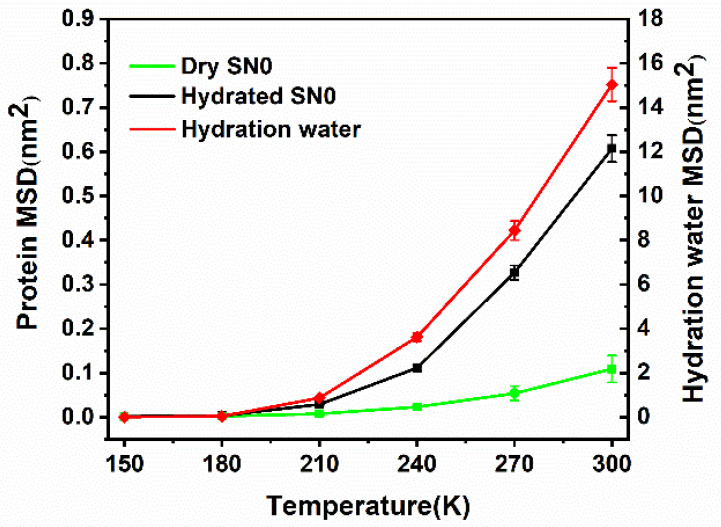
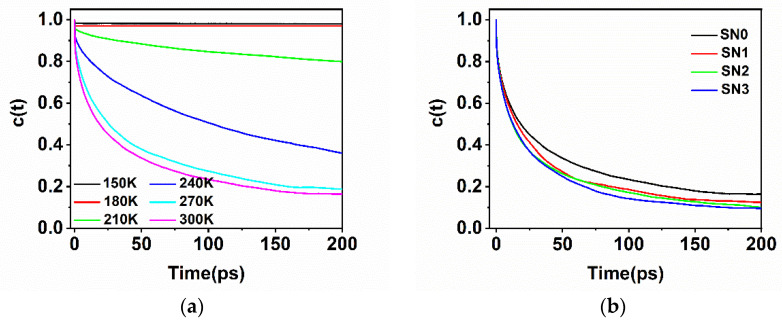
The dynamics of protein-water fluctuations are of biological significance. Molecular dynamics simulations were performed in order to explore the hydration dynamics of staphylococcal nuclease (SNase) at different temperatures and mutation levels. A dynamical transition in hydration water (at ~210 K) can trigger larger-amplitude fluctuations of protein. The protein-water hydrogen bonds lost about 40% in the total change from 150 K to 210 K, while the Mean Square Displacement increased by little. The protein was activated when the hydration water in local had a comparable trend in making hydrogen bonds with protein- and other waters. The mutations changed the local chemical properties and the hydration exhibited a biphasic distribution, with two time scales. Hydrogen bonding relaxation governed the local protein fluctuations on the picosecond time scale, with the fastest time (24.9 ps) at the hydrophobic site and slowest time (40.4 ps) in the charged environment. The protein dynamic was related to the water's translational diffusion via the relaxation of the protein-water's H-bonding. The structural and dynamical properties of protein-water at the molecular level are fundamental to the physiological and functional mechanisms of SNase.
蛋白质-水波动的动力学具有生物学意义。为了探究不同温度和突变水平下的枯草溶菌素核酸酶(SNase)的水合动力学,进行了分子动力学模拟。水合作用的动力学转变(在~210 K 时)可以引发蛋白质更大幅度的波动。在从 150 K 到 210 K 的总变化中,蛋白质-水氢键损失了约 40%,而均方根位移增加很少。当局部水合作用与蛋白质和其他水分子形成氢键的趋势相同时,蛋白质被激活。突变改变了局部化学性质,水合作用表现出两相分布,具有两个时间尺度。氢键松弛控制了皮秒时间尺度上的局部蛋白质波动,最快时间(24.9 ps)在疏水区,最慢时间(40.4 ps)在带电环境中。蛋白质动力学通过蛋白质-水氢键的松弛与水的平移扩散有关。蛋白质-水在分子水平上的结构和动力学性质是 SNase 生理和功能机制的基础。