Kang Moon Sung, Jang Hee Jeong, Lee Seok Hyun, Lee Ji Eun, Jo Hyo Jung, Jeong Seung Jo, Kim Bongju, Han Dong-Wook
Department of Cogno-Mechatronics Engineering, College of Nanoscience and Nanotechnology, Pusan National University, Busan 46241, Korea.
Department of Optics and Mechatronics Engineering, College of Nanoscience and Nanotechnology, Pusan National University, Busan 46241, Korea.
Materials (Basel). 2021 Sep 6;14(17):5104. doi: 10.3390/ma14175104.
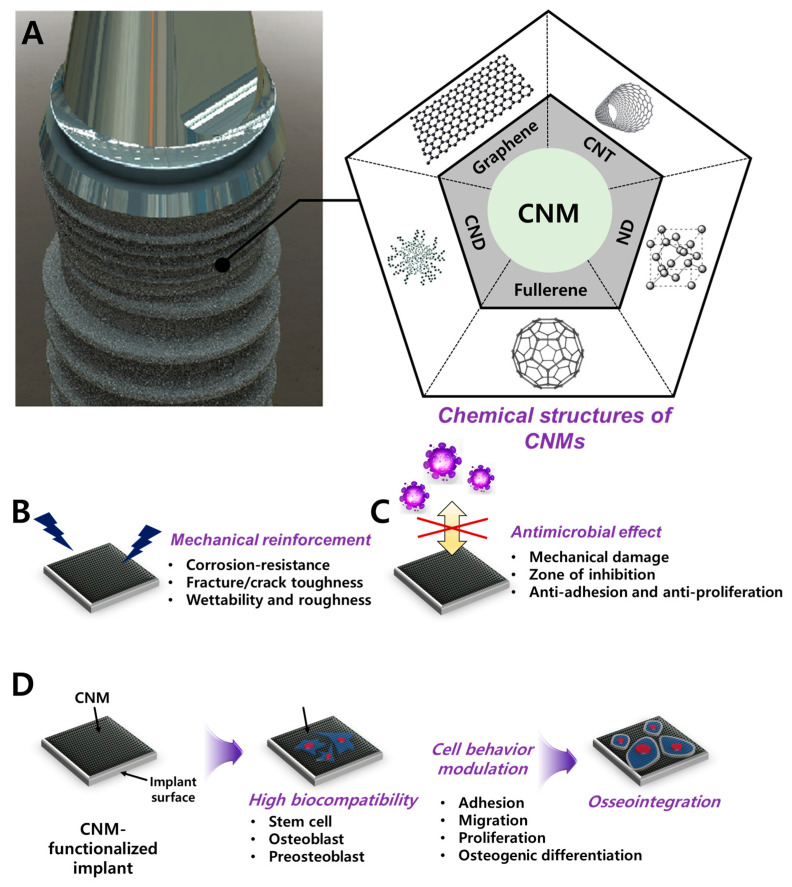
While conventional dental implants focus on mechanical properties, recent advances in functional carbon nanomaterials (CNMs) accelerated the facilitation of functionalities including osteoinduction, osteoconduction, and osseointegration. The surface functionalization with CNMs in dental implants has emerged as a novel strategy for reinforcement and as a bioactive cue due to their potential for mechanical reinforcing, osseointegration, and antimicrobial properties. Numerous developments in the fabrication and biological studies of CNMs have provided various opportunities to expand their application to dental regeneration and restoration. In this review, we discuss the advances in novel dental implants with CNMs in terms of tissue engineering, including material combination, coating strategies, and biofunctionalities. We present a brief overview of recent findings and progression in the research to show the promising aspect of CNMs for dental implant application. In conclusion, it is shown that further development of surface functionalization with CNMs may provide innovative results with clinical potential for improved osseointegration after implantation.
传统牙科植入物侧重于机械性能,而功能碳纳米材料(CNMs)的最新进展加速了包括骨诱导、骨传导和骨整合等功能的实现。由于碳纳米材料具有机械增强、骨整合和抗菌特性的潜力,牙科植入物中碳纳米材料的表面功能化已成为一种新型的增强策略和生物活性线索。碳纳米材料在制造和生物学研究方面的众多进展为将其应用扩展到牙齿再生和修复提供了各种机会。在本综述中,我们从组织工程的角度讨论了含碳纳米材料的新型牙科植入物的进展,包括材料组合、涂层策略和生物功能。我们简要概述了该研究的最新发现和进展,以展示碳纳米材料在牙科植入物应用方面的前景。总之,研究表明,碳纳米材料表面功能化的进一步发展可能会带来具有临床潜力的创新成果,以改善植入后的骨整合。