Yamamoto Akitaka, Wada Hideo, Ichikawa Yuhuko, Mizuno Hikaru, Tomida Masaki, Masuda Jun, Makino Katsutoshi, Kodama Shuji, Yoshida Masamichi, Fukui Shunsuke, Moritani Isao, Inoue Hidekazu, Shiraki Katsuya, Shimpo Hideto
Department of Emergency and Critical Care Center, Mie Prefectural General Medical Center, Yokkaichi 510-0885, Japan.
Department of General and Laboratory Medicine, Mie Prefectural General Medical Center, Yokkaichi 510-0885, Japan.
J Clin Med. 2021 Aug 24;10(17):3775. doi: 10.3390/jcm10173775.
Although many Japanese patients infected with coronavirus disease 2019 (COVID-19) only experience mild symptoms, in some cases a patient's condition deteriorates, resulting in a poor outcome. This study examines the behavior of biomarkers in patients with mild to severe COVID-19.
The disease severity of 152 COVID-19 patients was classified into mild, moderate I, moderate II, and severe, and the behavior of laboratory biomarkers was examined across these four disease stages.
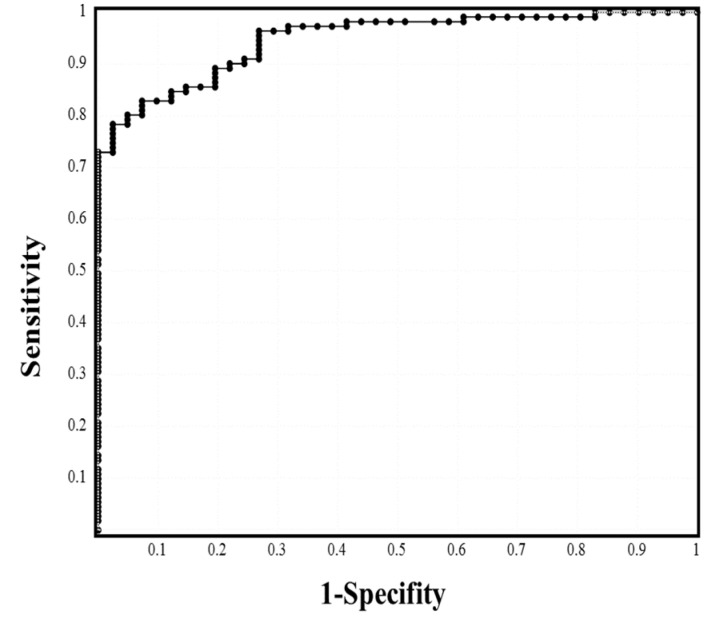
The median age and male/female ratio increased with severity. The mortality rate was 12.5% in both moderate II and severe stages. Underlying diseases, which were not observed in 45% of mild stage patients, increased with severity. An ROC analysis showed that C-reactive protein (CRP), ferritin, procalcitonin (PCT), hemoglobin (Hb) A1c, albumin, and lactate dehydrogenase (LDH) levels were significantly useful for the differential diagnosis of mild/moderate I stage and moderate II/severe stage. In the severe stage, Hb levels, coagulation time, total protein, and albumin were significantly different on the day of worsening from those observed on the day of admission. The frequency of hemostatic biomarker abnormalities was high in the severe disease stage.
The evaluation of severity is valuable, as the mortality rate was high in the moderate II and severe stages. The levels of CRP, ferritin, PCT, albumin, and LDH were useful markers of severity, and hemostatic abnormalities were frequently observed in patients in the severe disease stage.
尽管许多感染2019冠状病毒病(COVID-19)的日本患者仅出现轻微症状,但在某些情况下,患者病情会恶化,导致预后不良。本研究探讨了轻至重度COVID-19患者生物标志物的变化情况。
将152例COVID-19患者的疾病严重程度分为轻度、中度I、中度II和重度,并在这四个疾病阶段检测实验室生物标志物的变化情况。
中位年龄和男女比例随病情严重程度增加。中度II期和重度期的死亡率均为12.5%。基础疾病在45%的轻度期患者中未观察到,且随病情严重程度增加。ROC分析显示,C反应蛋白(CRP)、铁蛋白、降钙素原(PCT)、糖化血红蛋白(Hb)A1c、白蛋白和乳酸脱氢酶(LDH)水平对轻度/中度I期和中度II/重度期的鉴别诊断具有显著意义。在重度期,恶化当天的血红蛋白水平、凝血时间、总蛋白和白蛋白与入院当天相比有显著差异。严重疾病阶段止血生物标志物异常的发生率较高。
由于中度II期和重度期死亡率较高,评估疾病严重程度具有重要价值。CRP、铁蛋白、PCT、白蛋白和LDH水平是疾病严重程度的有用标志物,严重疾病阶段的患者经常出现止血异常。