Kaczmarek-Ryś Marta, Hryhorowicz Szymon Tytus, Lis Emilia, Banasiewicz Tomasz, Paszkowski Jacek, Borejsza-Wysocki Maciej, Walkowiak Jarosław, Cichy Wojciech, Krokowicz Piotr, Czkwianianc Elżbieta, Hnatyszyn Andrzej, Krela-Kaźmierczak Iwona, Dobrowolska Agnieszka, Słomski Ryszard, Pławski Andrzej
Institute of Human Genetics, Polish Academy of Sciences, 60-479 Poznan, Poland.
Department of General, Endocrinological Surgery and Gastroenterological Oncology, Poznan University of Medical Sciences, 60-355 Poznan, Poland.
J Clin Med. 2021 Aug 24;10(17):3777. doi: 10.3390/jcm10173777.
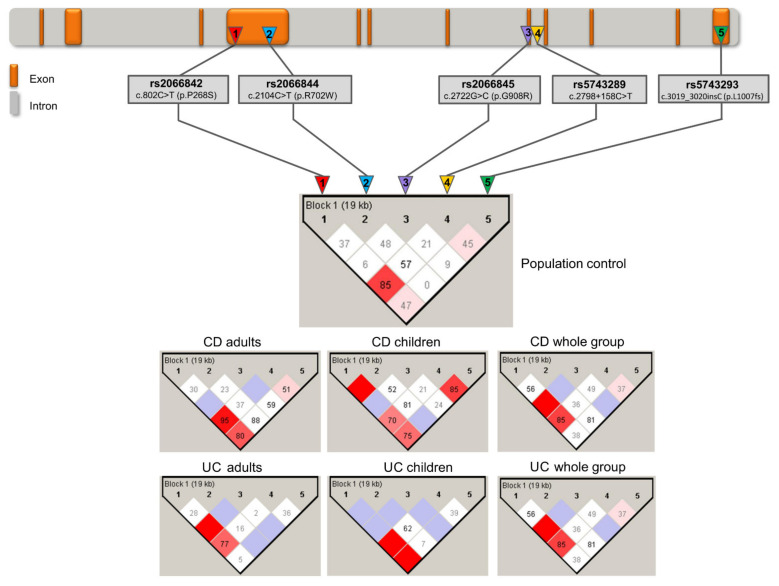
The genetic background and the determinants influencing the disease form, course, and onset of inflammatory bowel disease (IBD) remain unresolved. We aimed to determine the gene haplotypes and their relationship with IBD occurrence, clinical presentation, and onset, analyzing a cohort of 578 patients with IBD, including children, and 888 controls. Imaging or endoscopy with a histopathological confirmation was used to diagnose IBD. Genotyping was performed to assess the differences in genotypic and allelic frequencies. Linkage disequilibrium was analyzed, and associations between haplotypes and clinical data were evaluated. We emphasized the prevalence of risk alleles in all analyzed loci in patients with Crohn disease (CD). Interestingly, c.2722G>C and c.3019_3020insC alleles were also overrepresented in ulcerative colitis (UC). T-C-G-C-insC, T-C-G-T-insC, and T-T-G-T-wt haplotypes were correlated with the late-onset form of CD (OR = 23.01, 5.09, and 17.71, respectively), while T-T-G-T-wt and C-C-G-T-wt were prevalent only in CD children (OR = 29.36, and 12.93, respectively; -value = 0.001). In conclusion, the presence of c.3019_3020insC along with c.802C>T occurred as the most fundamental contributing diplotype in late-onset CD form, while in CD children, the mutual allele in all predisposing haplotypes was the c.2798 + 158T. Identifying the unique, high-impact haplotypes supports further studies of the gene, including haplotypic backgrounds.
炎症性肠病(IBD)的遗传背景以及影响其疾病形式、病程和发病的决定因素仍未明确。我们旨在通过分析578例IBD患者(包括儿童)和888名对照,确定基因单倍型及其与IBD发生、临床表现和发病的关系。采用影像学或内镜检查并经组织病理学证实来诊断IBD。进行基因分型以评估基因型和等位基因频率的差异。分析连锁不平衡,并评估单倍型与临床数据之间的关联。我们着重研究了克罗恩病(CD)患者所有分析位点中风险等位基因的患病率。有趣的是,c.2722G>C和c.3019_3020insC等位基因在溃疡性结肠炎(UC)中也过度表达。T-C-G-C-insC、T-C-G-T-insC和T-T-G-T-wt单倍型与CD的晚发型相关(OR分别为23.01、5.09和17.71),而T-T-G-T-wt和C-C-G-T-wt仅在CD儿童中普遍存在(OR分别为29.36和12.93;P值=0.001)。总之,c.3019_3020insC与c.802C>T同时存在是晚发型CD形式中最基本的致病双倍型,而在CD儿童中,所有易感单倍型中的共同等位基因为c.2798 + 158T。识别独特的、具有高影响力的单倍型有助于对该基因进行进一步研究,包括单倍型背景研究。