Pietropaolo Amelia, Geraghty Robert M, Veeratterapillay Rajan, Rogers Alistair, Kallidonis Panagiotis, Villa Luca, Boeri Luca, Montanari Emanuele, Atis Gokhan, Emiliani Esteban, Sener Tarik Emre, Al Jaafari Feras, Fitzpatrick John, Shaw Matthew, Harding Chris, Somani Bhaskar K
Department of Urology, University Hospital Southampton, Southampton SO16 6YD, UK.
Department of Urology, Freeman Hospital, Freeman Road, Newcastle-upon-Tyne NE1 7DN, UK.
J Clin Med. 2021 Aug 29;10(17):3888. doi: 10.3390/jcm10173888.
With the rise in the use of ureteroscopy and laser stone lithotripsy (URSL), a proportionate increase in the risk of post-procedural urosepsis has also been observed. The aims of our paper were to analyse the predictors for severe urosepsis using a machine learning model (ML) in patients that needed intensive care unit (ICU) admission and to make comparisons with a matched cohort.
A retrospective study was conducted across nine high-volume endourology European centres for all patients who underwent URSL and subsequently needed ICU admission for urosepsis (Group A). This was matched by patients with URSL without urosepsis (Group B). Statistical analysis was performed with 'R statistical software' using the 'randomforests' package. The data were segregated at random into a 70% training set and a 30% test set using the 'sample' command. A random forests ML model was then built with = 300 trees, with the test set used for internal validation. Diagnostic accuracy statistics were generated using the 'caret' package.
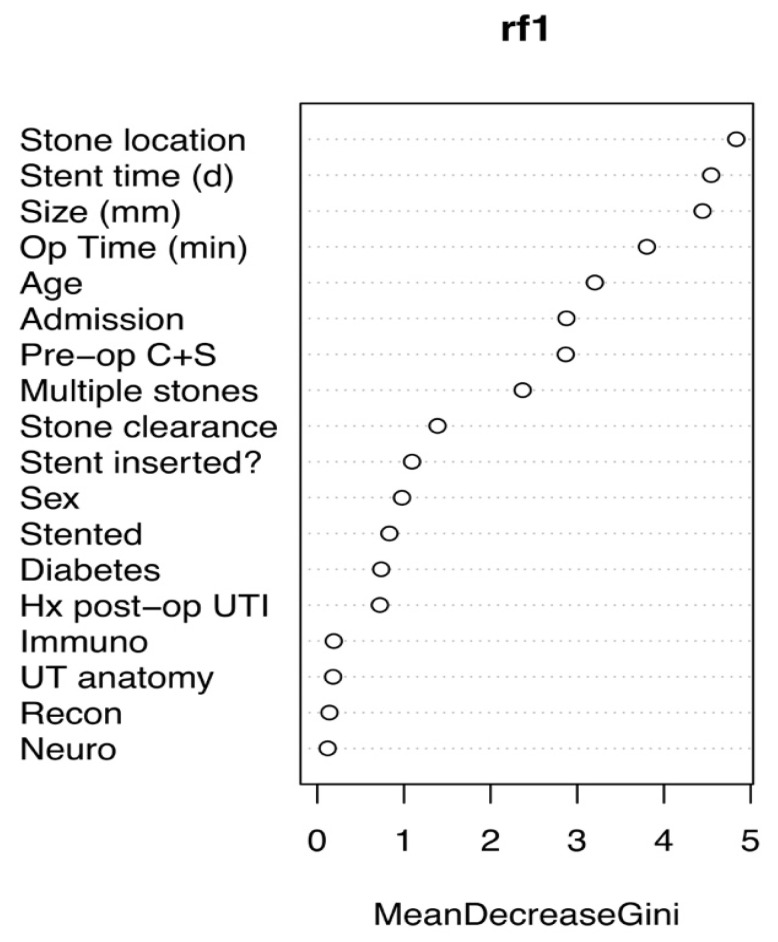
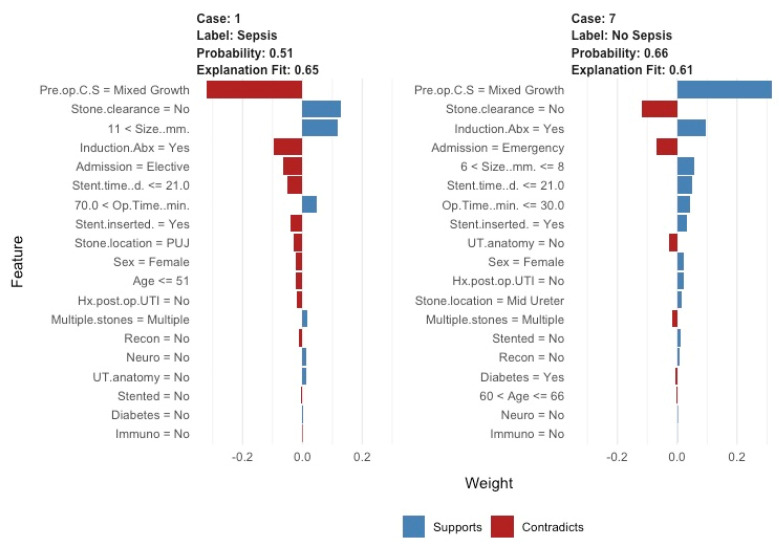
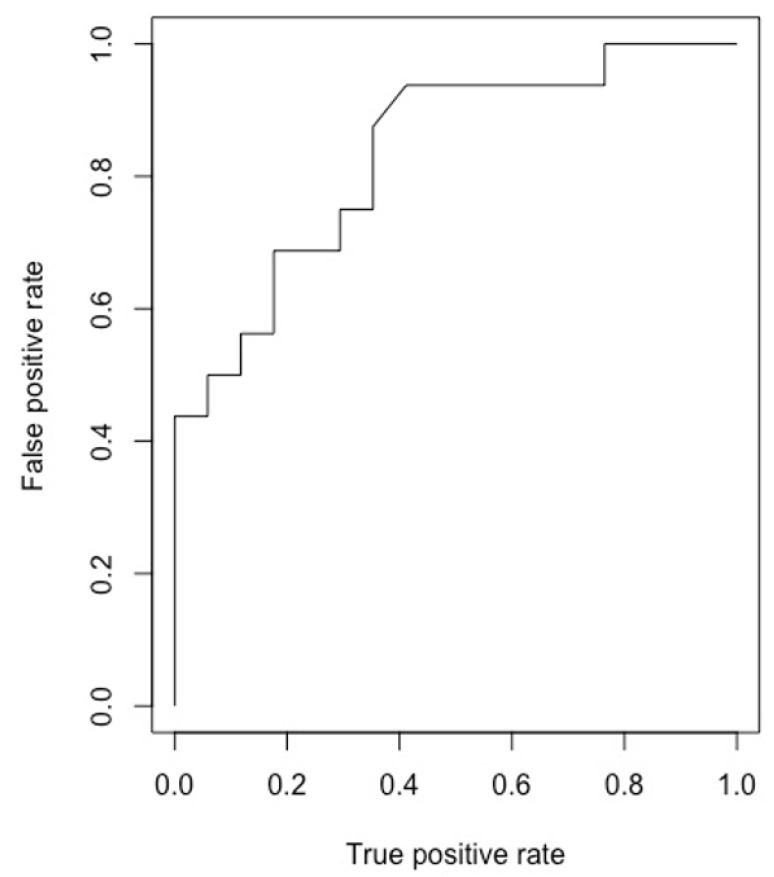
A total of 114 patients were included (57 in each group) with a mean age of 60 ± 16 years and a male:female ratio of 1:1.19. The ML model correctly predicted risk of sepsis in 14/17 (82%) cases (Group A) and predicted those without urosepsis for 12/15 (80%) controls (Group B), whilst overall it also discriminated between the two groups predicting both those with and without sepsis. Our model accuracy was 81.3% (95%, CI: 63.7-92.8%), sensitivity = 0.80, specificity = 0.82 and area under the curve = 0.89. Predictive values most commonly accounting for nodal points in the trees were a large proximal stone location, long stent time, large stone size and long operative time.
Urosepsis after endourological procedures remains one of the main reasons for ICU admission. Risk factors for urosepsis are reasonably accurately predicted by our innovative ML model. Focusing on these risk factors can allow one to create predictive strategies to minimise post-operative morbidity.
随着输尿管镜检查和激光碎石术(URSL)使用的增加,术后尿脓毒症的风险也相应增加。我们论文的目的是使用机器学习模型(ML)分析需要入住重症监护病房(ICU)的患者发生严重尿脓毒症的预测因素,并与匹配队列进行比较。
对欧洲九个高容量腔内泌尿外科中心的所有接受URSL且随后因尿脓毒症需要入住ICU的患者进行了一项回顾性研究(A组)。将其与接受URSL但无尿脓毒症的患者进行匹配(B组)。使用“R统计软件”中的“randomforests”包进行统计分析。使用“sample”命令将数据随机分为70%的训练集和30%的测试集。然后构建一个具有300棵树的随机森林ML模型,测试集用于内部验证。使用“caret”包生成诊断准确性统计数据。
共纳入114例患者(每组57例),平均年龄60±16岁,男女比例为1:1.19。ML模型在14/17(82%)的病例(A组)中正确预测了脓毒症风险,在12/15(80%)的对照(B组)中预测了无尿脓毒症的患者,总体上也区分了两组,同时预测了有和无脓毒症的患者。我们的模型准确率为81.3%(95%,CI:63.7 - 92.8%),敏感性 = 0.80,特异性 = 0.82,曲线下面积 = 0.89。在树中最常作为节点的预测值是近端结石位置大、支架留置时间长、结石尺寸大以及手术时间长。
腔内泌尿外科手术后的尿脓毒症仍然是入住ICU的主要原因之一。我们创新的ML模型能够较为准确地预测尿脓毒症的风险因素。关注这些风险因素可以制定预测策略,以尽量减少术后发病率。