Ambroszkiewicz Jadwiga, Gajewska Joanna, Mazur Joanna, Klemarczyk Witold, Rowicka Grażyna, Ołtarzewski Mariusz, Strucińska Małgorzata, Chełchowska Magdalena
Department of Screening Tests and Metabolic Diagnostics, Institute of Mother and Child, 01-211 Warsaw, Poland.
Department of Humanization in Medicine and Sexology, Collegium Medicum, University of Zielona Gora, 65-726 Zielona Gora, Poland.
J Clin Med. 2021 Sep 3;10(17):3995. doi: 10.3390/jcm10173995.
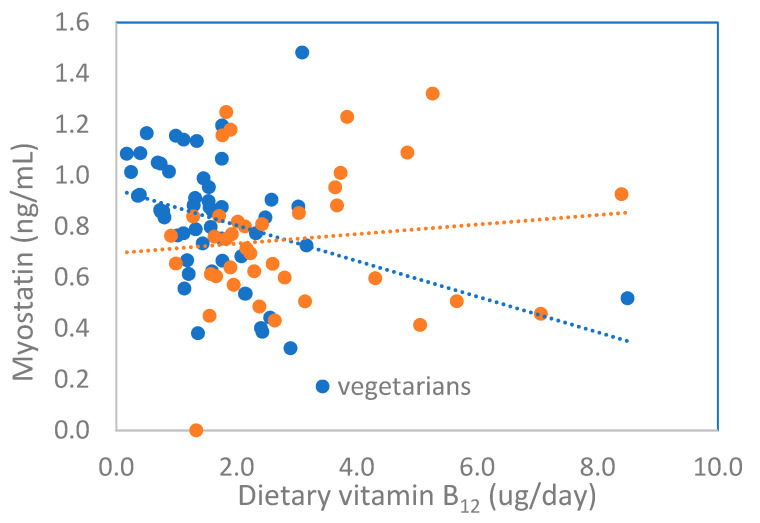
Myokines are cytokines secreted by muscle and exert autocrine, paracrine, or endocrine effects. Myokines mediate communication between muscle and other organs, including adipose tissue. The aim of the study was to assess serum myokines and their relationships with adipokines and anthropometric and nutritional parameters in children following vegetarian and omnivorous diets. One hundred and five prepubertal children were examined. Among them there were 55 children on a vegetarian diet and 50 children on an omnivorous diet. Concentrations of myokines (myostatin, irisin) and adipokines (leptin, adiponectin, omentin, visfatin) in serum were determined by enzyme-linked immunosorbent assay (ELISA). We observed comparable median values of serum myokines and adipokines (except of leptin concentration) in both of the studied groups of children. We also found several correlations between myokine and adipokine levels and certain nutritional parameters. Serum myostatin was positively correlated with omentin levels in vegetarians and omnivores ( = 0.002). Serum irisin was positively associated with omentin ( = 0.045) levels in omnivores and inversely with visfatin concentration ( = 0.037) in vegetarians. Myostatin concentration was negatively correlated with the percentage of energy from protein ( = 0.014), calcium ( = 0.046), and vitamin A ( = 0.028) intakes in vegetarians and with dietary vitamin C ( = 0.041) and vitamin E ( = 0.021) intakes in omnivores. In multivariate regression analyses, positive correlations of serum myostatin with omentin levels were revealed in both study groups (β = 0.437, < 0.001 for vegetarians; and β = 0.359, = 0.001 for omnivores). Consuming a lacto-ovo-vegetarian diet did not influence serum levels of myokines (myostatin, irisin) and adipokines such as adiponectin, visfatin, and omentin in prepubertal children. However, leptin levels were significantly lower in vegetarians compared with omnivores. The observed significant positive correlations between myostatin and omentin concentrations might suggest tissue cross-talk between skeletal muscle and fat tissue. Further studies, carried out in a larger group of children following different dietary patterns, could be important to fully understand the relations between muscle, adipose tissues, and nutrition.
肌动蛋白是由肌肉分泌的细胞因子,发挥自分泌、旁分泌或内分泌作用。肌动蛋白介导肌肉与包括脂肪组织在内的其他器官之间的通讯。本研究的目的是评估素食和杂食儿童的血清肌动蛋白及其与脂肪因子、人体测量和营养参数之间的关系。对105名青春期前儿童进行了检查。其中55名儿童为素食饮食,50名儿童为杂食饮食。采用酶联免疫吸附测定(ELISA)法测定血清中肌动蛋白(肌肉生长抑制素、鸢尾素)和脂肪因子(瘦素、脂联素、网膜素、内脏脂肪素)的浓度。我们观察到两组受试儿童血清肌动蛋白和脂肪因子的中位数水平相当(瘦素浓度除外)。我们还发现肌动蛋白和脂肪因子水平与某些营养参数之间存在若干相关性。素食者和杂食者血清中的肌肉生长抑制素与网膜素水平呈正相关(P = 0.002)。杂食者血清鸢尾素与网膜素水平呈正相关(P = 0.045),而素食者血清鸢尾素与内脏脂肪素浓度呈负相关(P = 0.037)。素食者的肌肉生长抑制素浓度与蛋白质(P = 0.014)、钙(P = 0.046)和维生素A(P = 0.028)的能量摄入百分比呈负相关,杂食者的肌肉生长抑制素浓度与膳食维生素C(P = 0.041)和维生素E(P = 0.021)的摄入量呈负相关。在多变量回归分析中,两个研究组均显示血清肌肉生长抑制素与网膜素水平呈正相关(素食者β = 0.437,P < 0.001;杂食者β = 0.359,P = 0.001)。食用乳蛋素食对青春期前儿童血清肌动蛋白(肌肉生长抑制素、鸢尾素)和脂联素、内脏脂肪素、网膜素等脂肪因子的水平没有影响。然而,素食者的瘦素水平明显低于杂食者。观察到的肌肉生长抑制素与网膜素浓度之间显著的正相关可能表明骨骼肌与脂肪组织之间存在组织间相互作用。在更多遵循不同饮食模式的儿童群体中开展进一步研究,对于全面了解肌肉、脂肪组织和营养之间的关系可能具有重要意义。