Lee Sang-Jeong, Yoo Ji-Yong, Woo Sang-Yoon, Yang Hoon Joo, Kim Jo-Eun, Huh Kyung-Hoe, Lee Sam-Sun, Heo Min-Suk, Hwang Soon Jung, Yi Won-Jin
Dental Research Institute, Seoul National University, Seoul 03080, Korea.
Department of Biomedical Radiation Sciences, Graduate School of Convergence Science and Technology, Seoul National University, Seoul 08826, Korea.
J Clin Med. 2021 Sep 3;10(17):4000. doi: 10.3390/jcm10174000.
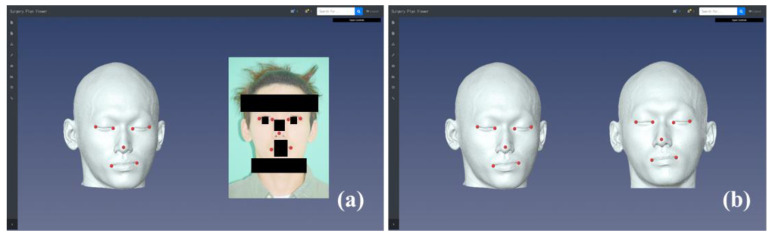
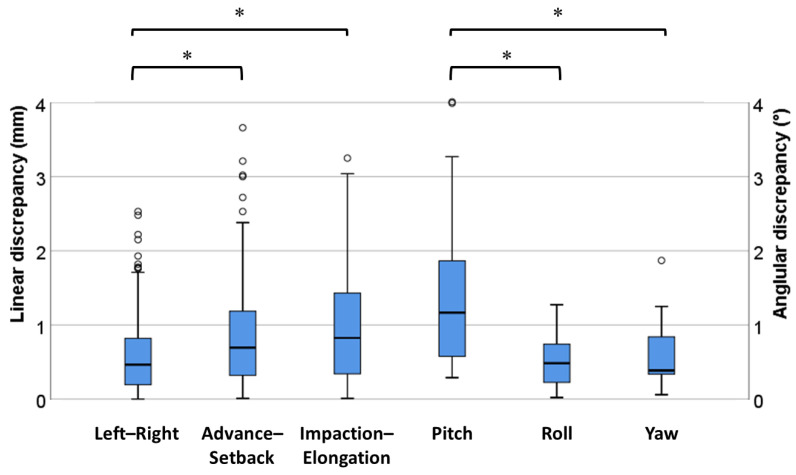
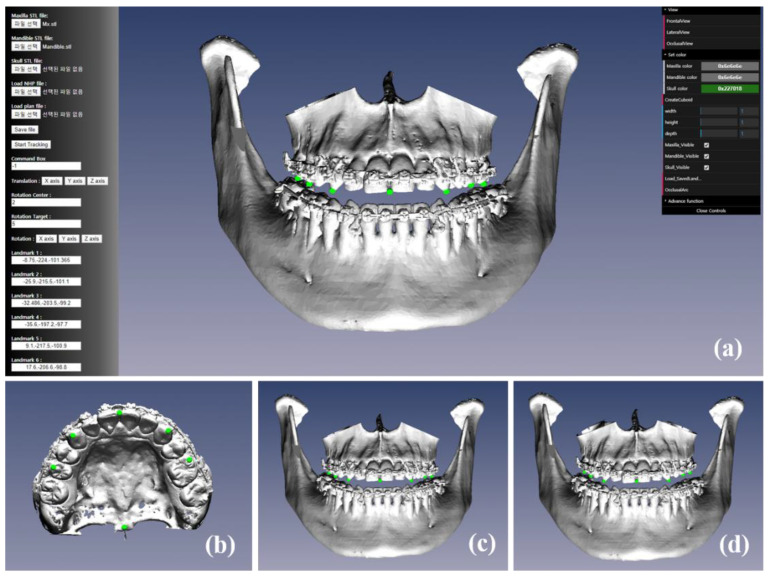
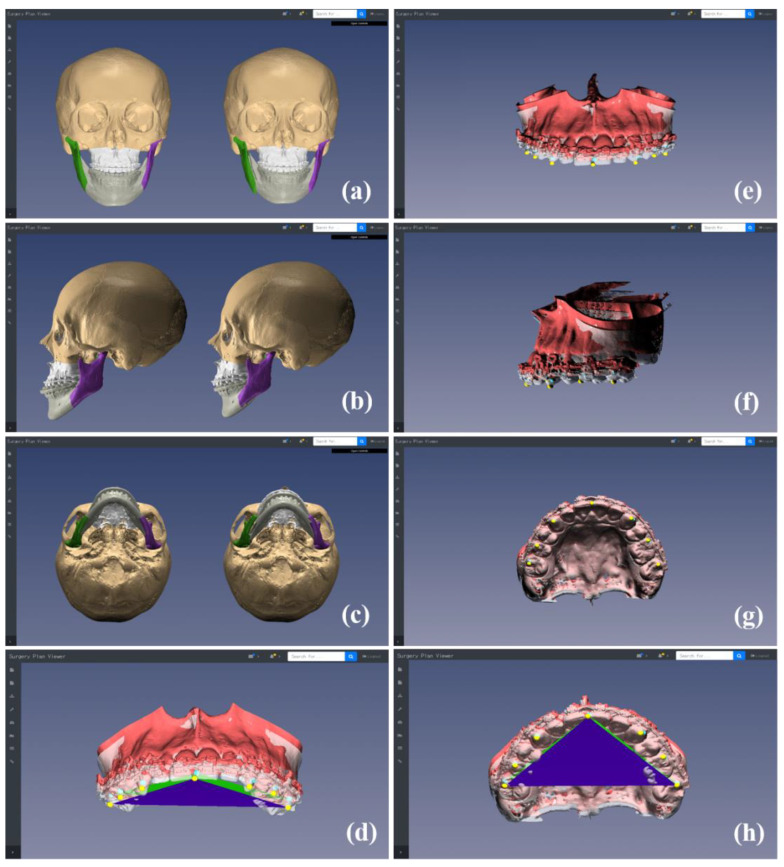
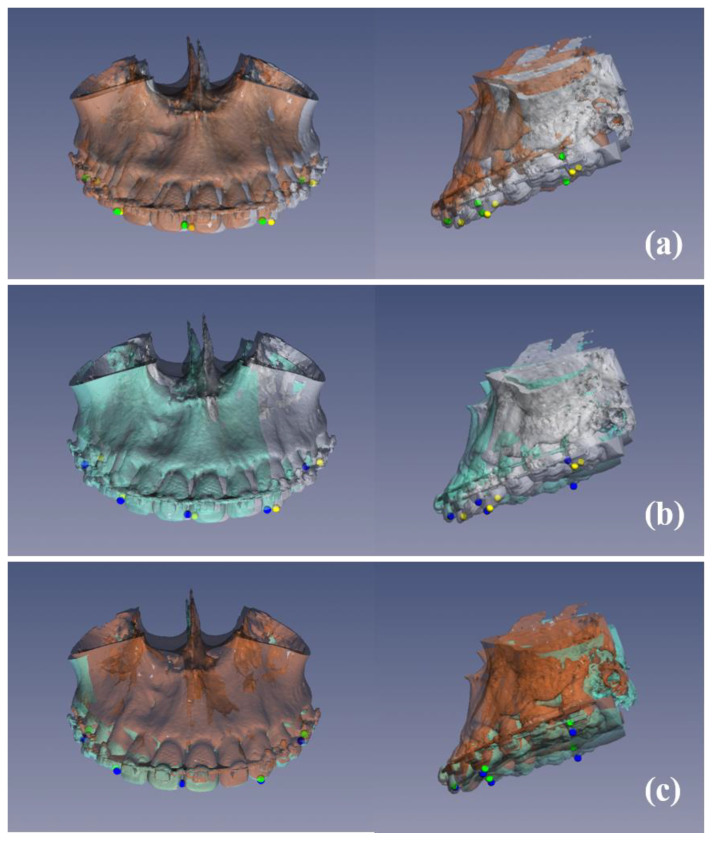
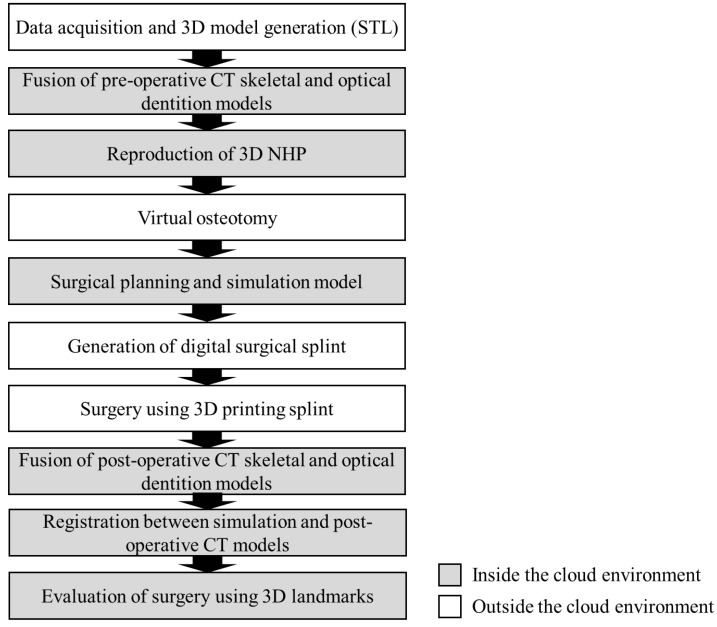
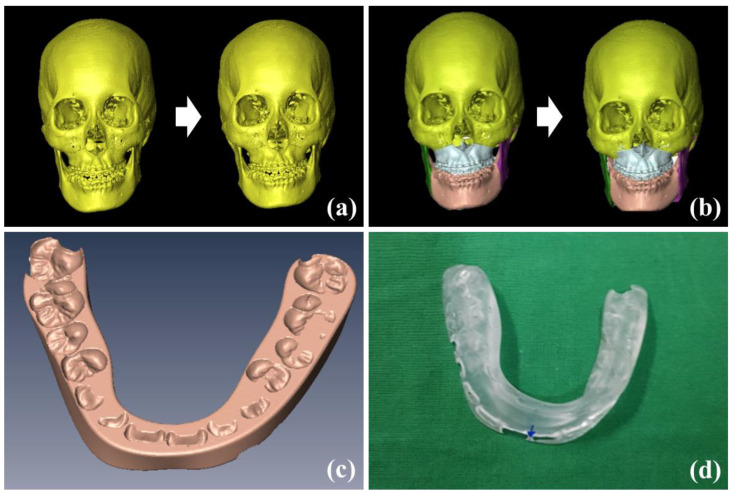
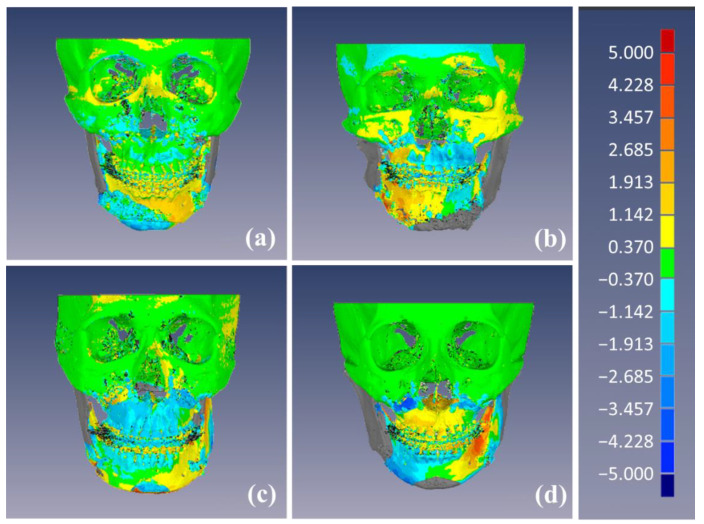
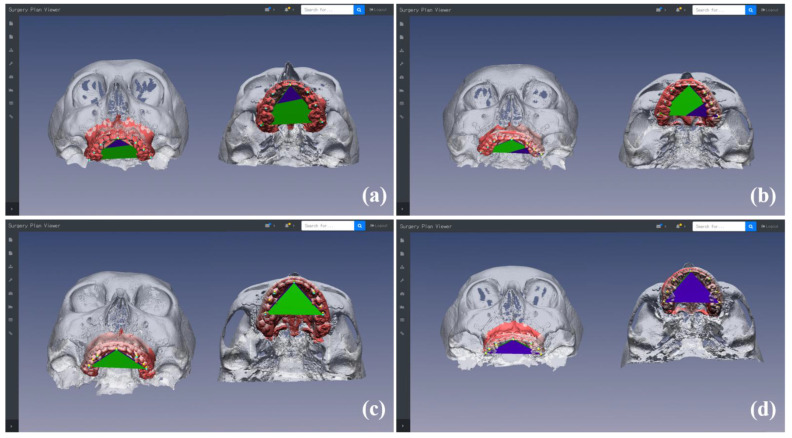
The purpose of this study was to develop a complete digital workflow for planning, simulation, and evaluation for orthognathic surgery based on 3D digital natural head position reproduction, a cloud-based collaboration platform, and 3D landmark-based evaluation. We included 24 patients who underwent bimaxillary orthognathic surgery. Surgeons and engineers could share the massive image data immediately and conveniently and collaborate closely in surgical planning and simulation using a cloud-based platform. The digital surgical splint could be optimized for a specific patient before or after the physical fabrication of 3D printing splints through close collaboration. The surgical accuracy was evaluated comprehensively via the translational (linear) and rotational (angular) discrepancies between identical 3D landmarks on the simulation and postoperative computed tomography (CT) models. The means of the absolute linear discrepancy at eight tooth landmarks were 0.61 ± 0.55, 0.86 ± 0.68, and 1.00 ± 0.79 mm in left-right, advance-setback, and impaction-elongation directions, respectively, and 1.67 mm in the root mean square direction. The linear discrepancy in the left-right direction was significantly different from the other two directions as shown by analysis of variance (ANOVA, < 0.05). The means of the absolute angular discrepancies were 1.43 ± 1.06°, 0.50 ± 0.31°, and 0.58 ± 0.41° in the pitch, roll, and yaw orientations, respectively. The angular discrepancy in the pitch orientation was significantly different from the other two orientations (ANOVA, < 0.05). The complete digital workflow that we developed for orthognathic patients provides efficient and streamlined procedures for orthognathic surgery and shows high surgical accuracy with efficient image data sharing and close collaboration.
本研究的目的是基于三维数字自然头位重现、基于云的协作平台和基于三维标志点的评估,开发一种用于正颌外科手术规划、模拟和评估的完整数字工作流程。我们纳入了24例行双颌正颌手术的患者。外科医生和工程师可以通过基于云的平台即时、便捷地共享海量图像数据,并在手术规划和模拟中密切协作。通过紧密合作,在3D打印夹板实体制作之前或之后,可以针对特定患者优化数字手术夹板。通过模拟模型和术后计算机断层扫描(CT)模型上相同三维标志点之间的平移(线性)和旋转(角度)差异,全面评估手术准确性。在左右、前后和垂直向伸长方向上,八个牙齿标志点的绝对线性差异均值分别为0.61±0.55、0.86±0.68和1.00±0.79mm,均方根方向为1.67mm。方差分析(ANOVA,<0.05)显示,左右方向的线性差异与其他两个方向显著不同。在俯仰、横滚和偏航方向上,绝对角度差异均值分别为1.43±1.06°、0.50±0.31°和0.58±0.41°。俯仰方向的角度差异与其他两个方向显著不同(ANOVA,<0.05)。我们为正颌患者开发的完整数字工作流程为正颌外科手术提供了高效、简化的程序,并通过高效的图像数据共享和密切协作显示出较高的手术准确性。