Department of AI & Informatics, Graduate School, Sangmyung University, Seoul 03016, Korea.
R&D Team, Zena Inc., Seoul 04782, Korea.
Sensors (Basel). 2021 Sep 2;21(17):5910. doi: 10.3390/s21175910.
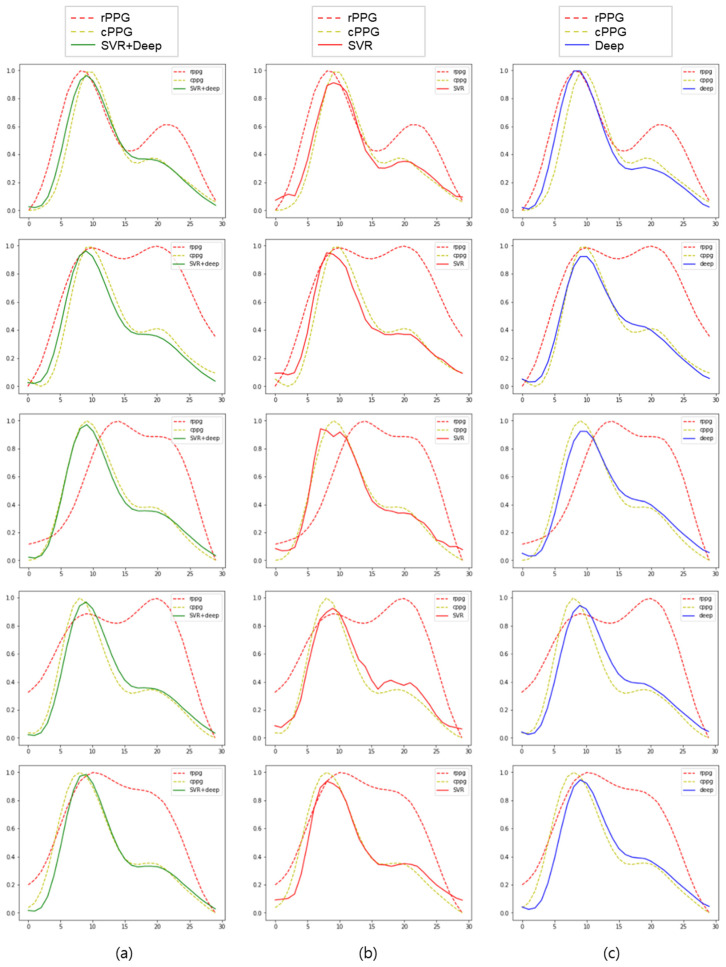
Photoplethysmography (PPG) is an optical measurement technique that detects changes in blood volume in the microvascular layer caused by the pressure generated by the heartbeat. To solve the inconvenience of contact PPG measurement, a remote PPG technology that can measure PPG in a non-contact way using a camera was developed. However, the remote PPG signal has a smaller pulsation component than the contact PPG signal, and its shape is blurred, so only heart rate information can be obtained. In this study, we intend to restore the remote PPG to the level of the contact PPG, to not only measure heart rate, but to also obtain morphological information. Three models were used for training: support vector regression (SVR), a simple three-layer deep learning model, and SVR + deep learning model. Cosine similarity and Pearson correlation coefficients were used to evaluate the similarity of signals before and after restoration. The cosine similarity before restoration was 0.921, and after restoration, the SVR, deep learning model, and SVR + deep learning model were 0.975, 0.975, and 0.977, respectively. The Pearson correlation coefficient was 0.778 before restoration and 0.936, 0.933, and 0.939, respectively, after restoration.
光体积描记法(PPG)是一种光学测量技术,用于检测由于心跳产生的压力引起的微血管层中血液体积的变化。为了解决接触式 PPG 测量的不便,开发了一种远程 PPG 技术,该技术可以使用相机以非接触的方式测量 PPG。然而,远程 PPG 信号的脉动分量比接触式 PPG 信号小,其形状模糊,因此只能获得心率信息。在这项研究中,我们旨在将远程 PPG 恢复到接触式 PPG 的水平,不仅可以测量心率,还可以获得形态信息。使用了三个模型进行训练:支持向量回归(SVR)、简单的三层深度学习模型和 SVR+深度学习模型。使用余弦相似度和 Pearson 相关系数来评估信号在恢复前后的相似性。恢复前的余弦相似度为 0.921,恢复后 SVR、深度学习模型和 SVR+深度学习模型的余弦相似度分别为 0.975、0.975 和 0.977。恢复前的 Pearson 相关系数为 0.778,恢复后分别为 0.936、0.933 和 0.939。