Rickard Brittany P, Conrad Christina, Sorrin Aaron J, Ruhi Mustafa Kemal, Reader Jocelyn C, Huang Stephanie A, Franco Walfre, Scarcelli Giuliano, Polacheck William J, Roque Dana M, Del Carmen Marcela G, Huang Huang-Chiao, Demirci Utkan, Rizvi Imran
Curriculum in Toxicology & Environmental Medicine, School of Medicine, University of North Carolina at Chapel Hill, Chapel Hill, NC 27599, USA.
Joint Department of Biomedical Engineering, University of North Carolina at Chapel Hill, Chapel Hill, NC, and North Carolina State University, Raleigh, NC 27599, USA.
Cancers (Basel). 2021 Aug 26;13(17):4318. doi: 10.3390/cancers13174318.
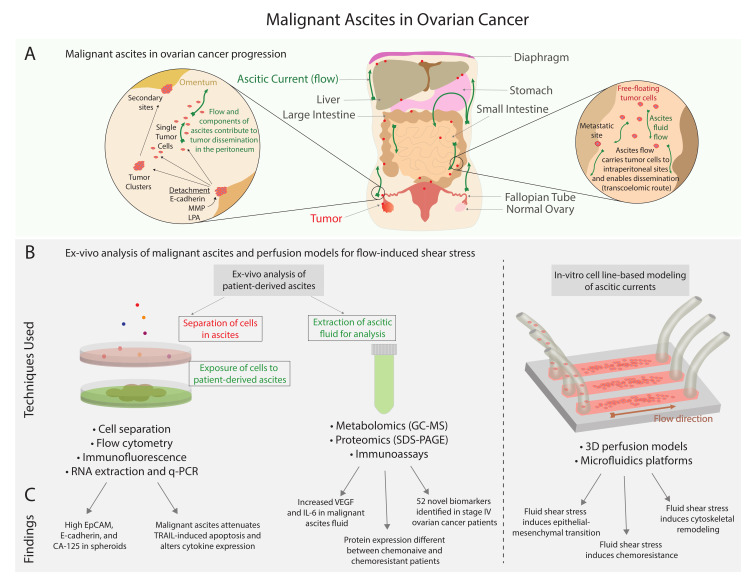
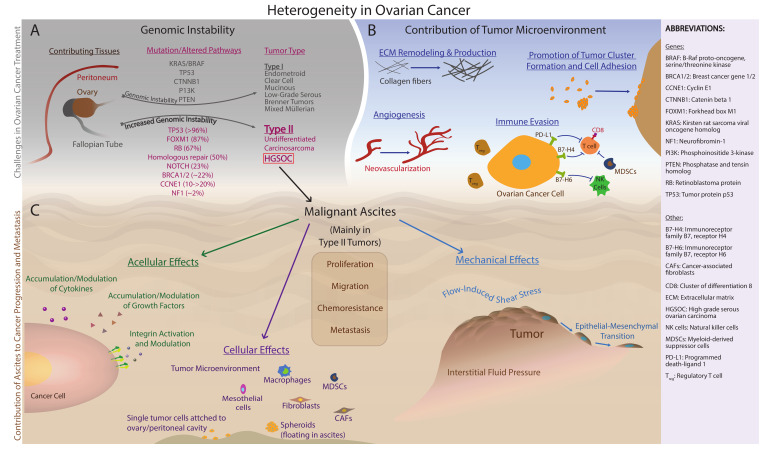
Ascites refers to the abnormal accumulation of fluid in the peritoneum resulting from an underlying pathology, such as metastatic cancer. Among all cancers, advanced-stage epithelial ovarian cancer is most frequently associated with the production of malignant ascites and is the leading cause of death from gynecologic malignancies. Despite decades of evidence showing that the accumulation of peritoneal fluid portends the poorest outcomes for cancer patients, the role of malignant ascites in promoting metastasis and therapy resistance remains poorly understood. This review summarizes the current understanding of malignant ascites, with a focus on ovarian cancer. The first section provides an overview of heterogeneity in ovarian cancer and the pathophysiology of malignant ascites. Next, analytical methods used to characterize the cellular and acellular components of malignant ascites, as well the role of these components in modulating cell biology, are discussed. The review then provides a perspective on the pressures and forces that tumors are subjected to in the presence of malignant ascites and the impact of physical stress on therapy resistance. Treatment options for malignant ascites, including surgical, pharmacological and photochemical interventions are then discussed to highlight challenges and opportunities at the interface of drug discovery, device development and physical sciences in oncology.
腹水是指由于潜在病理状况(如转移性癌症)导致腹腔内液体异常积聚。在所有癌症中,晚期上皮性卵巢癌最常与恶性腹水的产生相关,并且是妇科恶性肿瘤死亡的主要原因。尽管数十年来的证据表明腹腔积液预示着癌症患者最差的预后,但恶性腹水在促进转移和治疗抵抗中的作用仍知之甚少。本综述总结了目前对恶性腹水的认识,重点是卵巢癌。第一部分概述了卵巢癌的异质性和恶性腹水的病理生理学。接下来,讨论了用于表征恶性腹水细胞和无细胞成分的分析方法,以及这些成分在调节细胞生物学中的作用。然后,该综述阐述了在存在恶性腹水的情况下肿瘤所承受的压力和作用力,以及物理应激对治疗抵抗的影响。随后讨论了恶性腹水的治疗选择,包括手术、药物和光化学干预,以突出肿瘤学中药物发现、设备开发和物理科学交叉领域的挑战与机遇。