Fouquet Guillemette, Wartski Myriam, Dechmi Amina, Willems Lise, Deau-Fischer Bénédicte, Franchi Patricia, Descroocq Justine, Deschamps Paul, Blanc-Autran Estelle, Clerc Jérôme, Bouscary Didier, Barreau Sylvain, Chapuis Nicolas, Vignon Marguerite, Cottereau Anne-Ségolène
Assistance Publique-Hôpitaux de Paris Centre, Université de Paris, Service d'Hématologie Clinique, Hôpital Cochin, 75014 Paris, France.
Assistance Publique-Hôpitaux de Paris Centre, Université de Paris, Service de Médecine Nucléaire, Hôpital Cochin, 75014 Paris, France.
Cancers (Basel). 2021 Aug 27;13(17):4323. doi: 10.3390/cancers13174323.
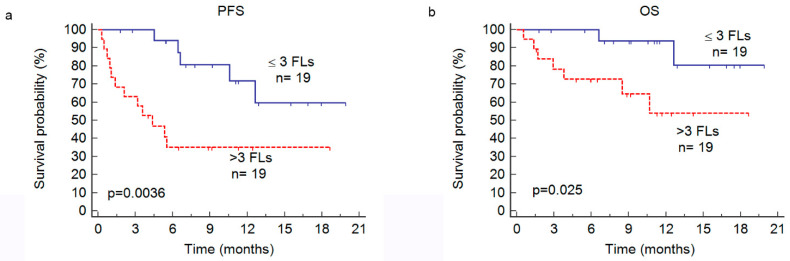
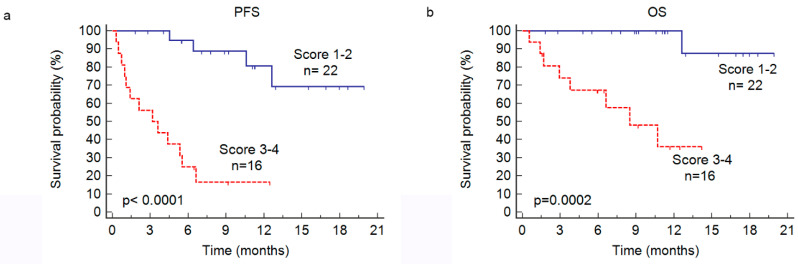
Although anti-CD38 monoclonal antibodies have improved the prognosis of relapsed/refractory multiple myeloma (RRMM), some patients still experience early relapses with poor outcomes. This present study evaluated the predictive value of FDG PET/CT parameters for RRMM prior to initiating anti-CD38 treatment. We included 38 consecutive RRMM patients who underwent a PET/CT scan treated at our institution at relapse. The median PFS was 12.5 months and the median OS was not reached. 42% of the patients had an initial ISS score of 1, 37% of 2, and 21% of 3. The presence of >3 focal lesions (FLs, = 19) and the ISS score were associated with inferior PFS ( = 0.0036 and = 0.0026) and OS ( = 0.025 and = 0.0098). Patients with >3 FLs had a higher initial ISS score ( = 0.028). In multivariable analysis, the ISS score and >3 FLs were independent prognostic factors for PFS ( = 0.010 and = 0.025 respectively), and combined they individualized a high-risk group with a median PFS and OS of 3.1 months and 8.5 months respectively vs. not reached for the other patients. The presence of >3 FLs on PET was predictive of survival outcomes in patients with RRMM treated using CD38 targeted therapy. Combined with the initial ISS, an ultra-high-risk RRMM population can thus be identified.
尽管抗CD38单克隆抗体改善了复发/难治性多发性骨髓瘤(RRMM)的预后,但仍有一些患者出现早期复发且预后较差。本研究评估了氟代脱氧葡萄糖正电子发射断层扫描/计算机断层扫描(FDG PET/CT)参数在启动抗CD38治疗前对RRMM的预测价值。我们纳入了38例在我院复发时接受PET/CT扫描的连续RRMM患者。中位无进展生存期(PFS)为12.5个月,中位总生存期(OS)未达到。42%的患者初始国际分期系统(ISS)评分为1期,37%为2期,21%为3期。>3个局灶性病变(FLs,n = 19)的存在和ISS评分与较差的PFS(P = 0.0036和P = 0.0026)及OS(P = 0.025和P = 0.0098)相关。有>3个FLs的患者初始ISS评分更高(P = 0.028)。在多变量分析中,ISS评分和>3个FLs是PFS的独立预后因素(分别为P = 0.010和P = 0.025),两者结合可将高危组个体化,该组中位PFS和OS分别为3.1个月和8.个月,而其他患者未达到。PET上>3个FLs的存在可预测接受CD38靶向治疗的RRMM患者的生存结局。结合初始ISS,因此可以识别出超高危RRMM人群。