Seifert Philipp, Schenke Simone, Zimny Michael, Stahl Alexander, Grunert Michael, Klemenz Burkhard, Freesmeyer Martin, Kreissl Michael C, Herrmann Ken, Görges Rainer
Clinic of Nuclear Medicine, Jena University Hospital, 07749 Jena, Germany.
Division of Nuclear Medicine, Department of Radiology and Nuclear Medicine, Magdeburg University Hospital, 39120 Magdeburg, Germany.
Cancers (Basel). 2021 Sep 4;13(17):4467. doi: 10.3390/cancers13174467.
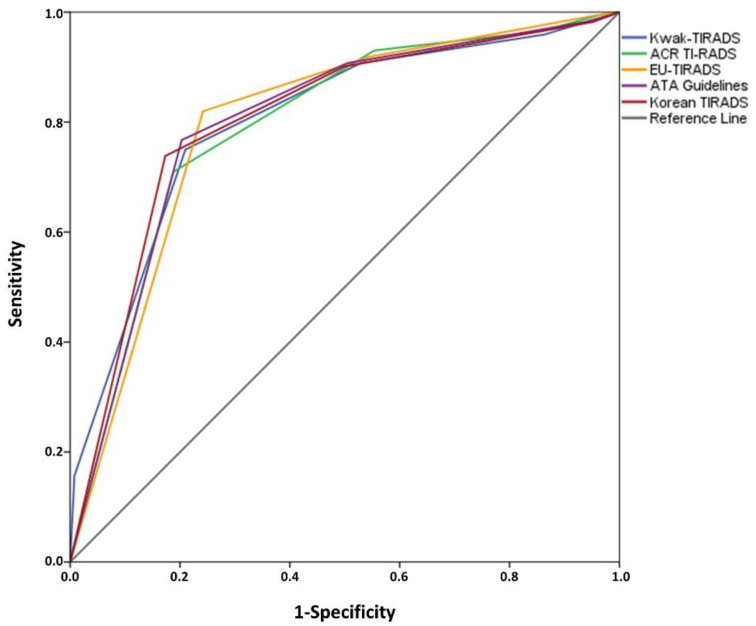
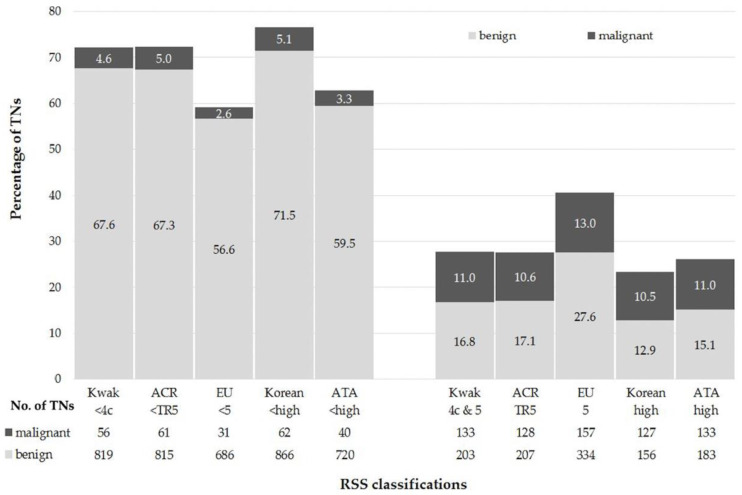
Germany has a long history of insufficient iodine supply and thyroid nodules occur in over 30% of the adult population, the vast majority of which are benign. Non-invasive diagnostics remain challenging, and ultrasound-based risk stratification systems are essential for selecting lesions requiring further clarification. However, no recommendation can yet be made about which system performs the best for iodine deficiency areas. In a German multicenter approach, 1211 thyroid nodules from 849 consecutive patients with cytological or histopathological results were enrolled. Scintigraphically hyperfunctioning lesions were excluded. Ultrasound features were prospectively recorded, and the resulting classifications according to five risk stratification systems were retrospectively determined. Observations determined 1022 benign and 189 malignant lesions. The diagnostic accuracies were 0.79, 0.78, 0.70, 0.82, and 0.79 for Kwak Thyroid Imaging Reporting and Data System (Kwak-TIRADS), American College of Radiology (ACR) TI-RADS, European Thyroid Association (EU)-TIRADS, Korean-TIRADS, and American Thyroid Association (ATA) Guidelines, respectively. Receiver Operating Curves revealed Areas under the Curve of 0.803, 0.795, 0.800, 0.805, and 0.801, respectively. According to the ATA Guidelines, 135 thyroid nodules (11.1%) could not be classified. Kwak-TIRADS, ACR TI-RADS, and Korean-TIRADS outperformed EU-TIRADS and ATA Guidelines and therefore can be primarily recommended for non-autonomously functioning lesions in areas with a history of iodine deficiency.
德国长期存在碘供应不足的情况,超过30%的成年人口患有甲状腺结节,其中绝大多数为良性。非侵入性诊断仍然具有挑战性,基于超声的风险分层系统对于选择需要进一步明确的病变至关重要。然而,对于碘缺乏地区哪种系统表现最佳,目前尚无定论。在一项德国多中心研究中,纳入了来自849例连续患者的1211个具有细胞学或组织病理学结果的甲状腺结节。排除了闪烁扫描显示功能亢进的病变。前瞻性记录超声特征,并回顾性确定根据五种风险分层系统得出的分类。观察结果确定了1022个良性病变和189个恶性病变。对于Kwak甲状腺影像报告和数据系统(Kwak-TIRADS)、美国放射学会(ACR)TI-RADS、欧洲甲状腺协会(EU)-TIRADS、韩国-TIRADS和美国甲状腺协会(ATA)指南,诊断准确率分别为0.79、0.78、0.70、0.82和0.79。受试者工作特征曲线显示曲线下面积分别为0.803、0.795、0.800、0.805和