Departamento de Ensino e Pesquisa, Fundação Centro de Controle de Oncologia do Estado do Amazonas-FCECON, Manaus, AM, Brazil.
Universidade do Estado do Amazonas, Programa de Pós-Graduação em Medicina Tropical, Manaus, AM, Brazil.
PLoS One. 2021 Sep 10;16(9):e0255950. doi: 10.1371/journal.pone.0255950. eCollection 2021.
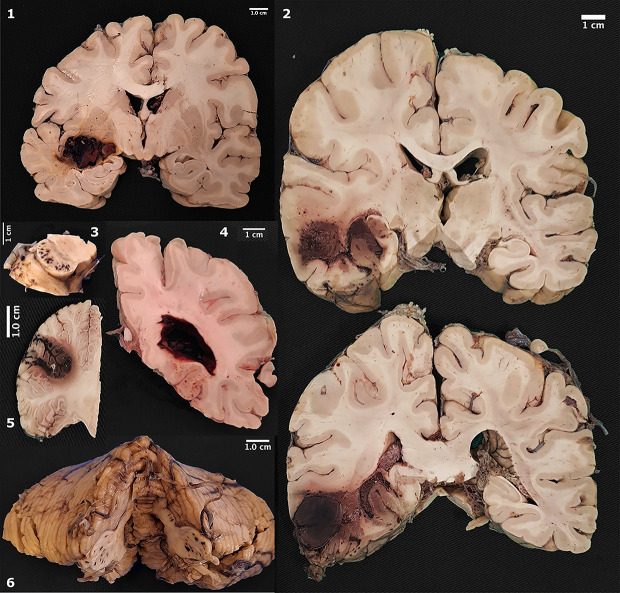
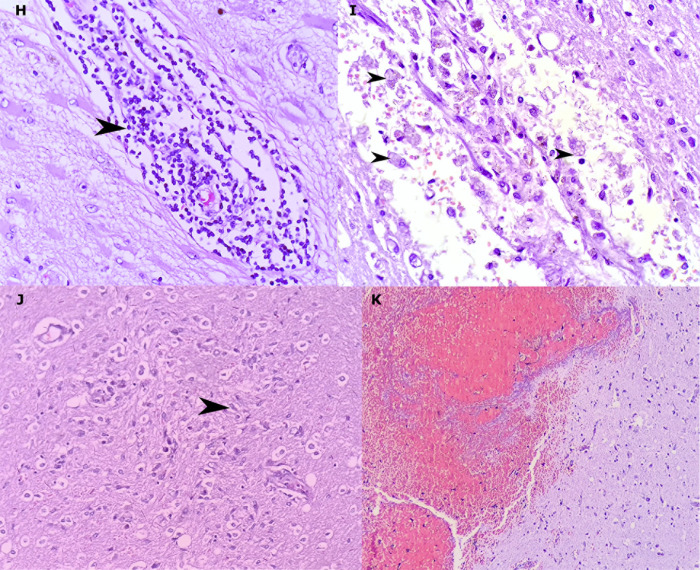
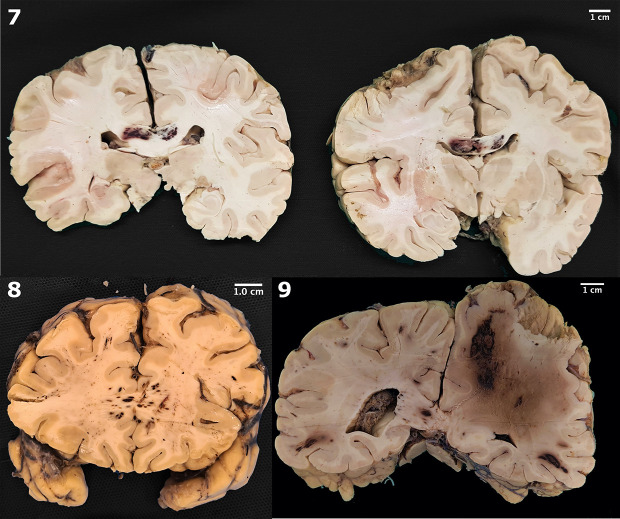
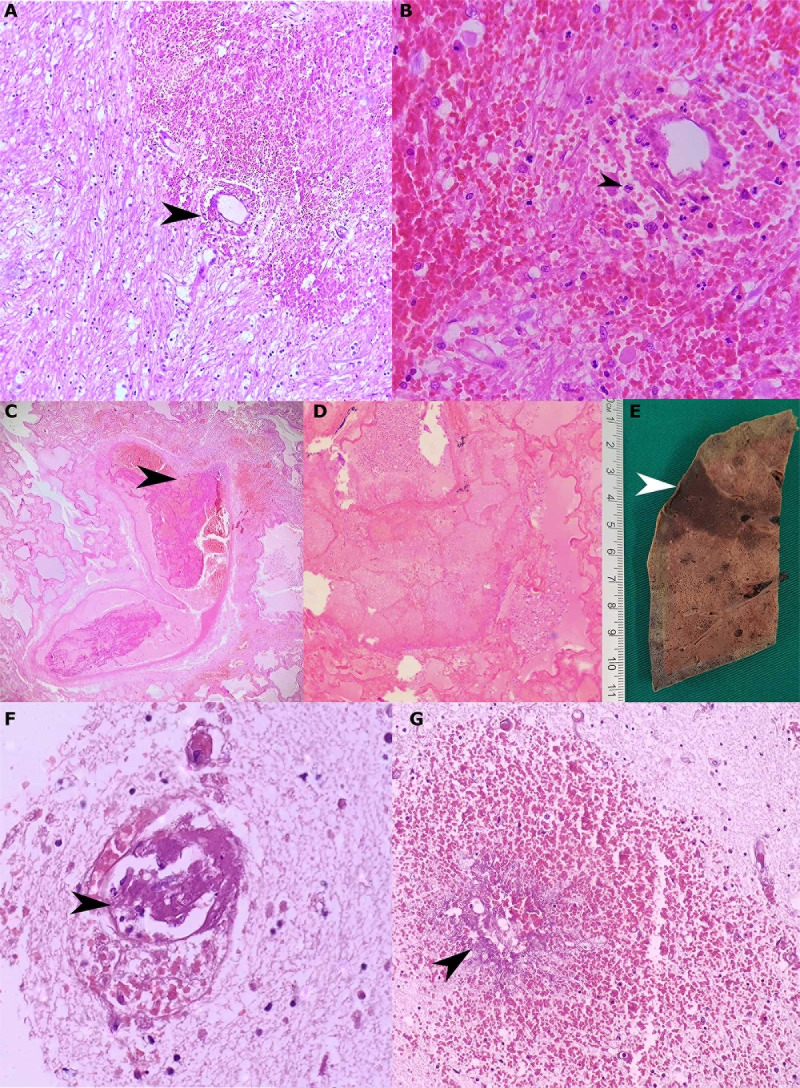
SARS-CoV-2 affects mainly the lungs, however, other manifestations, including neurological manifestations, have also been described during the disease. Some of the neurological findings have involved intracerebral or subarachnoid hemorrhage, strokes, and other thrombotic/hemorrhagic conditions. Nevertheless, the gross pathology of hemorrhagic lesions in the central nervous system has not been previously described in Brazilian autopsy cases. This study aimed to describe gross and microscopic central nervous system (CNS) pathology findings from the autopsies and correlate them with the clinical and laboratory characteristics of forty-five patients with COVID-19 from Manaus, Amazonas, Brazil. Forty-four patients were autopsied of which thirty-eight of these (86.36%) were positive by RT-PCR for COVID-19, and six (13.3%) were positive by the serological rapid test. Clinical and radiological findings were compatible with the infection. The patients were classified in two groups: presence (those who had hemorrhagic and/or thrombotic manifestations in the CNS) and absence (those who did not present hemorrhagic and/or thrombotic manifestations in the CNS). For risk assessment, relative risk and respective confidence intervals were estimated. Macroscopic or microscopic hemorrhages were found in twenty-three cases (52,27%). The postmortem gross examination of the brain revealed a broad spectrum of hemorrhages, from spots to large and confluent areas and, under microscopy, we observed mainly perivascular discharge. The association analyses showed that the use of corticosteroid, anticoagulant and antibiotic had no statistical significance with a risk of nervous system hemorrhagic manifestations. However, it is possible to infer a statistical tendency that indicates that individuals with diabetes had a higher risk for the same outcome (RR = 1.320, 95% CI = 0.7375 to 2.416, p = 0.3743), which was not observed in relation to other comorbidities. It is unknown whether the new variants of the virus can cause different clinical manifestations, such as those observed or indeed others. As a result, more studies are necessary to define clinical and radiologic monitoring protocols and strategic interventions for patients at risk of adverse and fatal events, such as the extensive hemorrhaging described here. It is imperative that clinicians must be aware of comorbidities and the drugs used to treat patients with COVID-19 to prevent CNS hemorrhagic and thrombotic events.
SARS-CoV-2 主要影响肺部,但在疾病过程中也描述了其他表现,包括神经系统表现。一些神经系统发现涉及脑内或蛛网膜下腔出血、中风和其他血栓形成/出血性疾病。然而,巴西尸检病例中以前没有描述过中枢神经系统出血性病变的大体病理学。本研究旨在描述来自玛瑙斯(巴西亚马逊州首府)的 45 例 COVID-19 患者尸检的中枢神经系统(CNS)大体和显微镜病理学发现,并将其与临床和实验室特征相关联。44 例患者进行了尸检,其中 38 例(86.36%)通过 RT-PCR 检测 COVID-19 呈阳性,6 例(13.3%)通过血清学快速检测呈阳性。临床和影像学发现与感染相符。患者分为两组:存在(中枢神经系统有出血和/或血栓形成表现的患者)和不存在(中枢神经系统无出血和/或血栓形成表现的患者)。为了进行风险评估,估计了相对风险和相应的置信区间。23 例(52.27%)发现宏观或微观出血。大脑的死后大体检查显示出广泛的出血范围,从斑点到大片和融合区域,在显微镜下,我们主要观察到血管周围漏出。关联分析表明,皮质类固醇、抗凝剂和抗生素的使用与神经系统出血表现的风险没有统计学意义。然而,可以推断出一种统计学趋势,表明患有糖尿病的个体发生相同结果的风险更高(RR = 1.320,95%CI = 0.7375 至 2.416,p = 0.3743),但与其他合并症无关。目前尚不清楚该病毒的新变体是否会引起不同的临床表现,例如这里观察到的或其他的临床表现。因此,需要更多的研究来定义临床和影像学监测方案以及对有发生不良和致命事件风险的患者的战略干预措施,例如这里描述的广泛出血。临床医生必须意识到 COVID-19 患者的合并症和用于治疗患者的药物,以预防中枢神经系统出血和血栓形成事件,这一点至关重要。