Division of Epidemiology, Department of Epidemiology and Population Health, Montefiore Medical Center and Albert Einstein College of Medicine, Bronx, New York, USA
Bureau of Health Services, Fire Department of the City of New York, Brooklyn, New York, USA.
Occup Environ Med. 2021 Oct;78(10):707-714. doi: 10.1136/oemed-2021-107570. Epub 2021 Sep 10.
To compare cancer incidence in Fire Department of the City of New York (FDNY) firefighters who worked at the World Trade Center (WTC) site to incidence in a population of non-WTC-exposed firefighters, the Career Firefighter Health Study (CFHS) cohort, and to compare rates from each firefighter cohort to rates in demographically similar US males.
FDNY (N=10 786) and CFHS (N=8813) cohorts included male firefighters who were active on 11 September 2001 (9/11) and were followed until death or 31 December 2016. Cases were identified from 15 state cancer registries. Poisson regression models assessed cancers in each group (FDNY and CFHS) versus US males, and associations between group and cancer rates; these models estimated standardised incidence ratios (SIRs) and adjusted relative rates (RRs), respectively. Secondary analyses assessed surveillance bias and smoking history.
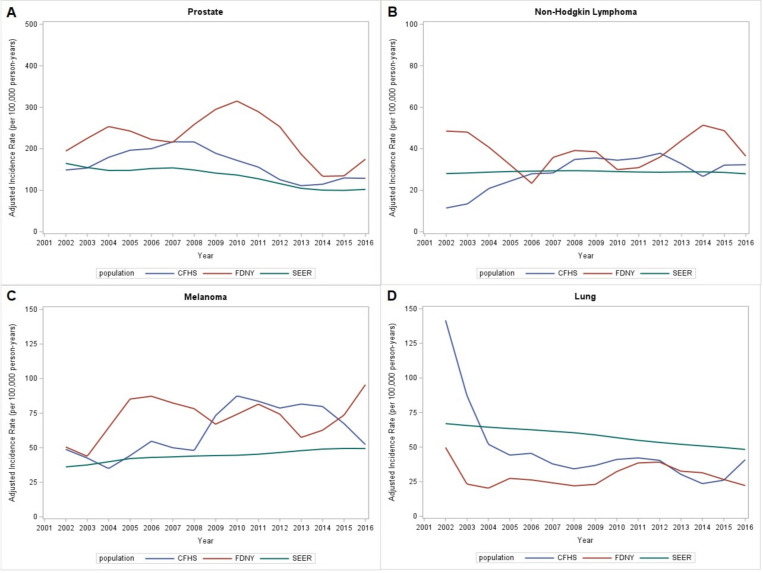
We identified 915 cancer cases in 841 FDNY firefighters and 1002 cases in 909 CFHS firefighters. FDNY had: higher rates for all cancers (RR=1.13; 95% CI 1.02 to 1.25), prostate (RR=1.39; 95% CI 1.19 to 1.63) and thyroid cancer (RR=2.53; 95% CI 1.37 to 4.70); younger median ages at diagnosis (55.6 vs 59.4; p<0.001, all cancers); and more cases with localised disease when compared with CFHS. Compared with US males, both firefighter cohorts had elevated SIRs for prostate cancer and melanoma. Control for surveillance bias in FDNY reduced most differences.
Excess cancers occurred in WTC-exposed firefighters relative to each comparison group, which may partially be explained by heightened surveillance. Two decades post-9/11, clearer understanding of WTC-related risk requires extended follow-up and modelling studies (laboratory or animal based) to identify workplace exposures in all firefighters.
比较在纽约市消防局(FDNY)在世界贸易中心(WTC)工作的消防员与未暴露于 WTC 的消防员(职业消防员健康研究 [CFHS] 队列)的癌症发病率,并将每个消防员队列的比率与人口统计学上相似的美国男性进行比较。
FDNY(N=10786)和 CFHS(N=8813)队列包括 2001 年 9 月 11 日(9/11)活跃的男性消防员,并随访至死亡或 2016 年 12 月 31 日。病例从 15 个州癌症登记处确定。泊松回归模型评估了每个组(FDNY 和 CFHS)与美国男性的癌症病例,并评估了组与癌症发病率之间的关系;这些模型分别估计了标准化发病率比(SIR)和调整后的相对比率(RR)。二次分析评估了监测偏倚和吸烟史。
我们在 841 名 FDNY 消防员中发现了 915 例癌症病例,在 909 名 CFHS 消防员中发现了 1002 例癌症病例。FDNY 具有:所有癌症(RR=1.13;95%CI 1.02 至 1.25)、前列腺癌(RR=1.39;95%CI 1.19 至 1.63)和甲状腺癌(RR=2.53;95%CI 1.37 至 4.70)的发病率更高;诊断时的中位年龄更低(55.6 岁与 59.4 岁;p<0.001,所有癌症);与 CFHS 相比,更多病例为局限性疾病。与美国男性相比,两个消防员队列的前列腺癌和黑色素瘤的 SIR 均升高。FDNY 中监测偏倚的控制降低了大多数差异。
暴露于 WTC 的消防员与每个对照组相比,癌症发病率更高,这可能部分归因于监测力度的加大。9/11 事件发生 20 年后,更清楚地了解与 WTC 相关的风险需要进行长期随访和建模研究(基于实验室或动物),以确定所有消防员的工作场所暴露情况。