Endocrine Breast Surgery, The First Affiliated Hospital of Chongqing Medical University, No.1 Youyi Road, Yuzhong District, Chongqing, 400016, China.
Department of Cardiology, Chongqing Kanghua Zhonglian Cardiovascular Hospital, Jiangbei District, No. 168 Haier Rd, Chongqing, 400016, China.
Clin Transl Oncol. 2022 Mar;24(3):503-516. doi: 10.1007/s12094-021-02704-8. Epub 2021 Sep 12.
Lysophosphatidic acid (LPA) is a bioactive molecule which participates in many physical and pathological processes. Although LPA receptor 6 (LPAR6), the last identified LPA receptor, has been reported to have diverse effects in multiple cancers, including breast cancer, its effects and functioning mechanisms are not fully known.
Multiple public databases were used to investigate the mRNA expression of LPAR6, its prognostic value, and potential mechanisms in breast cancer. Western blotting was performed to validate the differential expression of LPAR6 in breast cancer tissues and their adjacent tissues. Furthermore, in vitro experiments were used to explore the effects of LPAR6 on breast cancer. Additionally, TargetScan and miRWalk were used to identify potential upstream regulating miRNAs and validated the relationship between miR-27a-3p and LPAR6 via real-time polymerase chain reaction and an in vitro rescue assay.
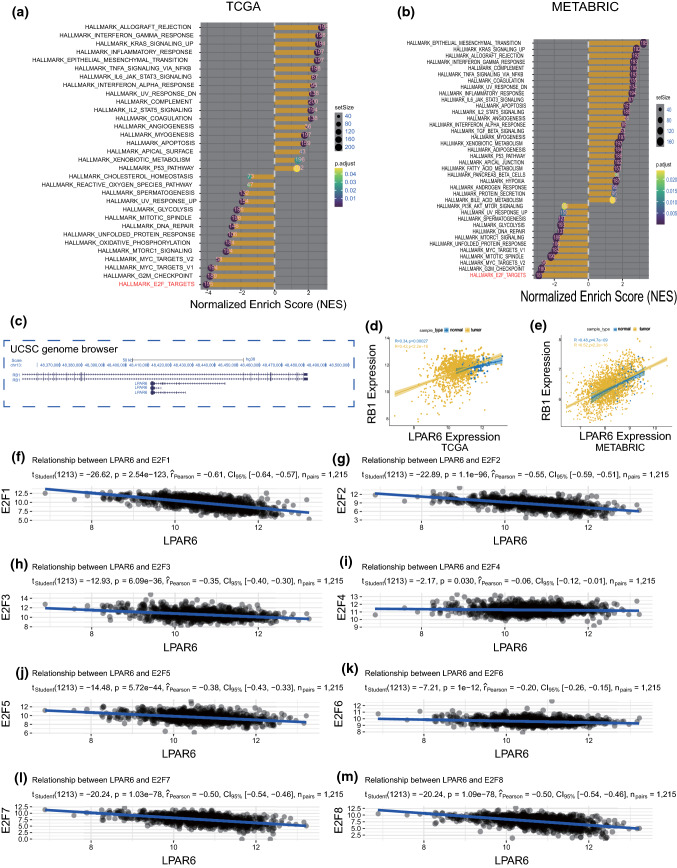
LPAR6 was significantly downregulated in breast cancer at transcriptional and translational levels. Decreased LPAR6 expression in breast cancer is significantly correlated with poor overall survival, disease-free survival, and distal metastasis-free survival, particularly for hormone receptor-positive patients, regardless of lymph node metastatic status. In vitro gain and loss-of-function assays indicated that LPAR6 attenuated breast cancer cell proliferation. The analyses of TCGA and METABRIC datasets revealed that LPAR6 may regulate the cell cycle signal pathway. Furthermore, the expression of LPAR6 could be positively regulated by miR-27a-3p. The knockdown of miR-27a-3p increased cell proliferation, and ectopic expression of LPAR6 could partly rescue this phenotype.
LPAR6 acts as a tumor suppressor in breast cancer and is positively regulated by miR-27a-3p.
溶血磷脂酸(LPA)是一种参与多种生理和病理过程的生物活性分子。尽管最后鉴定的 LPA 受体 6(LPAR6)已被报道在多种癌症中具有多种作用,包括乳腺癌,但它的作用和作用机制尚未完全清楚。
使用多个公共数据库来研究 LPAR6 在乳腺癌中的 mRNA 表达、其预后价值和潜在机制。进行 Western blot 以验证 LPAR6 在乳腺癌组织及其相邻组织中的差异表达。此外,进行体外实验以探索 LPAR6 对乳腺癌的影响。此外,使用 TargetScan 和 miRWalk 来鉴定潜在的上游调节 miRNA,并通过实时聚合酶链反应和体外挽救实验验证 miR-27a-3p 与 LPAR6 之间的关系。
LPAR6 在转录和翻译水平上在乳腺癌中显著下调。乳腺癌中 LPAR6 表达的降低与整体生存率、无病生存率和远处转移无病生存率显著相关,特别是对于激素受体阳性患者,无论淋巴结转移状态如何。体外获得和丧失功能试验表明 LPAR6 可减弱乳腺癌细胞增殖。TCGA 和 METABRIC 数据集的分析表明,LPAR6 可能调节细胞周期信号通路。此外,LPAR6 的表达可以被 miR-27a-3p 正向调节。miR-27a-3p 的敲低增加了细胞增殖,而 LPAR6 的异位表达可以部分挽救这种表型。
LPAR6 在乳腺癌中作为肿瘤抑制因子发挥作用,并被 miR-27a-3p 正向调节。