Institute of Biomedical Sciences, National Sun Yat-Sen University, Kaohsiung 804, Taiwan.
Department of Otolaryngology, Head and Neck Surgery, Kaohsiung Veterans General Hospital, Kaohsiung 813, Taiwan.
Cells. 2021 Jun 29;10(7):1629. doi: 10.3390/cells10071629.
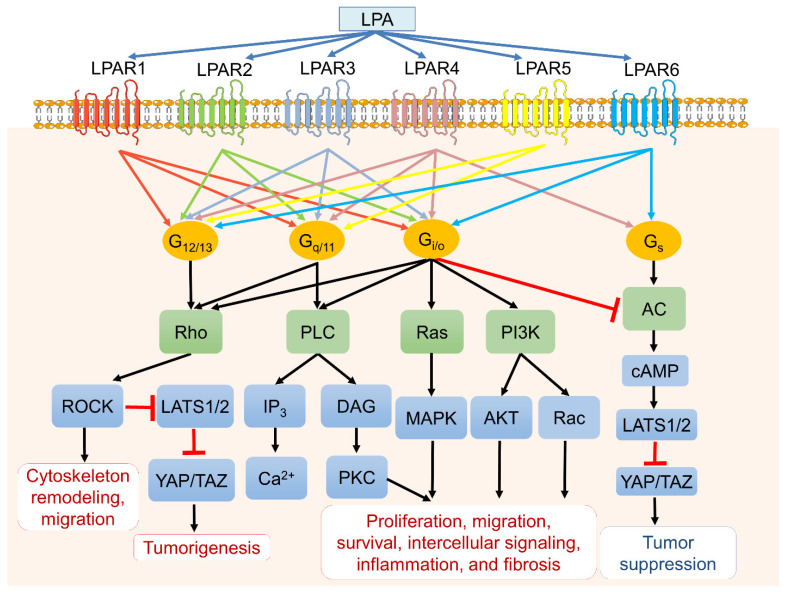
Lysophosphatidic acid (LPA) is a bioactive lipid mediator primarily derived from membrane phospholipids. LPA initiates cellular effects upon binding to a family of G protein-coupled receptors, termed LPA receptors (LPAR1 to LPAR6). LPA signaling drives cell migration and proliferation, cytokine production, thrombosis, fibrosis, angiogenesis, and lymphangiogenesis. Since the expression and function of LPA receptors are critical for cellular effects, selective antagonists may represent a potential treatment for a broad range of illnesses, such as cardiovascular diseases, idiopathic pulmonary fibrosis, voiding dysfunctions, and various types of cancers. More new LPA receptor antagonists have shown their therapeutic potentials, although most are still in the preclinical trial stage. This review provided integrative information and summarized preclinical findings and recent clinical trials of different LPA receptor antagonists in cancer progression and resistance. Targeting LPA receptors can have potential applications in clinical patients with various diseases, including cancer.
溶血磷脂酸(LPA)是一种生物活性脂质介质,主要来源于细胞膜磷脂。LPA 与一组 G 蛋白偶联受体(称为 LPA 受体(LPAR1 至 LPAR6))结合后引发细胞效应。LPA 信号转导可驱动细胞迁移和增殖、细胞因子产生、血栓形成、纤维化、血管生成和淋巴管生成。由于 LPA 受体的表达和功能对细胞效应至关重要,因此选择性拮抗剂可能代表了广泛疾病(如心血管疾病、特发性肺纤维化、排尿功能障碍和各种类型的癌症)的潜在治疗方法。尽管大多数仍处于临床前试验阶段,但更多的新型 LPA 受体拮抗剂已显示出其治疗潜力。本文综述了不同 LPA 受体拮抗剂在癌症进展和耐药性中的临床前发现和最新临床试验的综合信息。针对 LPA 受体可能在包括癌症在内的各种疾病的临床患者中具有潜在应用价值。