Qiang Wei, Wei Ran, Chen Yongjiang, Chen Danian
Research Laboratory of Ophthalmology and Vision Sciences, State Key Laboratory of Biotherapy, West China Hospital, Sichuan University, Chengdu, China.
Department of Ophthalmology, West China Hospital, Sichuan University, Chengdu, China.
Front Neurosci. 2021 Aug 26;15:734860. doi: 10.3389/fnins.2021.734860. eCollection 2021.
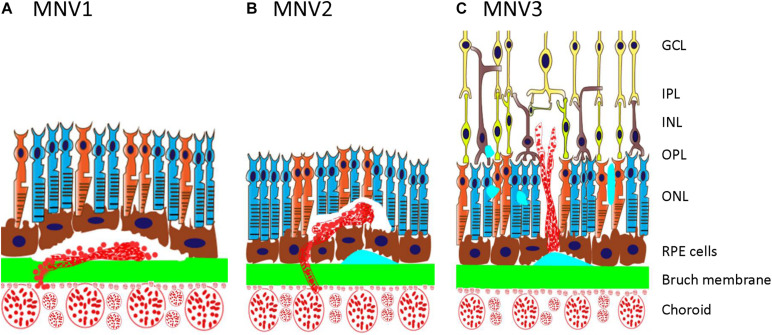
Type 3 macular neovascularization (MNV3), or retinal angiomatous proliferation (RAP), is a distinct type of neovascular age-related macular degeneration (AMD), which is a leading cause of vision loss in older persons. During the past decade, systematic investigation into the clinical, multimodal imaging, and histopathological features and therapeutic outcomes has provided important new insight into this disease. These studies favor the retinal origin of MNV3 and suggest the involvement of retinal hypoxia, inflammation, von Hippel-Lindau (VHL)-hypoxia-inducible factor (HIF)-vascular endothelial growth factor (VEGF) pathway, and multiple cell types in the development and progression of MNV3. Several mouse models, including the recently built triple knockout mouse model by our group, have induced many of the histological features of MNV3 and provided much insight into the underlying pathological mechanisms. These models have revealed the roles of retinal hypoxia, inflammation, lipid metabolism, VHL/HIF pathway, and retinoblastoma tumor suppressor (Rb)-E2F cell cycle pathway in the development of MNV3. This article will summarize the clinical, multimodal imaging, and pathological features of MNV3 and the diversity of animal models that exist for MNV3, as well as their strengths and limitations.
3型黄斑新生血管(MNV3),即视网膜血管瘤样增殖(RAP),是年龄相关性黄斑变性(AMD)的一种独特类型,而AMD是老年人视力丧失的主要原因。在过去十年中,对其临床、多模态成像、组织病理学特征及治疗结果的系统研究为该疾病提供了重要的新见解。这些研究支持MNV3起源于视网膜,并提示视网膜缺氧、炎症、冯·希佩尔-林道(VHL)-缺氧诱导因子(HIF)-血管内皮生长因子(VEGF)通路以及多种细胞类型参与了MNV3的发生发展。多种小鼠模型,包括我们团队最近构建的三基因敲除小鼠模型,诱导出了许多MNV3的组织学特征,并为其潜在病理机制提供了诸多见解。这些模型揭示了视网膜缺氧、炎症、脂质代谢、VHL/HIF通路和成视网膜细胞瘤肿瘤抑制因子(Rb)-E2F细胞周期通路在MNV3发生过程中的作用。本文将总结MNV3的临床、多模态成像和病理特征,以及现有的MNV3动物模型的多样性,及其优缺点。