Liang Danhong, Liang Zhi, Deng Guoliang, Cen Anfen, Luo Dandan, Zhang Chen, Ni Suiqin
School of Biology and Biological Engineering, South China University of Technology, Guangzhou, Guangdong, China.
Department of Pharmacy, The Second Affiliated Hospital, School of Medicine, South China University of Technology, Guangzhou, Guangdong, China.
Front Pharmacol. 2023 Mar 29;14:1122310. doi: 10.3389/fphar.2023.1122310. eCollection 2023.
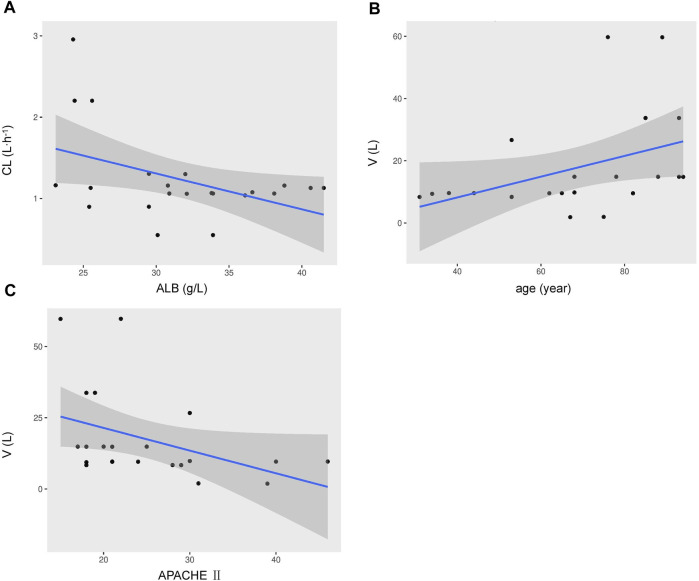
Since the global broadcast of multidrug-resistant gram-negative bacteria is accelerating, the use of Polymyxin B is sharply increasing, especially in critically ill patients. Unsatisfactory therapeutic effects were obtained because of the abnormal physiological function in critically ill patients. Therefore, the determination of optimal polymyxin B dosage becomes highly urgent. This study aimed to illustrate the polymyxin B pharmacokinetic characteristics by defining the influencing factors and optimizing the dosing regimens to achieve clinical effectiveness. Steady-state concentrations of polymyxin B from twenty-two critically ill patients were detected by a verified liquid chromatography-tandem mass spectrometry approach. The information on age, weight, serum creatinine, albumin levels, and Acute Physiology and Chronic Health Evaluation-II (APACHE-II) score was also collected. The population PK parameters were calculated by the non-parametric adaptive grid method in Pmetrics software, and the pharmacokinetic/pharmacodynamics target attainment rate was determined by the Monte Carlo simulation method. The central clearance and apparent volume of distribution for polymyxin B were lower in critically ill patients (1.24 ± 0.38 L h and 16.64 ± 12.74 L, respectively). Moreover, albumin (ALB) levels can be used to explain the variability in clearance, and age can be used to describe the variability in the apparent volume of distribution. For maintaining clinical effectiveness and lowering toxicity, 75 mg q12 h is the recommended dosing regimen for most patients suffering from severe infections. This study has clearly defined that in critically ill patients, age and ALB levels are potentially important factors for the PK parameters of polymyxin B. Since older critically ill patients tend to have lower ALB levels, so higher dosages of polymyxin B are necessary for efficacy.
由于耐多药革兰氏阴性菌在全球范围内的传播正在加速,多粘菌素B的使用量急剧增加,尤其是在重症患者中。由于重症患者生理功能异常,治疗效果不尽人意。因此,确定最佳的多粘菌素B剂量变得极为迫切。本研究旨在通过确定影响因素并优化给药方案以实现临床疗效,从而阐明多粘菌素B的药代动力学特征。采用经过验证的液相色谱-串联质谱法检测了22例重症患者的多粘菌素B稳态浓度。还收集了年龄、体重、血清肌酐、白蛋白水平以及急性生理与慢性健康状况评分系统II(APACHE-II)评分等信息。通过Pmetrics软件中的非参数自适应网格法计算群体药代动力学参数,并采用蒙特卡洛模拟法确定药代动力学/药效学目标达成率。重症患者中多粘菌素B的中央清除率和表观分布容积较低(分别为1.24±0.38 L/h和16.64±12.74 L)。此外,白蛋白(ALB)水平可用于解释清除率的变异性,年龄可用于描述表观分布容积的变异性。为维持临床疗效并降低毒性,对于大多数重症感染患者,推荐的给药方案是每12小时75 mg。本研究明确指出,在重症患者中,年龄和ALB水平是多粘菌素B药代动力学参数的潜在重要影响因素。由于老年重症患者往往白蛋白水平较低,因此为达到疗效需要更高剂量的多粘菌素B。