Weston-Green Katrina, Clunas Helen, Jimenez Naranjo Carlos
Neurohorizons Laboratory, Molecular Horizons and School of Medicine, Faculty of Science, Medicine and Health, University of Wollongong, Wollongong, NSW, Australia.
Illawarra Health and Medical Research Institute, Wollongong, NSW, Australia.
Front Psychiatry. 2021 Aug 26;12:583211. doi: 10.3389/fpsyt.2021.583211. eCollection 2021.
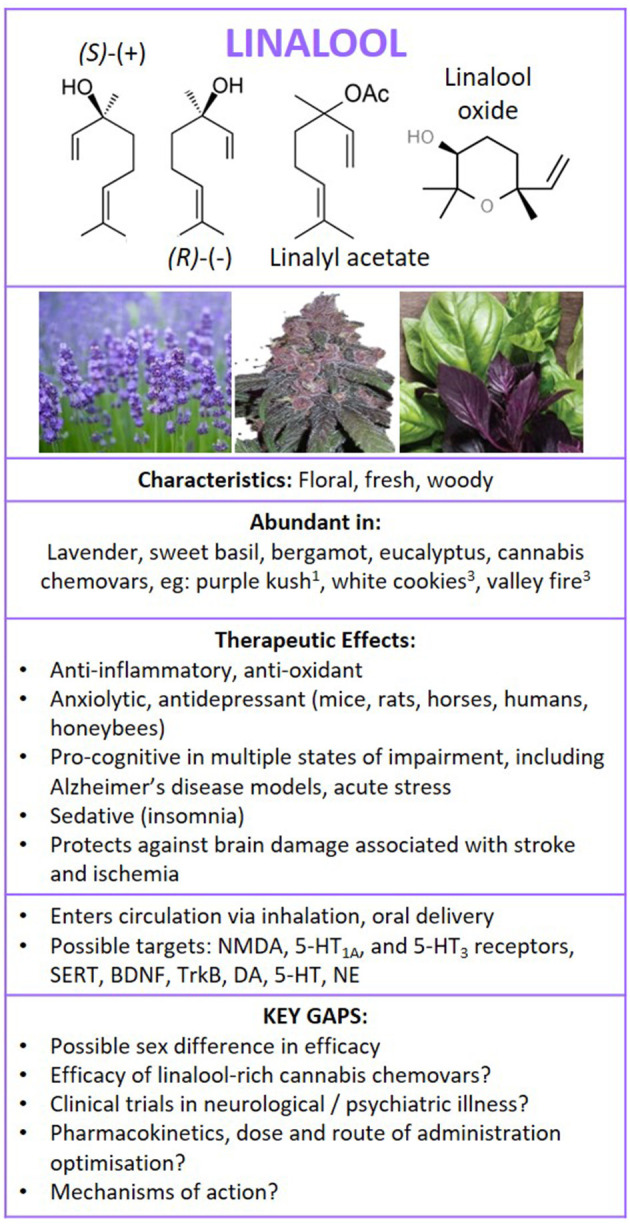
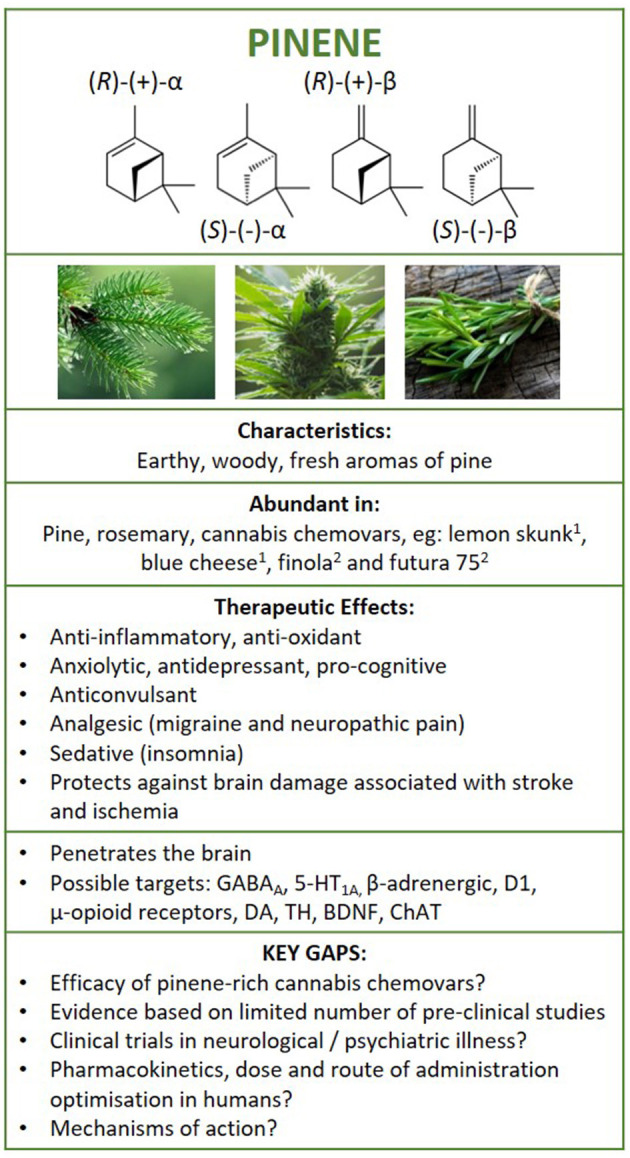
"Medicinal cannabis" is defined as the use of cannabis-based products for the treatment of an illness. Investigations of cannabis compounds in psychiatric and neurological illnesses primarily focus on the major cannabinoids, cannabidiol (CBD) and Δ-tetrahydrocannabinol (Δ-THC), which are hypothesised to benefit multiple illnesses manifesting cognitive impairment, neurodegeneration and neuro-inflammation, as well as chronic pain, epilepsy and post-traumatic stress disorder, respectively. The cannabis plant contains >500 compounds, including terpenes responsible for the flavour and fragrance profiles of plants. Recently, research has begun providing evidence on the potential use of certain plant-derived terpenes in modern medicine, demonstrating anti-oxidant, anti-inflammatory, and neuroprotective effects of these compounds. This review examined the effects of two key terpenes, pinene and linalool, on parameters relevant to neurological and psychiatric disorders, highlighting gaps in the literature and recommendations for future research into terpene therapeutics. Overall, evidence is mostly limited to preclinical studies and well-designed clinical trials are lacking. Nevertheless, existing data suggests that pinene and linalool are relevant candidates for further investigation as novel medicines for illnesses, including stroke, ischemia, inflammatory and neuropathic pain (including migraine), cognitive impairment (relevant to Alzheimer's disease and ageing), insomnia, anxiety, and depression. Linalool and pinene influence multiple neurotransmitter, inflammatory and neurotrophic signals as well as behaviour, demonstrating psycho-activity (albeit non-intoxicating). Optimising the phytochemical profile of cannabis chemovars to yield therapeutic levels of beneficial terpenes and cannabinoids, such as linalool, pinene and CBD, could present a unique opportunity to discover novel medicines to treat psychiatric and neurological illnesses; however, further research is needed.
“药用大麻”被定义为使用基于大麻的产品来治疗疾病。对大麻化合物在精神和神经疾病方面的研究主要集中在主要的大麻素,即大麻二酚(CBD)和Δ-四氢大麻酚(Δ-THC),据推测它们分别对多种表现出认知障碍、神经退行性变和神经炎症的疾病以及慢性疼痛、癫痫和创伤后应激障碍有益。大麻植物含有500多种化合物,包括负责植物风味和香气特征的萜类化合物。最近,研究开始为某些植物衍生的萜类化合物在现代医学中的潜在用途提供证据,证明了这些化合物的抗氧化、抗炎和神经保护作用。这篇综述研究了两种关键萜类化合物,蒎烯和芳樟醇,对与神经和精神疾病相关参数的影响,突出了文献中的空白以及萜类疗法未来研究的建议。总体而言,证据大多限于临床前研究,缺乏精心设计的临床试验。然而,现有数据表明,蒎烯和芳樟醇作为包括中风、缺血、炎性和神经性疼痛(包括偏头痛)、认知障碍(与阿尔茨海默病和衰老相关)、失眠、焦虑和抑郁症等疾病的新型药物,是值得进一步研究的相关候选物。芳樟醇和蒎烯会影响多种神经递质、炎症和神经营养信号以及行为,显示出精神活性(尽管不会使人上瘾)。优化大麻化学变种的植物化学特征,以产生有益萜类化合物和大麻素(如芳樟醇、蒎烯和CBD)的治疗水平,可能为发现治疗精神和神经疾病的新型药物提供独特的机会;然而,还需要进一步的研究。