Yao Ying-Ye, Wei Zi-Jun, Zhang Yue-Chan, Li Xiang, Gong Liu, Zhou Jia-Wei, Wang Yu, Zhang Yun-Yun, Wang Rui-Ping
Department of Neurology, Yueyang Hospital of Integrated Traditional Chinese and Western Medicine Affiliated to Shanghai University of Traditional Chinese Medicine, Shanghai, China.
Department of Neurology, Shanghai Baoshan Integrated Traditional Chinese and Western Medicine Hospital, Shanghai, China.
Front Neurol. 2021 Aug 26;12:649088. doi: 10.3389/fneur.2021.649088. eCollection 2021.
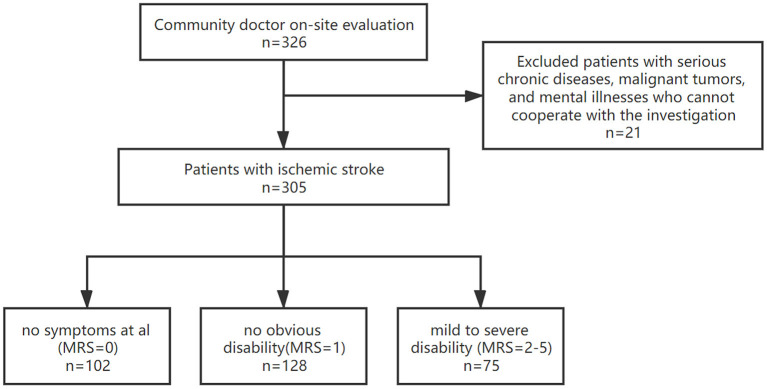
This study aimed to understand the demographics, functional disabilities, cognitive impairment, and depressive mood among stroke patients and to explore the correlation between functional disability and the other health conditions so as to provide some data for community rehabilitation among stroke patients. A cross-sectional study was conducted to investigate the functional status of ischemic stroke patients with stroke history between 1 month and 2 years by applying the modified Rankin Scale (mRS). Data were collected during October 2016 and January 2017 from 11 communities in two districts of Shanghai, China. We used face-to-face questionnaire interviews to collect information on sociodemographics, vascular risks associated with stroke, cognitive function [Mini-Mental State Examination (MMSE)], and depression [Patient Health Questionnaire-9 (PHQ-9)]; and we applied SPSS 24.0 for data analysis. In this study, 305 patients with ischemic stroke were finally recruited, including 189 (61.97%) men, with an average age of 67 years. According to the mRS score, ischemic stroke patients were divided into patients without symptoms (controls, mRS = 0), patients without obvious disability (mRS = 1), and patients with mild to severe disability (mRS = 2-5). Ischemic stroke patients with different mRS levels demonstrated significant differences in age, tobacco smoke exposure, previous stroke history, cognitive function, and depression status. Compared with patients without symptoms (mRS = 0), patients with mRS = 1 had a lower MMSE score [odds ratio (OR): 0.48, 95% confidence interval (CI): 0.26-0.90]; and patients with mRS = 2-5 had a lower MMSE score [OR = 0.16, 95% CI: 0.08-0.33], had a higher PHQ-9 score [OR = 5.36, 95% CI: 2.19-13.11], and were more likely to have previous stroke history [OR = 2.18, 95% CI: 1.01-4.79]. Lower degrees of functional independence are related to cognitive impairment, as well as the previous stroke history and depression status.
本研究旨在了解脑卒中患者的人口统计学特征、功能残疾情况、认知障碍及抑郁情绪,并探讨功能残疾与其他健康状况之间的相关性,以便为脑卒中患者的社区康复提供一些数据。采用横断面研究方法,应用改良Rankin量表(mRS)对1个月至2年有脑卒中病史的缺血性脑卒中患者的功能状况进行调查。2016年10月至2017年1月期间,在中国上海两个区的11个社区收集数据。我们通过面对面问卷调查收集社会人口统计学、与脑卒中相关的血管风险、认知功能[简易精神状态检查表(MMSE)]和抑郁[患者健康问卷-9(PHQ-9)]的信息;并应用SPSS 24.0进行数据分析。在本研究中,最终招募了305例缺血性脑卒中患者,其中男性189例(61.97%),平均年龄67岁。根据mRS评分,缺血性脑卒中患者分为无症状患者(对照组,mRS = 0)、无明显残疾患者(mRS = 1)和轻至重度残疾患者(mRS = 2 - 5)。不同mRS水平的缺血性脑卒中患者在年龄、烟草烟雾暴露、既往脑卒中病史、认知功能和抑郁状态方面存在显著差异。与无症状患者(mRS = 0)相比,mRS = 1的患者MMSE评分较低[比值比(OR):0.48,95%置信区间(CI):0.26 - 0.90];mRS = 2 - 5的患者MMSE评分较低[OR = 0.16,95% CI:0.08 - 0.33],PHQ-9评分较高[OR = 5.36,95% CI:2.19 - 13.11],且更有可能有既往脑卒中病史[OR = 2.18,95% CI:1.01 - 4.79]。较低程度的功能独立性与认知障碍、既往脑卒中病史及抑郁状态有关。