Immunobiology & Transplant Science Center, Department of Surgery, Houston Methodist Research Institute & Institute for Academic Medicine, Houston Methodist Hospital, Houston, TX, United States.
College of Medicine, Texas A&M Health Science Center, College Station, TX, United States.
Front Immunol. 2021 Aug 26;12:725618. doi: 10.3389/fimmu.2021.725618. eCollection 2021.
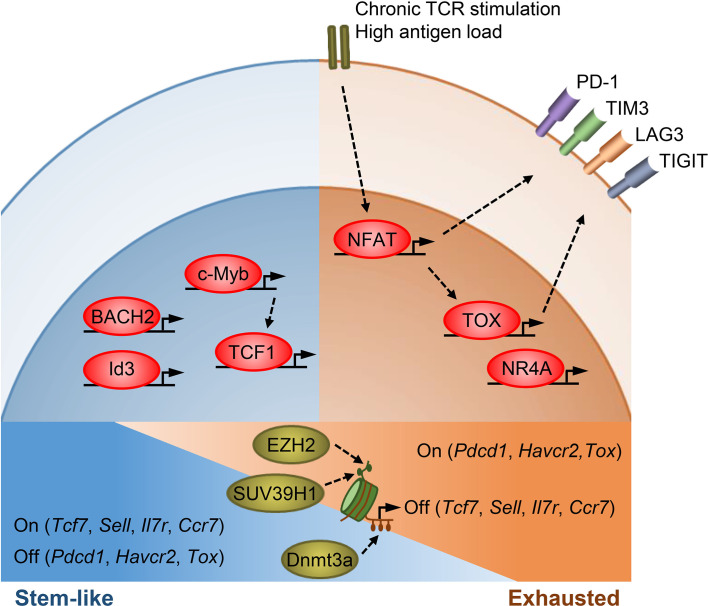
T cell stemness and exhaustion coexist as two key contrasting phenomena during chronic antigen stimulation, such as infection, transplant, cancer, and autoimmunity. T cell exhaustion refers to the progressive loss of effector function caused by chronic antigen exposure. Exhausted T (T) cells highly express multiple inhibitory receptors and exhibit severe defects in cell proliferation and cytokine production. The term T cell stemness describes the stem cell-like behaviors of T cells, including self-renewal, multipotency, and functional persistence. It is well accepted that naïve and some memory T cell subsets have stem cell-like properties. When investigating the exhaustive differentiation of T cells in chronic infection and cancer, recent studies highlighted the stemness of "precursors of exhausted" T (T) cells prior to their terminal differentiation to T cells. Clinically successful checkpoint blockades for cancer treatment appear to invigorate antitumor T cells but not T cells. Here we discuss the transcriptional and epigenetic regulations of T cell stemness and exhaustion, with a focus on how systems immunology was and will be utilized to define the molecular basis underlying the transition of T to T cells. We suggest a "stepwise model" of T cell stemness and exhaustion, in which loss of stemness and exhaustion progression are gradual multi-step processes. We provide perspectives on the research needed to define T cell stemness and exhaustion in the transplantation setting, in which allogenic T cells are also chronically exposed to alloantigens. A better understanding of T cell stemness and exhaustion will shed light on developing novel strategies for immunotherapies.
T 细胞干性和耗竭是慢性抗原刺激(如感染、移植、癌症和自身免疫)过程中两个关键的对比现象。T 细胞耗竭是指慢性抗原暴露导致效应功能逐渐丧失。耗竭的 T(T)细胞高度表达多种抑制性受体,并表现出严重的增殖和细胞因子产生缺陷。T 细胞干性一词描述了 T 细胞的干细胞样行为,包括自我更新、多能性和功能持久性。人们普遍认为,幼稚和一些记忆 T 细胞亚群具有干细胞样特性。在研究慢性感染和癌症中 T 细胞的耗尽分化时,最近的研究强调了“耗尽前”T(T)细胞在终末分化为 T 细胞之前的干性。临床上成功的癌症治疗检查点阻断似乎激活了抗肿瘤 T 细胞而不是 T 细胞。在这里,我们讨论了 T 细胞干性和耗竭的转录和表观遗传调控,重点介绍了系统免疫学如何以及将如何用于定义 T 细胞向 T 细胞转化的分子基础。我们提出了 T 细胞干性和耗竭的“逐步模型”,其中干性丧失和耗竭进展是逐渐的多步骤过程。我们就需要在移植环境中定义 T 细胞干性和耗竭的研究提供了一些观点,在这种环境中,同种异体 T 细胞也会受到同种异体抗原的慢性暴露。更好地理解 T 细胞干性和耗竭将为开发新的免疫疗法策略提供思路。