Sakamoto Takashi, Kubota Tadao, Funakoshi Hiraku, Lefor Alan Kawarai
Department of Clinical Epidemiology and Health Economics, School of Public Health, The University of Tokyo, Tokyo 1130033, Japan.
Department of Surgery, Tokyo Bay Urayasu Ichikawa Medical Center, Chiba 2790001, Japan.
World J Gastrointest Surg. 2021 Aug 27;13(8):806-813. doi: 10.4240/wjgs.v13.i8.806.
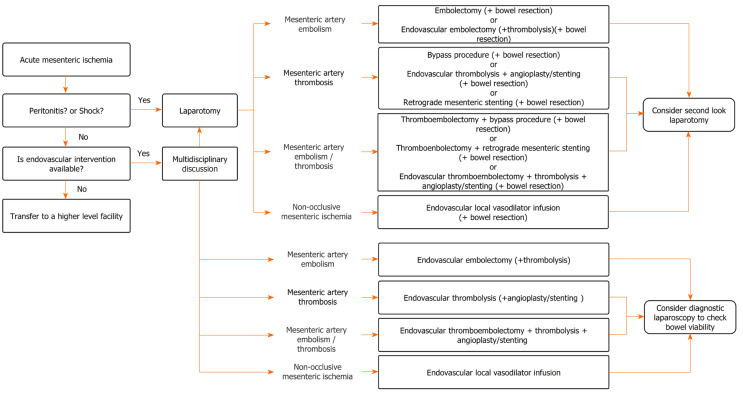
Acute mesenteric ischemia (AMI) is a rare cause of the "acute abdomen", characterized by impaired blood flow to the intestine. The principle of treatment is restoration of perfusion to ischemic bowel and resection of any necrotic intestine. Surgery and endovascular intervention are two complementary approaches to mesenteric ischemia. Endovascular intervention is not an alternative to the surgical approach, but it has the potential to improve the prognosis of patients with AMI when judiciously combined with a surgical approach. Due to the need for emergent treatment of patients with acute mesenteric ischemia, the treatment strategy needs to be modified for each facility. This review aims to highlight cutting-edge studies and provide reasonable treatment strategies for patients with acute mesenteric ischemia based on available evidence.
急性肠系膜缺血(AMI)是“急腹症”的一种罕见病因,其特征为肠道血流受损。治疗原则是恢复对缺血肠段的灌注,并切除任何坏死的肠段。手术和血管内介入是治疗肠系膜缺血的两种互补方法。血管内介入并非手术方法的替代方案,但与手术方法合理结合时,它有可能改善AMI患者的预后。由于急性肠系膜缺血患者需要紧急治疗,因此每个医疗机构的治疗策略都需要进行调整。本综述旨在突出前沿研究,并根据现有证据为急性肠系膜缺血患者提供合理的治疗策略。