Feng Yang, Feng Yahui, Gu Liming, Liu Pengfei, Cao Jianping, Zhang Shuyu
School of Radiation Medicine and Protection, State Key Laboratory of Radiation Medicine, Soochow University, Suzhou, China.
China National Nuclear Corporation 416 Hospital (Second Affiliated Hospital of Chengdu Medical College), Chengdu, China.
Front Oncol. 2021 Aug 27;11:720632. doi: 10.3389/fonc.2021.720632. eCollection 2021.
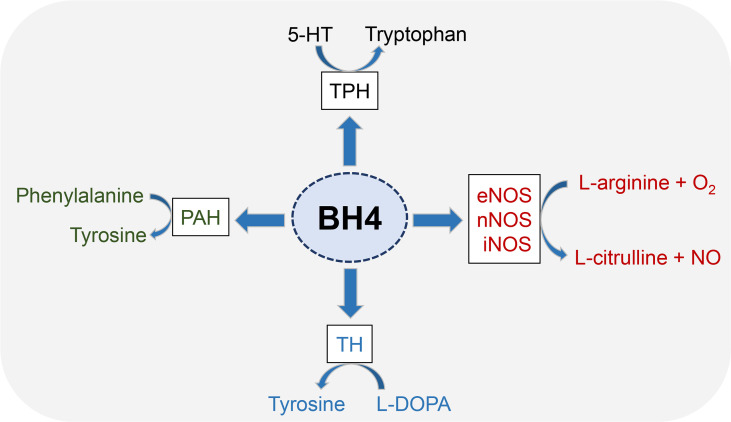
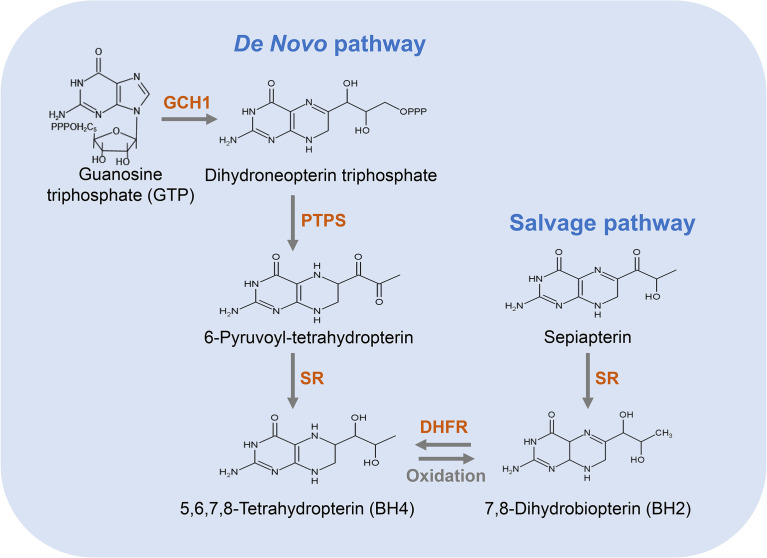
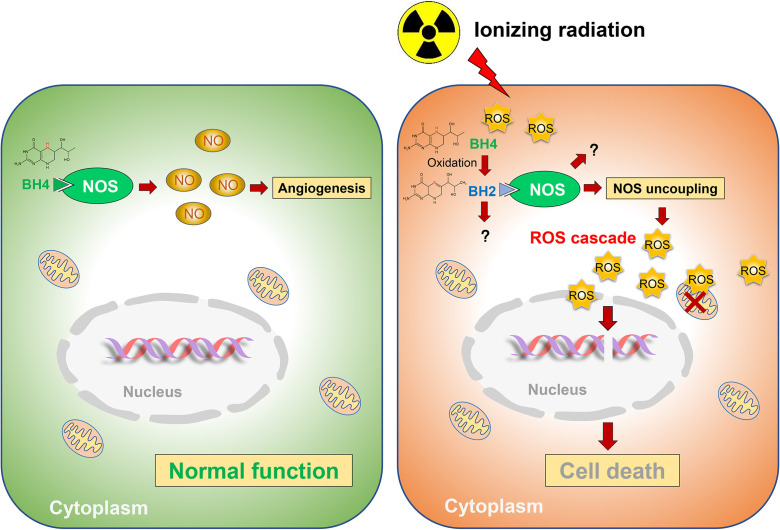
Ionizing radiation and radioactive materials have been widely used in industry, medicine, science and military. The efficacy of radiotherapy and adverse effects of normal tissues are closed related to cellular radiosensitivity. Molecular mechanisms underlying radiosensitivity are of significance to tumor cell radiosensitization as well as normal tissue radioprotection. 5,6,7,8-Tetrahydrobiopterin (BH4) is an essential cofactor for nitric oxide synthases (NOS) and aromatic amino acid hydroxylases, and its biosynthesis involves biosynthesis and a pterin salvage pathway. In this review we overview the role of BH4 metabolism in modulating radiosensitivity. BH4 homeostasis determines the role of NOS, affecting the production of nitric oxide (NO) and oxygen free radicals. Under conditions of oxidative stress, such as UV-radiation and ionizing radiation, BH4 availability is diminished due to its oxidation, which subsequently leads to NOS uncoupling and generation of highly oxidative free radicals. On the other hand, BH4/NOS axis facilitates vascular normalization, a process by which antiangiogenic therapy corrects structural and functional flaws of tumor blood vessels, which enhances radiotherapy efficacy. Therefore, BH4/NOS axis may serve as an angel or a devil in regulating cellular radiosensitivity. Finally, we will address future perspectives, not only from the standpoint of perceived advances in treatment, but also from the potential mechanisms. These advances have demonstrated that it is possible to modulate cellular radiosensitivity through BH4 metabolism.
电离辐射和放射性物质已广泛应用于工业、医学、科学和军事领域。放射治疗的疗效和正常组织的不良反应与细胞放射敏感性密切相关。放射敏感性的分子机制对肿瘤细胞放射增敏以及正常组织放射保护具有重要意义。5,6,7,8-四氢生物蝶呤(BH4)是一氧化氮合酶(NOS)和芳香族氨基酸羟化酶的必需辅因子,其生物合成涉及生物合成和蝶呤补救途径。在本综述中,我们概述了BH4代谢在调节放射敏感性中的作用。BH4的稳态决定了NOS的作用,影响一氧化氮(NO)和氧自由基的产生。在氧化应激条件下,如紫外线辐射和电离辐射,由于BH4被氧化,其可用性降低,随后导致NOS解偶联并产生高氧化性自由基。另一方面,BH4/NOS轴促进血管正常化,这是一个抗血管生成疗法纠正肿瘤血管结构和功能缺陷的过程,可提高放射治疗疗效。因此,BH4/NOS轴在调节细胞放射敏感性方面可能既是天使也是魔鬼。最后,我们将从治疗方面已取得的进展以及潜在机制的角度探讨未来前景。这些进展表明,通过BH4代谢调节细胞放射敏感性是可能的。