Butler-Dawson Jaime, Krisher Lyndsay, Dally Miranda, James Katherine A, Johnson Richard J, Jaramillo Diana, Yoder Hillary, Johnson Evan C, Pilloni Daniel, Asensio Claudia, Cruz Alex, Newman Lee S
Center for Health, Work, & Environment, Colorado School of Public Health, University of Colorado, Anschutz Medical Campus, Aurora, Colorado, USA.
Department of Environmental and Occupational Health, Colorado School of Public Health, University of Colorado, Anschutz Medical Campus, Aurora, Colorado, USA.
Kidney Int Rep. 2021 Jun 22;6(9):2404-2414. doi: 10.1016/j.ekir.2021.06.003. eCollection 2021 Sep.
Agricultural workers laboring in thermally stressful environments are at increased risk for kidney injury and chronic kidney disease of unknown origin (CKDu), and their environmental and occupational exposures have been considered to be important risk factors. This study examined the effects of repeated kidney stress from the simultaneous strain of work and other factors experienced by workers in Guatemala during a typical workweek.
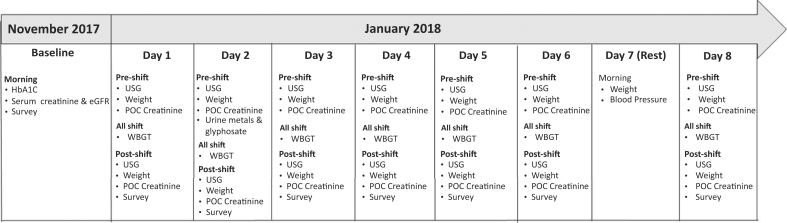
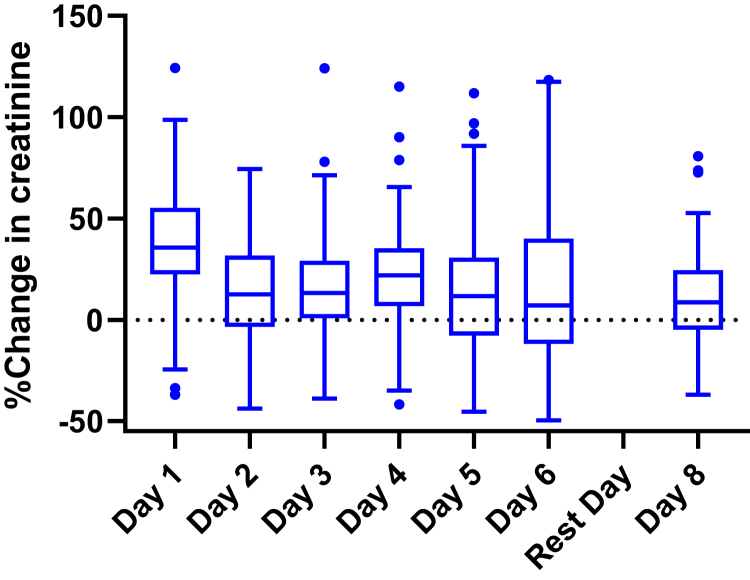
We collected data from 107 sugarcane workers across 7 consecutive work shifts. Data included information on daily occupational, meteorological, environmental, and lifestyle factors. We used multivariable linear mixed models to evaluate associations of these factors with percent change in creatinine.
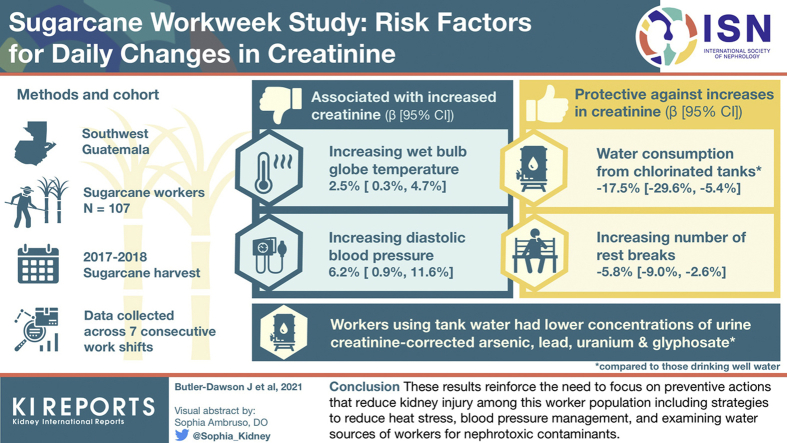
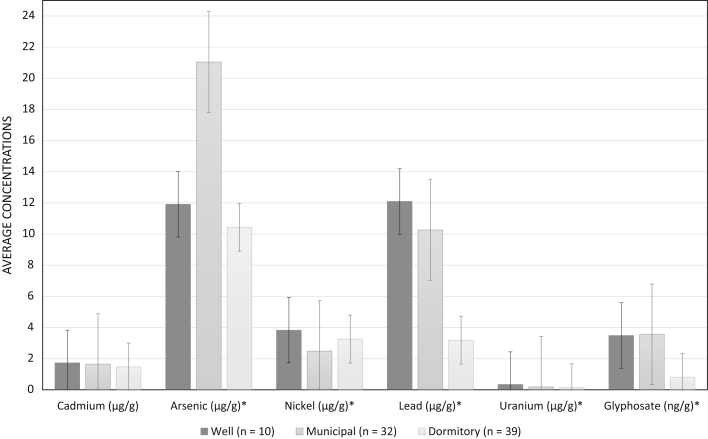
We observed that increasing wet bulb globe temperature (β = 2.5%, 95% confidence interval [CI] = 0.3%, 4.7%) and increasing diastolic blood pressure (β = 6.2%, 95% CI = 0.9%, 11.6%) were associated with increases in creatinine across the shift, whereas consumption of water from chlorinated dormitory tanks as compared to artesian well water (β = -17.5%, 95% CI = -29.6%, -5.4%) and increasing number of rest breaks (β = -5.8%, 95% CI = -9.0%, -2.6%) were found to be protective against increases in creatinine. Workers reporting drinking tank water had lower concentrations of urine creatinine-corrected arsenic, lead, uranium, and glyphosate compared to workers reporting the use of well water or municipal water.
These results reinforce the need to focus on preventive actions that reduce kidney injury among this worker population, including strategies to reduce heat stress, managing blood pressure, and examining water sources of workers for nephrotoxic contaminants.
在热应激环境中劳作的农业工人患肾损伤和不明原因慢性肾脏病(CKDu)的风险增加,其环境和职业暴露被认为是重要的风险因素。本研究考察了危地马拉工人在典型工作周内工作压力与其他因素同时作用下反复出现的肾脏应激的影响。
我们收集了107名甘蔗工人连续7个工作日班次的数据。数据包括每日职业、气象、环境和生活方式因素的信息。我们使用多变量线性混合模型来评估这些因素与肌酐变化百分比之间的关联。
我们观察到,湿球黑球温度升高(β = 2.5%,95%置信区间[CI] = 0.3%,4.7%)和舒张压升高(β = 6.2%,95% CI = 0.9%,11.6%)与整个班次肌酐升高有关,而与自流井水相比,饮用氯化宿舍水箱水(β = -17.5%,95% CI = -29.6%,-5.4%)以及休息次数增加(β = -5.8%,95% CI = -9.0%,-2.6%)被发现可预防肌酐升高。报告饮用水箱水的工人与报告使用井水或市政供水的工人相比,尿肌酐校正后的砷、铅、铀和草甘膦浓度较低。
这些结果强化了需要关注采取预防措施以减少该工人群体肾损伤的必要性,包括降低热应激的策略、控制血压以及检查工人水源中的肾毒性污染物。