Bradley P, Wilson J, Taylor R, Nixon J, Redfern J, Whittemore P, Gaddah M, Kavuri K, Haley A, Denny P, Withers C, Robey R C, Logue C, Dahanayake N, Min D Siaw Hui, Coles J, Deshmukh M S, Ritchie S, Malik M, Abdelaal H, Sivabalah K, Hartshorne M D, Gopikrishna D, Ashish A, Nuttall E, Bentley A, Bongers T, Gatheral T, Felton T W, Chaudhuri N, Pearmain L
North West Lung Centre, Wythenshawe Hospital, Manchester University NHS Foundation Trust, Manchester, UK.
Respiratory department, Blackpool Teaching Hospitals NHS Foundation Trust, Blackpool, UK.
EClinicalMedicine. 2021 Oct;40:101122. doi: 10.1016/j.eclinm.2021.101122. Epub 2021 Sep 8.
Continuous positive airway pressure (CPAP) therapy is commonly used for respiratory failure due to severe COVID-19 pneumonitis, including in patients deemed not likely to benefit from invasive mechanical ventilation (nIMV). Little evidence exists demonstrating superiority over conventional oxygen therapy, whilst ward-level delivery of CPAP presents practical challenges. We sought to compare clinical outcomes of oxygen therapy versus CPAP therapy in patients with COVID-19 who were nIMV.
This retrospective multi-centre cohort evaluation included patients diagnosed with COVID-19 who were nIMV, had a treatment escalation plan of ward-level care and clinical frailty scale ≤ 6. Recruitment occurred during the first two waves of the UK COVID-19 pandemic in 2020; from 1 March to May 31, and from 1 September to 31 December. Patients given CPAP were compared to patients receiving oxygen therapy that required FiO ≥04 for more than 12 hours at hospitals not providing ward-level CPAP. Logistic regression modelling was performed to compare 30-day mortality between treatment groups, accounting for important confounders and within-hospital clustering.
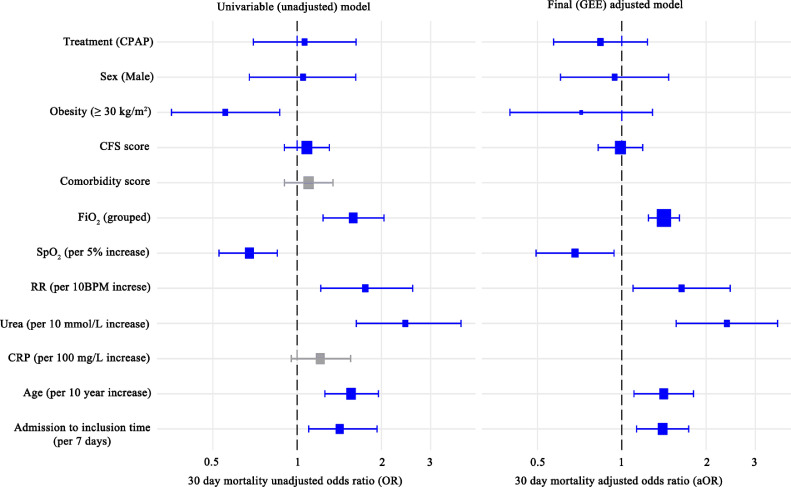
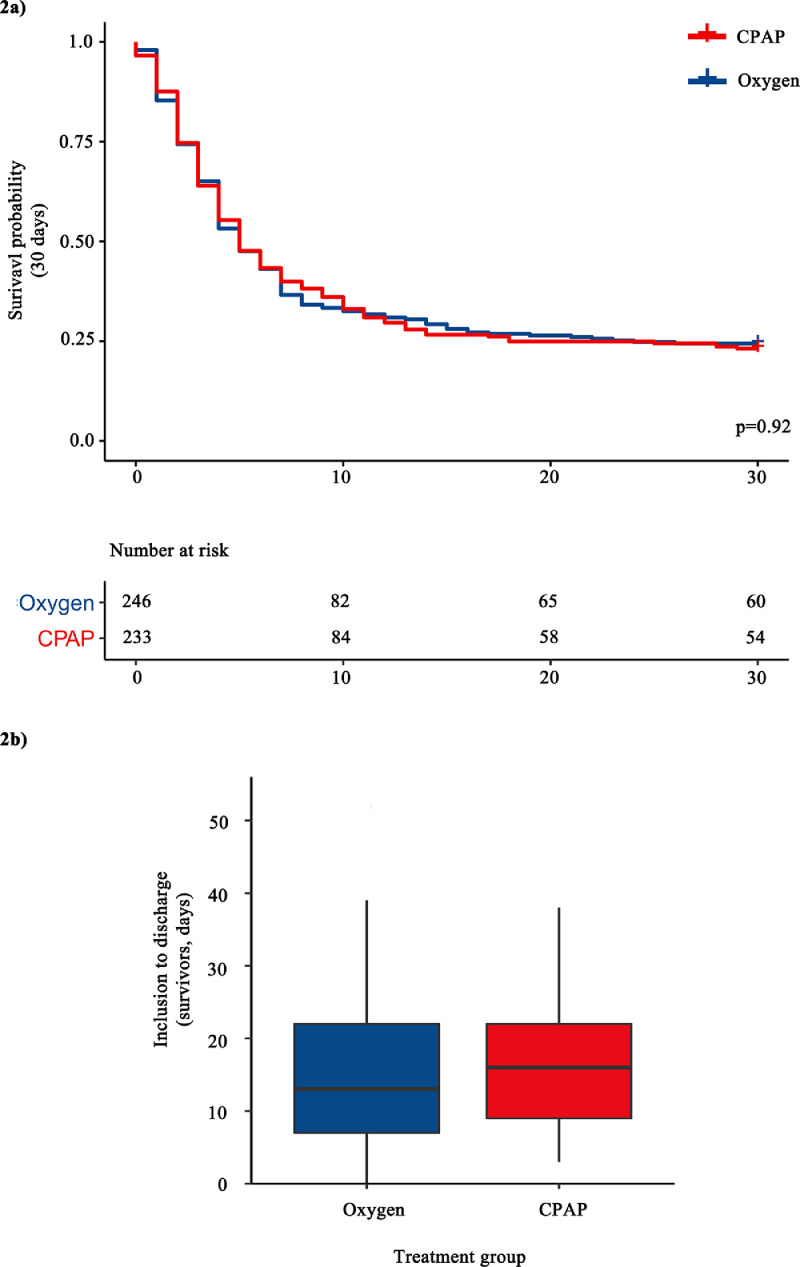
Seven hospitals provided data for 479 patients during the UK COVID-19 pandemic in 2020. Overall 30-day mortality was 75.6% in the oxygen group (186/246 patients) and 77.7% in the CPAP group (181/233 patients). A lack of evidence for a treatment effect persisted in the adjusted model (adjusted odds ratio 0.84 95% CI 0.57-1.23, p=0.37). 49.8% of patients receiving CPAP-therapy (118/237) chose to discontinue it.
No survival difference was found between using oxygen alone or CPAP to treat patients with severe COVID-19 who were nIMV. A high patient-initiated discontinuation rate for CPAP suggests a significant treatment burden. Further reflection is warranted on the current treatment guidance and widespread application of CPAP in this setting.
L Pearmain is supported by the MRC (MR/R00191X/1). TW Felton is supported by the NIHR Manchester Biomedical Research Centre.
持续气道正压通气(CPAP)疗法常用于治疗因重症新型冠状病毒肺炎导致的呼吸衰竭,包括那些被认为不太可能从有创机械通气(nIMV)中获益的患者。几乎没有证据表明其优于传统氧疗,而在病房层面实施CPAP存在实际挑战。我们试图比较nIMV的新型冠状病毒肺炎患者接受氧疗与CPAP治疗的临床结局。
这项回顾性多中心队列评估纳入了被诊断为新型冠状病毒肺炎且为nIMV、有病房级护理治疗升级计划且临床衰弱量表评分≤6的患者。招募工作于2020年英国新型冠状病毒肺炎疫情的前两波期间进行,即3月1日至5月31日以及9月1日至12月31日。将接受CPAP治疗的患者与在未提供病房级CPAP的医院中接受需要FiO₂≥0.4超过12小时的氧疗的患者进行比较。进行逻辑回归建模以比较治疗组之间的30天死亡率,同时考虑重要的混杂因素和医院内聚类情况。
在2020年英国新型冠状病毒肺炎疫情期间,7家医院提供了479例患者的数据。总体而言,氧疗组的30天死亡率为75.6%(246例患者中的186例),CPAP组为77.7%(233例患者中的181例)。在调整后的模型中仍缺乏治疗效果的证据(调整后的优势比为0.84,95%置信区间为0.57 - 1.23,p = 0.37)。接受CPAP治疗的患者中有49.8%(118/237)选择停止治疗。
对于nIMV的重症新型冠状病毒肺炎患者,单独使用氧疗或CPAP治疗在生存率上没有差异。CPAP较高的患者主动停用率表明治疗负担较重。有必要对当前的治疗指南以及CPAP在这种情况下的广泛应用进行进一步反思。
L·皮尔梅因得到医学研究委员会(MR/R00191X/1)的支持。TW·费尔顿得到英国国家卫生研究院曼彻斯特生物医学研究中心的支持。