Department of Neurology, Mayo Clinic, Rochester, Minnesota, USA.
International Clinical Research Center, St. Anne's University Hospital, Brno, Czechia.
Cerebrovasc Dis. 2022;51(1):52-59. doi: 10.1159/000517968. Epub 2021 Aug 11.
During the COVID-19 pandemic, studies reported less number of hospitalizations for acute stroke and reduction in the use of recanalization treatments. This study analyzes nationwide data on stroke admissions and management in the Czech Republic during the first wave of the COVID-19 pandemic.
We compared the early COVID-19 pandemic (March-May 2020) with the pre-pandemic period (January-February 2020 and March-May 2019): (a) the National Register of Reimbursed Health Services provided volume of all admissions for subarachnoid hemorrhage (SAH), intracerebral hemorrhage (ICH), and ischemic stroke (IS), and volume of recanalization treatments (intravenous thrombolysis [IVT] and mechanical thrombectomy [MT]); (b) Registry of Stroke Care Quality provided door-to-needle time (DNT), onset-to-door time (ODT), and stroke severity at admission (National Institutes of Health Stroke Scale, NIHSS) for IS.
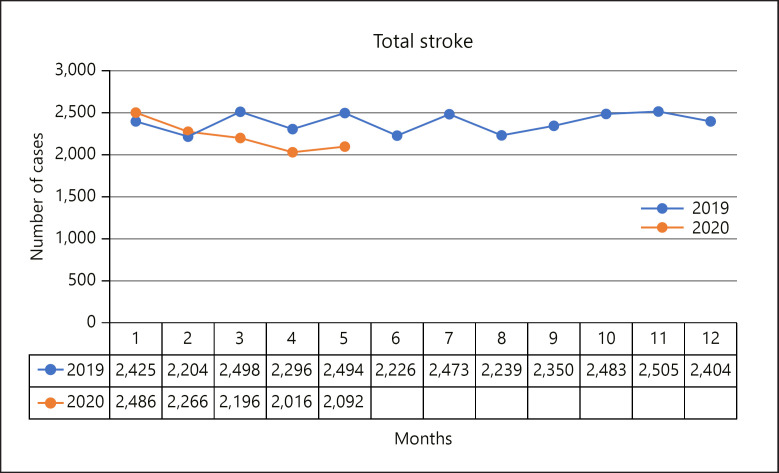
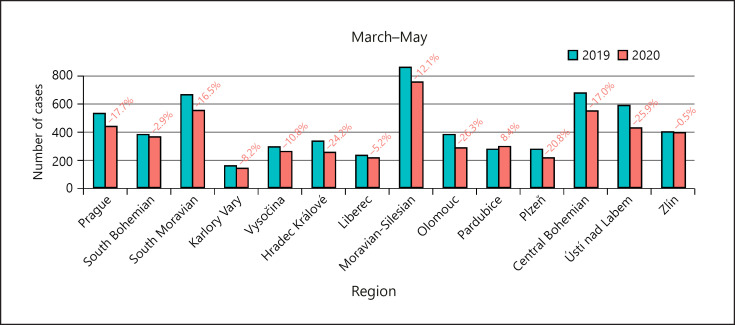
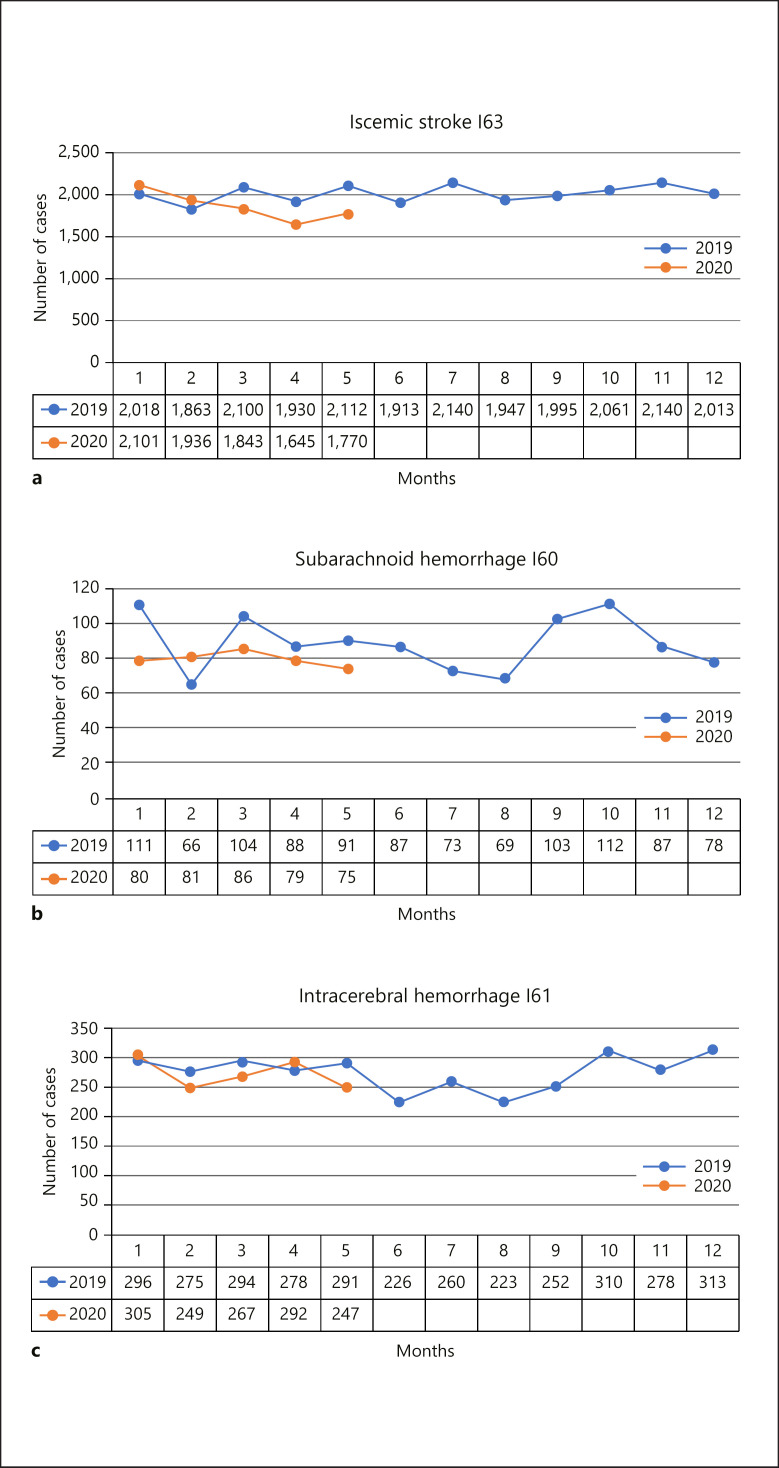
During the pandemic (March-May 2020), the peak number of COVID-19 patients treated in Czech hospitals was 39 per million. In March-May 2020 versus March-May 2019, hospital admissions decreased as follows: stroke overall by 14% (p < 0.001), IS by 14% (p < 0.001), SAH by 15% (p = 0.07), and ICH by 7% (p = 0.17). The mean age was 74 years versus 74 years (p = 0.33), and 52% versus 51% were men (p = 0.34). The volumes of IVT and MT decreased by 14% (p = 0.001) and 19% (p = 0.01), respectively. The proportions of all IS patients receiving IVT or MT remained unchanged, with, respectively, 17% versus 17% receiving IVT (p = 0.86) and 5% versus 5% receiving MT (p = 0.48). DNT and ODT were 24 versus 25 min (p = 0.58) and 168 versus 156 min (p = 0.23), respectively. NIHSS at admission did not differ (6 vs. 6; p = 0.54).
Even with a low burden of COVID-19 during the first wave and no change in organization and logistics of stroke services, stroke admissions and volume of recanalization treatments decreased. Public health communication campaigns should encourage people to seek emergency medical care for stroke symptoms during the COVID-19 pandemic.
在 COVID-19 大流行期间,有研究报告称急性中风住院人数减少,并且再通治疗的使用减少。本研究分析了 COVID-19 大流行第一波期间捷克共和国全国范围内的中风入院和管理数据。
我们将 COVID-19 大流行早期(2020 年 3 月至 5 月)与大流行前时期(2020 年 1 月至 2 月和 2019 年 3 月至 5 月)进行比较:(a)国家报销健康服务登记册提供蛛网膜下腔出血(SAH)、脑出血(ICH)和缺血性中风(IS)的所有入院量,以及再通治疗(静脉内溶栓[IVT]和机械血栓切除术[MT])的量;(b)中风护理质量登记册提供 IS 的门到针时间(DNT)、发病到门时间(ODT)和入院时的中风严重程度(国立卫生研究院中风量表,NIHSS)。
在大流行期间(2020 年 3 月至 5 月),捷克医院收治的 COVID-19 患者峰值为每百万人 39 人。与 2019 年 3 月至 5 月相比,2020 年 3 月至 5 月期间的住院人数如下减少:中风整体减少 14%(p<0.001),IS 减少 14%(p<0.001),SAH 减少 15%(p=0.07),ICH 减少 7%(p=0.17)。平均年龄为 74 岁,与 74 岁(p=0.33),52%为男性,与 51%(p=0.34)。IVT 和 MT 的量分别减少了 14%(p=0.001)和 19%(p=0.01)。所有 IS 患者接受 IVT 或 MT 的比例保持不变,分别为 17%接受 IVT(p=0.86)和 5%接受 MT(p=0.48)。DNT 和 ODT 分别为 24 分钟和 25 分钟(p=0.58)和 168 分钟和 156 分钟(p=0.23)。入院时 NIHSS 无差异(6 分 vs. 6 分;p=0.54)。
即使在第一波 COVID-19 期间负担较低,且中风服务的组织和物流没有变化,中风入院人数和再通治疗量仍有所减少。公共卫生宣传活动应鼓励人们在 COVID-19 大流行期间因中风症状寻求紧急医疗护理。