Sacco Simona, Ricci Stefano, Ornello Raffaele, Eusebi Paolo, Petraglia Luca, Toni Danilo
Neuroscience Section, Department of Applied Clinical Sciences and Biotechnology, University of L'Aquila, Italy (S.S., R.O.).
Department of Neurology and Stroke Unit, USL Umbria 1, Gubbio and Città di Castello Hospital, Perugia, Italy (S.R.).
Stroke. 2020 Dec;51(12):3746-3750. doi: 10.1161/STROKEAHA.120.031293. Epub 2020 Oct 16.
We aimed to investigate the rate of hospital admissions for cerebrovascular events and of revascularization treatments for acute ischemic stroke in Italy during the coronavirus disease 2019 (COVID-19) outbreak.
The Italian Stroke Organization performed a multicenter study involving 93 Italian Stroke Units. We collected information on hospital admissions for cerebrovascular events from March 1 to March 31, 2020 (study period), and from March 1 to March 31, 2019 (control period).
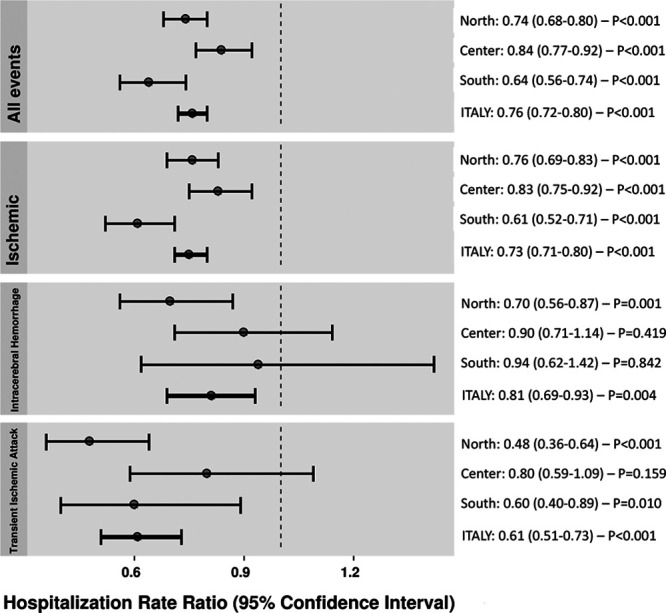
Ischemic strokes decreased from 2399 in 2019 to 1810 in 2020, with a corresponding hospitalization rate ratio (RR) of 0.75 ([95% CI, 0.71-0.80] <0.001); intracerebral hemorrhages decreased from 400 to 322 (hospitalization RR, 0.81 [95% CI, 0.69-0.93]; =0.004), and transient ischemic attacks decreased from 322 to 196 (hospitalization RR, 0.61 [95% CI, 0.51-0.73]; <0.001). Hospitalizations decreased in Northern, Central, and Southern Italy. Intravenous thrombolyses decreased from 531 (22.1%) in 2019 to 345 in 2020 (19.1%; RR, 0.86 [95% CI, 0.75-0.99]; =0.032), while primary endovascular procedures increased in Northern Italy (RR, 1.61 [95% CI, 1.13-2.32]; =0.008). We found no correlation (=0.517) between the hospitalization RRs for all strokes or transient ischemic attack and COVID-19 incidence in the different areas.
Hospitalizations for stroke or transient ischemic attacks across Italy were reduced during the worst period of the COVID-19 outbreak. Intravenous thrombolytic treatments also decreased, while endovascular treatments remained unchanged and even increased in the area of maximum expression of the outbreak. Limited hospitalization of the less severe patients and delays in hospital admission, due to overcharge of the emergency system by COVID-19 patients, may explain these data.
我们旨在调查2019年冠状病毒病(COVID-19)疫情期间意大利脑血管事件的住院率以及急性缺血性卒中的血管再通治疗率。
意大利卒中组织开展了一项多中心研究,涉及93个意大利卒中单元。我们收集了2020年3月1日至3月31日(研究期)以及2019年3月1日至3月31日(对照期)脑血管事件的住院信息。
缺血性卒中从2019年的2399例降至2020年的1810例,相应的住院率比(RR)为0.75([95%置信区间,0.71 - 0.80] <0.001);脑出血从400例降至322例(住院RR,0.81 [95%置信区间,0.69 - 0.93];P = 0.004),短暂性脑缺血发作从322例降至196例(住院RR,0.61 [95%置信区间,0.51 - 0.73];<0.001)。意大利北部、中部和南部的住院人数均有所下降。静脉溶栓治疗从2019年的531例(22.1%)降至2020年的345例(19.1%;RR,0.86 [95%置信区间,0.75 - 0.99];P = 0.032),而意大利北部的主要血管内治疗有所增加(RR,1.61 [95%置信区间,1.13 - 2.32];P = 0.008)。我们发现不同地区所有卒中或短暂性脑缺血发作的住院RR与COVID-19发病率之间无相关性(P = 0.517)。
在COVID-19疫情最严重时期,意大利全国范围内卒中或短暂性脑缺血发作的住院人数减少。静脉溶栓治疗也有所减少,而在疫情最严重地区血管内治疗保持不变甚至有所增加。病情较轻患者住院受限以及COVID-19患者使急诊系统负担过重导致住院延迟,可能解释了这些数据。